CD: Mitch Webb & The Swindles, "The Lonely Kind"

When I first saw Mitchell Justice Webb, he was eating fat flour tortillas smeared with beans and cheese at the Taco Cabana near Brackenridge Park, probably on break from managing the CD Exchange. He was about as unassuming as anyone else sucking down Dr. Pepper and brown salsa in quantity on a hot-ass SanAnto afternoon.
A few years later, and I’d scrape up just enough couch change for a Lone Star Tall Boy to suck on and collapse under tough-love tree-shade in 112-degree heat, crumpled like an empty 12-pack carton thrown out a truck window on Broadway. In other words, my life had started to resemble a dog-eared yarn from a Mitch Webb song.
Even now, when I think of those days, Mitch and his band the Swindles provide the soundtrack for heat-stroked visions of dusty porches and yellowed lawns, cantineras with distinctive skin like wrinkled paper bags calling me “mi’jo” and setting up a Shiner neatly wrapped in napkin sweating like my forehead. Thoughts of old friends who dream of owning their own piece of Texas big enough to shoot a gun and have the bullet drop on their own land, their own proper place.
And oddly enough that makes me miss my home state and ache inside like an empty-stomach buzz at sundown.
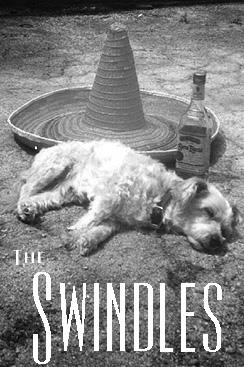
Mitch Webb and the Swindles describe themselves on MySpace as “kind of a country garage rock band,” a description about as unassuming and down-home as Webb’s personal presence, and they list commonplace influences that honky-tonk through my head like viejitos doing the tacuache at Lerma’s: “Frito Pie, Doug Sahm, watermelon, Freddy Fender, enchiladas, 13th Floor Elevators, popsicles.” And don’t forget Los #3 Dinners!
Their recent and fourth release, “The Lonely Kind,” bears the imprint of Supreme Music Co., but dial their listed number and Mitch will probably pick up with a big “Howdy!” Following their tribute DVD/CD to the passing of famed rock-spot Taco Land and beloved wild-man owner Ram Ayala, this latest recording contrasts homespun humor on a range of roots covers with more deep country-ballad meditations from Webb’s store of personal history.
I’ve had the chance to write a few reviews over the years that touch on what the Swindles evoke as a Texas band with big chops minus big ego, like when they opened for Doug Sahm on a Quintet reunion some months before he passed: “...the Sir Douglas Quintet represents San Antonio's greatest pop hope of yesteryear, while any number of Swindles tunes could make this band known countrywide.” Closer to home, I tried to describe what the Swindles meant for my own experience of Texas: “Mitch Webb's Tex-Mex balladeering and Spanglish twanging brings to mind being stuck driving through King Ranch on a Sunday afternoon in a pickup truck without A/C, the windows wide-open and radio cranking for a sing-a-long to pass the time.”
More plainly, I described their late-’90s release “Drunk for Your Amusement” as “simply great hip-shaking, beer-drinking rock 'n' roll.” Grammy Winner Joe Reyes rocked the shit on tunes like “H.E.B.” and “Round Rock,” and he returns on “Lonely” with distinctive journeyman fretwork to lay down solid musicianship behind Webb’s drawling vocals and heart-heavy lyrics.
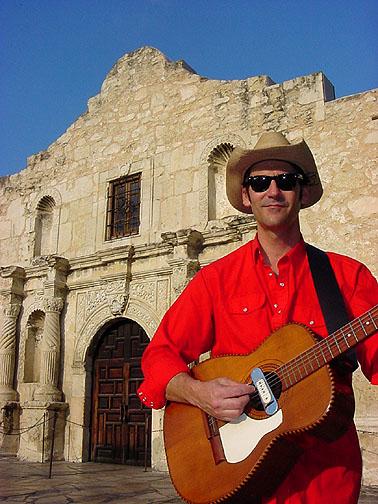
But for the various covers, this release is pretty somber and true to its title. It kicks off with “A Man Can Cry,” a Freddy Fender doo-wop that opens the door for “The Pig Song,” a trad-ditty about hitting rock bottom and literally piggybacking with the only friend who will take you to the nearest liquor store. Though this is pretty playful stuff, Webb’s recently passed-away sister, Dallas Louise Webb Wickham Grodman, contributed vocals on this track that becomes a sort of elegy to how much Webb’s family has informed his musical and cultural background.
Not till the third song do we hear an original Webb composition, and it follows with Sergio Lara adding twinkling texture on mandolin in a flamenco-folk nexus. On this track, drunkenness and love vie for a man’s heart even while both derange his senses beyond clarity. It’s an odd leap next to “10,000 Years Ago (AKA The Bragging Song),” a sort of country one-liner a la Kinky Friedman: “I saw Peter, Paul and Moses playing ring around the roses/ And I’ll lick the guy that says it isn’t so.”
It’s an interesting back-and-forth that seems to find the archetypal Texas troubador caught between sardonic, shit-kickin' wit and searing, whiskey-chasing woe. For good measure, Webb throws in “Blubberball” by Claude Morgan and “Dance a Cachuca” by Sir Arthur Sullivan (of Gilbert and Sullivan fame).
It’s the grit of sorrow and humor caught at the same moment that makes this release a Swindles gem, like the title track that sums up both the despair and hope I sometimes felt in my most solitary moments down South.
Like Mitch says on “Cactus Blooms,” “Every man has his reasons for leaving.” But Texas looms ever-present in my mind as a place I can always come home to with a hunger for a country-kind of happy ending: “Gonna find me a sweet señorita/ Gonna buy me a parcel of land.”
R.I.P. Fliegelman
Jay Fliegelman, Coe Professor in American Literature at Stanford University, was my teacher once during my brief career as a PhD student in English. His seminar, “History as Literary Art,” was my favorite class, though I took my master’s degree and fled the Farm after two very difficult years.
I was sad to see his obituary in an alum newsletter reporting that he passed in Menlo Park on August 14, at 58 years old.
When I first visited Stanford in 1992, on a whirlwind tour also of Berkeley, he picked me up and showed me around campus, giving me a thumbnail history of the school with one of his signature “readings” of architecture in the main quad. “The Spanish-colonial style speaks to a sense of enclosure and the need for geometrical security,” he might have said.
This was his kind of approach to artifacts in the American grain. Once, he brought a serving bowl from 17th century Massachusetts to class and “read” the dish, its weaving patterns and concavity and ornate lip signifying the entire history of colonial America in one fell swoop. And then he showed us a schedule book that, so the story goes, Nathaniel Hawthorne kept in his breast pocket. Thumbing through dates and scribblings, Fliegelman connected major events in American history with the life of one author and his writing, his notes, his daily experiences.
This class was nothing short of intriguing, the text list seminal, the lectures amazing. Without knowing it, I absorbed a deeper appreciation of American history and narrative from Fliegelman. Reading William Carlos Williams and Norman Mailer for his class would start me on a path that led to Wolfe and the New Journalism, later still, to writing journalism myself.
Though I didn’t go on to work with him or pursue that postponed PhD, I’m thankful to have taken one of his seminars and to have worked briefly with a premier Americanist who was also kind and generous to me, his student.
Hard-Boiled Hot Fuzz
HONG KONG RISING
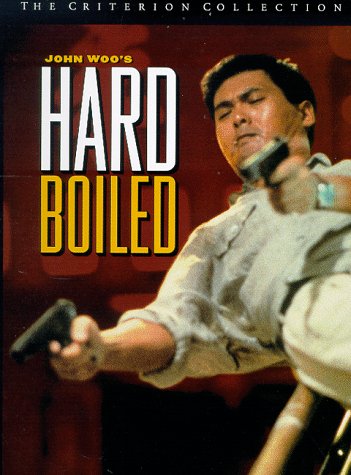
John Woo’s 1992 Hard Boiled opens with a determined fist brutally slamming a drink-tumbler onto dark table-top and thus mixing a carbonated sluice of hard liquor, foisted by famed Hong Kong star Chow Yun-Fat and then thrown back furiously with a gutsy grimace before he exhales cigarette smoke and starts in on the clarinet -- with some lite tune like “A Few of My Favorite Things” -- at a smoky jazz-bar spot.
The image of delicate, melodic chops lapped up with high-proof alcohol and blown out in eighth notes and second-hand smoke nicely sets up John Woo’s morality tale of good-guy/bad-guy indistinction, like so many fast-cutting shots in his movies of birds launched into flight with bullets exploding in every feather-dusted fire-grazed direction.
Later, at an all-nite neon-cloaked dim-sum joint, Tequila (Yun-Fat) and his partner chat over pot-stickers in the wee hours about how great the food in Hong Kong is, like you can’t get it anywhere else in the world. (The shadow of Hong Kong handed back to China is the subtext for this conversation, suggesting that these characters must soon decide to stay under China or break west.)
But the calming dim sum is just a front: Tequila eyeballs the action lining up at tea tables in the periphery, as patrons bring pet birds in cages and chat over food while handing each other tawdry manila envelopes bulging with paper.
Then, suddenly, the pot-stickers fly with caroming tea-kettles, and birds broken out of cages flap a hundred pairs of wings with ripped feathers and blasted cooking flour launched into a maelstrom of gunplay. The whole joint is crawling with undercover narcs and heavily armed bad guys. Super-stylized hell-on-earth rips open, with random homicide recouped for aesthetic brilliance like a ballistics waterfall, and bullet-holes rip the room in a cascade of bodies in explosively balletic melee. Tequila’s guns -- discharged sideways, crossways, and from every other cool angle -- never seem to empty, even when he hurdles booths and navigates stairwells like a Cirque de Soleil acrobat, sliding into impossible crossfire to rain down death and dismay on the enemy.
And, it turns out, the enemy was just another undercover, whom Tequila dispatches with a spat-out toothpick and bloody backblast into his ghostly, flour-caked face. How he keeps the toothpick in his mouth through the entire fight, who can tell? But the police action has been in vain, as Tequila loses good cops and good friends only to take out one of their own posing as a bad guy.
“Tequila” is a stand-in for “Tango” or “Cash,” for IceMan, McBain, and Callahan, all the hyper-cool, super-tough action stars of exploitative American cinema. But Hard Boiled ends up a subtle critique of the American action movie, even as a tsunami of explosions and gun blasts blow the viewer’s eyes wide open in rhythmic regularity. This is the sheer genius of John Woo, to make a movie originally titled “Hot-Handed God of Cops,” with a body count of 307 (according to Wikipedia), and turn his bad-ass action-movie sources inside-out, to do American action one better while commenting on how futile and silly the scenarios can be.
From this, moments of transcendent madness way beyond Woo’s American production Face/Off (1997), where a kid listens to “Over the Rainbow” on earphones while mommy and daddy blow away feds with shotties and grenade launchers.
Truly, when I saw Hard Boiled years ago at the Film Center Hong Kong Festival and then at a midnight Village showing, it blew my mind with the possibilities, with the kind of bad action crap I grew up watching but now re-mixed through a suave Asian playboy sensibility replete with jazz, hard drinking, and fashion anachronisms a’plenty.
Oh, and of course, a great knack for the comic homicidal one-liner, the spasmodic death throes, the last-stand speeches, the stray “COVER ME” that bespeaks homo-filial violence. And such a comfort to know that, while I wasted my time with video games and bad movies at the mall as a teenager, someone across the globe was watching too, and taking notes to turn the action movie right on its head while multiplying “bad-ass” by a factor of 100.
And, later still, others watched Woo to re-make and re-mix, to feed Hong Kong action back to America as our latest pulp fiction, lifted from others who lifted from us.
ET TU, BRITAIN?
The recent release of Dragon Dynasty’s two-disc “ultimate” Hard Boiled had me hit the Uptown Border’s bookstore for that, plus the DVD premiere of England’s Hot Fuzz (2007). A reminder in Austria some weeks ago, the bar postcard emblazoned in German:
“Zwei Bad Boys räumen auf!” (My trans. -- “Two Bad Boys go-off/throw-down!”)
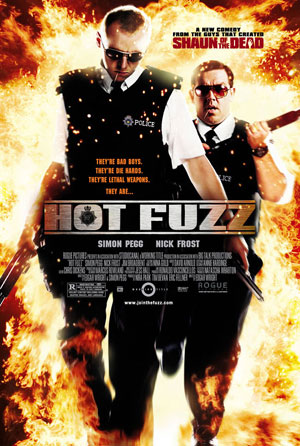
And the poster-image has stars Simon Pegg and Nick Frost flying into nowhere from out of nowhere, sui generis, in a fiery haze, complete with mirror-plated shades and unbreakable toothpicks jutting from the maw.
Of course, the reference here is to the Bad Boys franchise (1995/2003), with Will Smith and Martin Lawrence. But the United Kingdom re-casts an American action “classic” with all bobbies blasting, as the impeccably mannered British get in on the typically American dirty-work of good-old-fashioned ass-kicking.
The scenario is standard: Fish Out of Water, a staple of comedy. Here, a good, smart London cop gets re-assigned because he’s simply too good, ending up in a country village that prides itself on winning prizes for being such a gem of pastoral Britain seemingly frozen in time.
Once Nicholas Angel (Pegg) arrives in the idyllic township of Sandford, Gloucestershire, the movie plays out a bit like The Odd Couple. Officer Angel is a by-the-books super-pro (both at the gritty stuff and the paper work incurred by field action), trained in urban pacification and riot control. He finds himself paired up with one of various village drunks, an oafish-lout wannabe whom he busts on his first night in town for public inebriation.
But partner Danny Butterman (Frost) is the police chief’s son, and his co-workers are an odd, sleepy, lackadaisical, slack-jawed lot who break at 11 a.m. for pints at the pub, all to Angel’s chagrin.
Even so, Angel goes about his job with a stiff upper lip. And when dead bodies start piling up in innocent little Sandford, he uncovers the dark secret behind the town’s paradisical cover-story.
Which of course all leads to an apocalyptic gun-battle finale, and a DAMN GOOD one like out of Sam Peckinpah, in which Angel and Butterman strap on an arsenal and unload crates of buckshot in the town plaza. And never-ending gunfights of course lead to even longer end-game fist-fights when the ammo runs out, so Angel wrestles his nemesis in a miniature outdoor model of Sandford, visually tearing apart the fantasy of small-town England as un-touched Eden.
At one point in the film, Angel and Butterman stop at a smallish grocery store, and Danny amuses himself by reading off the videos for sale, vintage American and Hong Kong action flicks. Later, he asks Angel many juvenile, show-and-tell questions about being a cop, like “You ever fired two guns whilst flying through the air? … Is it true that there is a place in a man’s head, that if you shoot it, it will blow up?” He can’t believe it when Angel admits to never having seen Bad Boys II or Point Break. But eventually, Butterman and Angel fulfill the phallic, homo-erotic goal of the action/buddy flick: "Aufräumen," as the German-language ads put it. To get off by going off.
And Edenic England -- like the hinterlands of Illinois or China -- surely has been touched by globalization, by the preponderance of American action movies and real-life weaponry circulating the Earth. In fact, with Hot Fuzz, they’ve even re-mixed triumphal American visual narratives of violence and gunplay, like a full-bodied ale that sends you under the pub counter as a delicious one-too-many shot.
Satchmo Meets Amadeus
"The classical music of globalization"

(StudienVerlag 2006)
Impressionistic musings on Satchmo Meets Amadeus
Sometime around Y2K, I found a tasty piece of vinyl at a San Antonio thrift-store for a quarter: The dissection and reconstruction of music from the past as performed by the inmates of Lalo Schifrin’s demented ensemble as a tribute to the memory of the Marquis de Sade (Verve 1966).
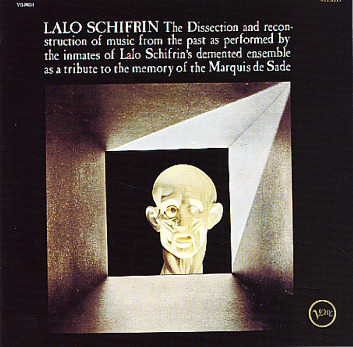
For short: Schifrin/Sade. I found it stuck under my rickety shopping-cart wheel, making the metal hinges swing the rolling basket in circles. This is sort of what the music did to my mind.
When I played this piece at parties, almost no one had a frame of reference for a rollicking mesh of blues, Bach, bebop, and “Bossa Antique” -- harpsichord scatting and chamber improv on cello and viola just didn’t seem to catch on.
But to me, it was perfect: An Argentine pianist/bandleader -- the guy who penned “Mission Impossible” and dozens more themes -- dredging classical baroque notions into a bluesy jazz idiom for a kind of soundtrack for my strolls, years later, into the hills of Salzburg.
Mozart would have sat in on that jam session.
You see, across nation and time and cultural context, jazz persists and continues to inform such experiences of world waltzing. As Salzburg historian Reinhold Wagnleitner puts it in his excellent collection Satchmo Meets Amadeus, jazz is “the classical music of globalization.”
I had the pleasure of meeting Reinhold at a recent Salzburg Global Seminar, and I wanted to share with him my stories of musical admixture, my own head medley produced by Bootsy and amplified by Wagner (maybe with a few beats by DJ Qbert).
The essence of his anthology, based in cross-disciplinary symposia from New Orleans to Salzburg: That Satchmo meets Amadeus every time we recognize the glorious, global connections between classical, pop, and our current mass culture. From the uneasy navigation of their hometown limitations, to the enshrining of each with an invisible TRADEMARK insignia, Pops and Moze created music that really moved, from Salzburg to Vienna, from New Orleans to Chicago to New York, and their tunes (properly received) turned the idea of classical versus pop, of high versus low culture, right on its powdered-wig head.
But more than that, Satchmo Meets Amadeus explodes the dichotomy between controlled, complex, classical execution versus naïve, “native” jazz genius. (In the shadows, observe the tired, hung-out-to-dry notion that jazz was purely African in provenance, later stolen by white people for someone else’s profit.)
Consider the Jews expelled from Europe, Austria included, who spread the tidings of classical music and helped build an industry of American production and distribution, recognizing genius where others saw only “race records.” Consider the Sicilians in New Orleans who taught voice, instrumentation, and arrangement to black people. Consider New Orleans as the biggest opera city in 19th century USA, mounting Mozart for Sidney Bechet, Buddy Bolden, and of course Satchel Mouth, among others.
Contrasting the catch-all put-down of “world music” as currently conceived, Satchmo Meets Amadeus gives true meaning to jazz as the first authentic world music, a sound forged in the uniquely spiced pot of New Orleans gumbo that included Creoles, Euros, Indios, and Africans of every diasporic shade and savor. From these origins, jazz went up the Mississippi to the Northern industrial corridor, on to New York, and out to the rest of the world, recognized finally and especially through the traumas of World War as the true sound of liberation.
The operative metaphor, here, is apt and American: The shot-gun wedding. Satchmo Meets Amadeus is a sort of nuptial presided over with a rifle. Like the deep Southern, Scots-Irish/Appalachian blood-feud brought to a boil by a bastard child and a marriage pressed at the end of a gun barrel, this book brings together global players divided only by historical amnesia but now thrown into conversation by the cataclysms of the 20th century, immanently unpacked in the idiom of globalization.
Highlights include Penny von Eschen’s re-hash of Satchmo Blows up the World (Harvard UP 2004), here sliced down to a meditation on “The Real Ambassadors” during the Cold War, touching on Louis Armstrong’s partly-Pepsi-sponsored tour of Africa in 1960-61, capturing the glaring contradiction of Jim Crow America touting black musicians to fight Cold War race perceptions. This piece carries over into essays about both Nazi contradictions with respect to jazz and the contradictory uses of Satchmo/Amadeus in pop/tourism.
Deeper still, historic pieces dig into the related histories of the Habsburg Monarchy, Salzburg, and New Orleans, within the context of colonial bartering and power-positioning. While recognizing the place of jazz as “the American high modernist contribution to world culture,” other pieces -- such as “New Orleans: An American Pompeii?,” by Lawrence N. Powell -- struggle to place Satchmo/Amadeus at the center of our current concepts of globalization. Given the rate of global change, will New Orleans merely be the first of various cities leveled and lost to climate shifts? And what will we have learned, really, from Satchmo/Amadeus, beyond tourism soundtracks, if their global import becomes sunken lost treasure?
In addition to the big questions, I take away from Satchmo Meets Amadeus a personal connection with Reinhold Wagnleitner at the Salzburg Global Seminar this July 2007. I enjoyed his personal narratives of trying to open up the Salzburg scene, to get past classical stagnation with the energy of jazz. His stories about musicians, tunes, and concerts remind me of my own love for such cities as San Antonio, for its unique contributions to American and global cultures.
(See, also, period pictures of Reinhold in his ’70s jazz/rock combo Pentameter, for which he played bass and injected new music into the Salzburg youth scene, documented in Satchmo....)
Behind today's trademarks and copyrights, you can still find the spark of musical revolution and a true global avant-garde, now on MP3 blogs and electronic platforms of digital convergence. What’s the next variation, Mozart? What’s the time signature and key, Satch?
Perhaps a sequel? A reprise, titled FLACO MEETS FALCO, A "Texe-Mexe" Odyssey featuring Mozart-as-Mestizo on the Frontiers of New Sanzburgtonio? Or Wolfie's Beautiful Big Enchilada, maybe Sir Douglas Sahm as Hill-Country Jedermann, or From Yodel to Grito: Alps Meet Hicks in the Trans-Atlantic Tradition of Country Yelping...etc., etc., etc., usw, &c.
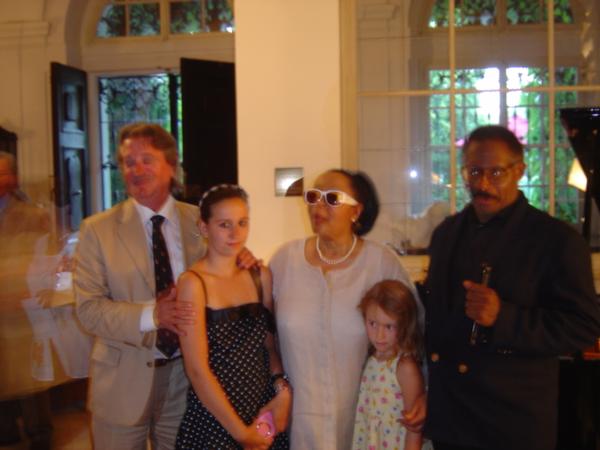
[Reinhold Wagnleitner, with musicians Valerie Capers and John Robinson, plus daughters Anna and Ella, after the Salzburg Seminar International Studies Program 20 Jazz Concert and Banquet...]
Salzburg Global Seminar / International Studies Program 20 (July 2007)
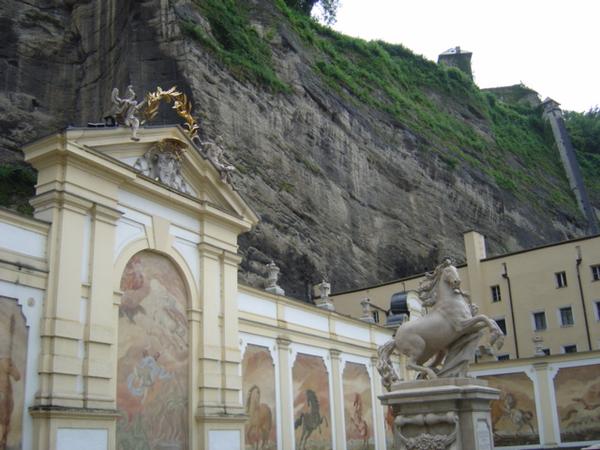
[Editorial Note: Any mistakes in German are of course all MEIN, but such is my attempt to infuse my writing with true code switching, to explode any sense of cultural purity or provincialism and to bring myself to a new place based in transformative lifelong learning, in this case hopefully to make German a new part of my outlook as a global citizen. Photos (minus one exception) and ALL glitches, likewise, are MEIN, for which I ask your kind patience, dear reader.]
FRESH OFF DAS BOOT
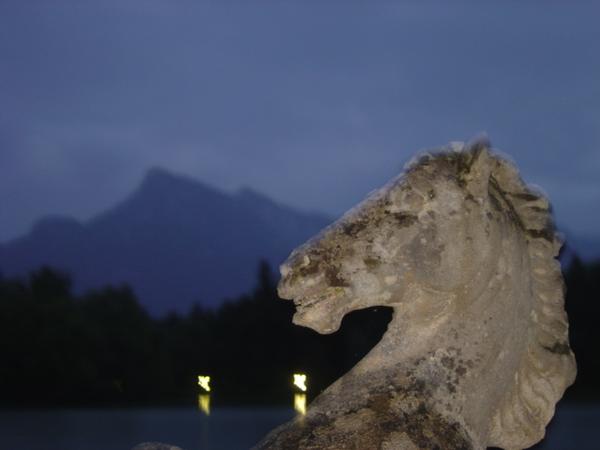
[PHOTO: Grounds of the Schloss Leopoldskron, upon my arrival.]
Little Robbin is nine years old and plays füssball (but not Amerikanische). He shows off Dinosaurien picture books and tries to play puzzles with me on a Lufthansa magic-pad. But I hardly understand what he's saying, as he rattles off like any kid anywhere and emotes with explosions and death-rattle sound effects.
Thankfully, he's a kid and doesn't care that I look at him blankly when he asks questions and I answer, "Augenblick, noch einmal? Was bedeutet das? Wie sagt man [BLANK] auf Deutsch? Wiederholen Sie bitte…"
As the plane from Frankfurt descends into Salzburg, Robbin points out the mountains of Österreich. He tells me that he too will be in Salzburg for eine Woche, and perhaps we'll see each other on the return plane.
And so went my first conversation in broken hoch Deutsch. (Aside from Frankfurt airport security, who kindly asked me to take off mein Gürtel, aber ist am besser mit Gürtel als ohne.)
What did everyone say? "It's so beautiful, you will love it!" Mountains, placid footpaths, medieval castles, dungeons, dudes in Lederhosen. Don't hate me because I yodel so wonderfully. All touristy stuff, to be sure.
But I have arrived at Schloss Leopoldskron, site of the Salzburg Global Seminar. I am here for City Colleges faculty development, to cull and bring home ideas for global initiatives. I truly have no idea how significant this piece of travel will end up being to me, how it will shatter old presumptions and bring me to the vertigo of new horizons, transcending what anyone might now tell me is “possible” and “impossible”.
FROM THE WC TO THE FERNSEHER
The toilets are labeled with a genteel "WC" -- where does this originate? "Water closet"? “Wo ist die WC?” Such a mannered mode of making one's way to the commode. But these are the best toilets I have ever seen in the world.
Yet I can't sleep, and so I flip on the Fernseher to some channel that looks like cable access bit-through with German enunciation. Kids with shorn, multi-colored mops speak in animated nic-fits through smoke and lip-piercings as they lounge in a communal flat, later camping out between the gutter and the metro entrance. Are they German? Austrian?
So CUTE: They remind of my college friends in their cheap second-hands and DIY do's.
I lie back and listen to their speech in cadences and clefts that spill out in randomly recognizable vocabulary. What are their lives like? What would they think of this Amerikaner? I must return to Europe with better German, to answer these questions.
For now, a stroll through the Schloss grounds, this manorial, palatial estate cloaked in marble and baroque flourishes. No one out, no one near, dim lights far off, and silence.
I AM NORTH AMERICAN SCUM
"You see, I love this place that I have grown to know,
Alright, North America.
And yeah, I know you wouldn't touch us with a ten-foot-pole
Cause we're North Americans.
We are North American scum.
We're North Americans.
We are North American scum.
We're North American."
--LCD SOUNDSYSTEM
The main lecture for tonight features Reinhold Wagnleitner -- a Salzburg native and New Orleans jazz aficionado -- speaking about perceptions of America outside of the U.S.
And the prognosis is not pretty -- we are dumb, fat, gullible, politically regressive ogres who don't even speak good English! "We are North American scum!" So goes an unscientific survey of various Salzburgians. The presentation ends with the LCD Soundsystem audio file, whose irony and caustic play seem lost on most of my colleagues.
I tell them that I am ready to wear the T-shirt in my travels to self-identify as such SCUM. Reinhold suggests this is NOT a good idea.
Somehow, this reminds of last night. While recovering from jet lag, I took a stroll by myself into the unlit post-Mitternacht darkness of Salzburg near my Schloss. Hearing the sounds of geese and insects and slathering brooks while gazing into the distant lights of the main Salzburg fortress eased my mind a bit, and then I saw a teenager, a "hoodie" all hip-hopped out, and I wanted to ask, when he walked by with a mumbled "wie geht's": YO MAN, where is it GOING DOWN tonight? Where's DAS SPOT?
On my way back, I see a placard advertising the "Mama Africa" fest: "EXOTISCH! EROTISCH! ANDERS! ('Something else!')." Tell me, mein little Freund, where to find the ANDERS...!
This stroll reminds me that, as much as I'd like to partake in a New Yorker or Chicagoan big-city SCUM identity, I am still a small-town boy who grew up in an isolated community of 3,000 souls. So my reactions, my credulity, my sentiments will ALWAYS be small-town.
And yet I try to mix into my speech the "ahs" und "ehs" und "na ja"s and "und so weiter"s ("etcetera"s) of a real German speaker. Why not? (I learn later that I could've asked the hoodie, "Wo hängst du ab?" WHERE YOU BE HANGIN'?)
Today, after a long morning and afternoon of lectures and situation in small action groups, I have a chance to waltz into the Zentrum of Salzburg, the downtown area carved out of mountains and scenic, small streets of quaint attraction. I stroll with J.L. from Harold Washington and Andy from Bronx College, and we stop for some Bier and have the most wonderful conversation about our homelands and peoples and passions.
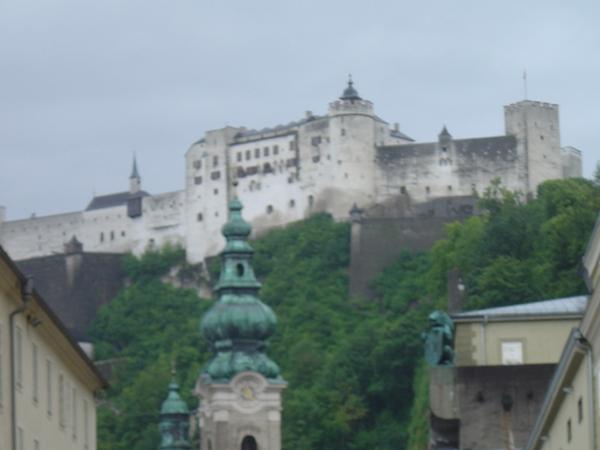
[PHOTO: Salzburg Zentrum]
I don't feel so alone anymore in my shy, small-town shoes, as J.L. speaks about Guadeloupe in the West Indies and Andy talks about Arkansas.
After tonight's keynote, I soak up vibes in the Bierstube, the Schloss-cellar “soakhole” (as we might call it in Chicago).
Time to watch more cable access auf Deutsch.
INTERZONE UNIVERSITY
We meet for more seminar lectures about sustainable development and teaching global ecological responsibility.
In my mind, I see "the globalized campus" as a scene from Naked Lunch by William Burroughs, in which students at InterZone University arrive on sandaled foot, in rickshaws, by camel, via pogo stick and rollerskate -- veiled, robed, and costumed in a schizophrenic swath of fashion. Updated Burroughs would have them working on abacus, Texas Instruments calculator, TRS-80 computer, and iPhone.
The capacious Schloss, with high-ceilinged horizons, allows me to play with these mental fancies, as our guest speaker from Toronto (and a major UNESCO contributor), Chuck Hopkins, speaks about rolling back environmental destruction and dreaming of ways to "have enough for all, forever," on this planet.
Through continued rain outside the seminar-room windows, Chuck runs down scenarios out of my childhood sci-fi fantasies, a la Soylent Green or The Omega Man: over-fishing and the collapse of entire species, crashing wildlife systems, vast majorities of the poor in mega-city slums living on pennies per day, potable water crises, ecological footprints that leave smoking craters, and trash-heap shanties without sanitation or toilets popping up in "the developing world," which is in fact MOST of the world.
(I remember Chuck's story last night at the Bierstube over many bottles of local Stiegl, talking about the time he sassed a U.S. customs official about how great it would be to make Canada the 51st state of the Union because the U.S.A. would thus become a nation of overwhelmingly majority Democrats.)
Time for another coffee, a communal tobacco-round, and Bierstube chats in the Schloss cellar, perhaps a foosball tournament...
WANDERLUST AT THE ZWEISTEIN
The display menu at Zweistein gay bar in downtown Salzburg seems to suggest a progression: ENERGY TRINKEN, POPPERS, GUMMI. "Was ist Gummi?" Our kind bartender answers, "A good kind of condom, would you like?"
I find myself at this place and hour (post-midnight) with J.L. from Chicago and Alexander, Cubano-descent professor from New York. We've made our way here after our seminar duties, having walked downtown and gotten lost, then re-oriented with the help of a Greek waiter who gave me directions in broken Deutsch, Greek, and English.
After a bit of lollygagging and skylarking, we cross one of the bridges over a roaring river, then find the Hotel Stein Terasse -- a roof-top bar with the perfect panorama for vistas up in the Salzburg skyline. (Across the way at some other peak, sparklers and roman candles flare.)
At this place, we treat ourselves to mojitos and pils, in the company of Aussies, Asians, and assorted Ausländers. Discussing cinema, literature, and art through an alcoholic haze iced by cigarette smoke, we are most impressed with our eventual visit to the WC.
In fact, Hotel Stein's toilet is the grandest, most immaculate, and comfortable latrine I've ever seen. (J.L. and Alexander agree heartily.) Marble, exceedingly pleasant design, and an automatic hand-cream dispenser make me feel like Beavis and Butthead discovering the self-flushing urinal.
“Ich bin Ausländer aber nicht dumm!”
But the Terasse shuts down at midnight, our Wanderlust not yet satisfied. From the Hotel Stein to Zweistein, I try out my German for directions, drinks, and small talk. I have become crafty enough to draw out Deutsch Sprechers and have them actually answer me IN GERMAN! (Of course, once they start to rattle off responses, they realize I'm not a native speaker…and yet, this is a kind of communications coup, something I can't quite pull off in Spanish when the nationalist native ear roots out my tongue.)
And at Zweistein, disco lights and syntho-pop keep us content in this smallish bar also equipped with spacious toilets (where male and even female couples sometimes disappear for a minute or two, or three)….
In this toilet, I find postcards emblazoned with anti-IV drug propaganda and imprints of Pamela Anderson, proving what I've heard about Euro-popularity of Baywatch reruns.
As we jump into our waiting cab, I talk to the driver, Wolfgang from Innsbruck, who points out the nearby club featuring Salsa Nacht, but we three are ready to head back to the Schloss and nurse ourselves through the night into next morning's lecture.
THE TORTURE TOWER
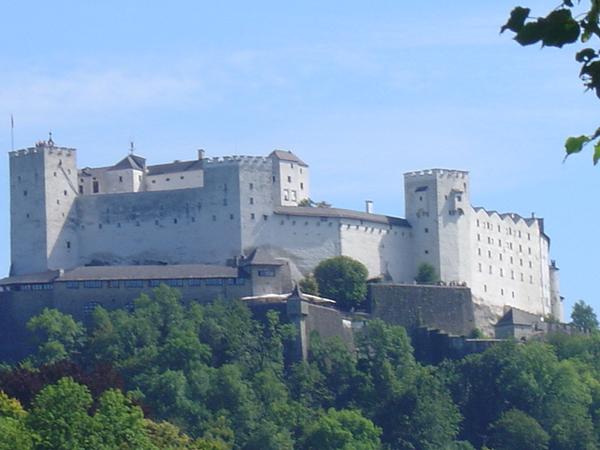
[PHOTO: Festung Hohensalzburg]
Hiking up the steep incline to the main Salzburg Fortress (Festung Hohensalzburg) with colleagues, we rest near the Torture Tower over beer, enjoying the bulwarks of medieval Austrian defense and punishment.
Afterwards, a stroll through the Zentrum leads me with a few others to Media Markt, a sort of Euro-style Best Buy. J.L wants to scope out the jazz CDs, but the first thing I see on the rack is fellow Texan Kinky Friedman's classic, They Ain't Makin' Jews Like Jesus Anymore. This is, of course, a cosmic sign that I really must buy this record.
With a quick adventure on public transit, it's back to the Schloss for an Austrian-style barbecue.
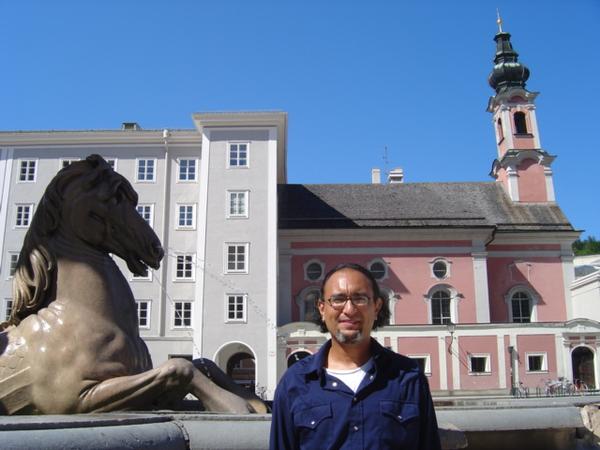
[PHOTO: Benjamin geht in den Zentrum.]
MEINSPACE: BURNING DOWN THE BIERSTUBE
In the high and wide Raum of the Schloss library, thoughts unravel and realign. The view framing this screen expands such sentiments, with ideas shooting up the sides of mountains and over across into Germany, past that, to London and then maybe Helsinki.

I must trace my way backwards.
Today, a contentious working-group meeting, like trying to grab hold of a greased pig.
This morning, a lecture with two liter bottles of water, to replenish and rehydrate.
Last night (also this morning?), shutting down the Great Hall, burning down the Bierstube, conversations in every direction like a train on fire, like a runaway semi-truck barreling down the side of a California cliff, just a'riding them brakes all the way down…
Arguments, accented with a pounding fist to the table, defending the lecture that pissed almost everybody (but not me) off, about "CORE" and "PERIPHERY" systems in this globalized world, and coming back around to feeling like I am a conservative among academics.
"Extremism in defense of moderation is no vice."
Some of us left the periphery to come to the core, to get an education, to move up and perhaps fulfill parents' dreams. And so why have we not returned to the periphery? Well isn't that obvious? Or should we perhaps disavow every single advantage, then, and do penance? In which case, I should move back to Texas and immediately offer myself up for Homeland Security removal.
No? What then?
Connections with our International Studies Program faculty: Reinholdt signs his book, Satchmo Meets Amadeus, for me. Dr. Bill Reckmeyer (ISP faculty) talks NBA as his paradigm to describe the structures of power and suggest how we might develop a model of cooperative competition. The realities of Realpolitik and the urge from some academics to keep hands clean in the realm of criticism: We know so much about what we're against, but what are we FOR and what do we DO about it?
And how do we get there? Reactions from the heart are OK, but what about the head? And how to use our hands, to get to a better place if not the best place, a new world?
And then the "informal optionals," the impromptu gay/straight alliance in which I was the hetero-ambassador. The post-barbecue savor of Austrian baked beans and elotes segues into Stiegl after Stiegl after Stiegl, and wine, and nicotine, and discourse past 3am over a knocked-out colleague, to the tune of piano doodles, of waltzes and salsa.
I am starting to feel the fire, to sense the most magnetic pull to wander more, to write, to meet new people in Johannesburg and Dubai, to take that walk instead of just talking so much talk, to make new colleagues in every nook and cranny possible.
And before all of this, walking into the Media Markt after the Festung, searching for CDs with J.L., Corey, and Maria. The first thing I see on the racks is Kinky Friedman, They Ain't Makin' Jews Like Jesus Anymore. COSMIC, that I should see this CD (with some German liner notes) from my fellow Texan and his "Ride 'em Jewboys…"
As far away as I can find myself, home pops up just around the corner. So keep looking, keep turning down these tiny streets, keep hiking up the Festung, get lost, take the bus, jump in a cab, and then bust out on the foosball table. Win/lose, then strike out in the darkness down that unfamiliar path.
Weiter. Noch Weiter. And then a break along the way, opening into stands of trees, babbling brooks. "Über meine Mütze/ Nur die Sterne." Over my head/ Nothing but stars.
JEDERMANN: Final Destination IV (The Salzburg Shuffle)
I've been going through music withdrawal, so I stroll into the hills with my iPod, and I must be an odd feature or strike an einzige pose, as motorists seem to set their gaze at me.
But Amadeus does finally rock me, in the Great Hall of the Schloss, at that. While lots of colleagues settle in the cellar Bierstube, I roll into the Great Hall by myself and hook my iPod Shuffle up to a stereo.
Portraits with powdered wigs and ornate frocks look down on me as I bop to Control Machete, Black Rebel Motorcycle Club, Bonde do Role, Johnny Horton, Esteban Jordan. Tejano melds into indie into Mex-Hop into country. This is my baroque mash-up. (Reinhold names it in French, “Texe-Mexe,” and we double over with laughter.)

[PHOTO: in the Great Hall…]
A few friends join my solo party, and we commence to pop-locking, shaking, freaking, and generally jubilating. "OK, let's get down TO IT boppers! CAN YOU DIG IT?!!!"
Funny, but the iPod, which has been so maligned by academic disdain for materialist culture, now is the party Prime Mover. JUST GET INTO IT…
And I won't tell you at what time I collapsed into my own private Idaho of dreams.
Next morning's lecture brings us Mary Catherine Bateson, who admits to "sounding off" and preaching (just a bit) from the bully pulpit. But I glean many ideas and bon mots.
"Cybernetics makes poets of us." Systems theory leads us to metaphorical thinking in order to describe the interface of human and other, to align our minds with an inter-connected reality that we can put words to, one that we can articulate lyrically.
Afterwards, somehow, back to arguments in defense of Bill Reckmeyer's systems analysis, which continues to work colleagues' nerves as a sort of "colonialist position," so they say. NONSENSE! I keep at this grindstone of misunderstanding and, as Bill put it, this separation of the heart from the head and hands.
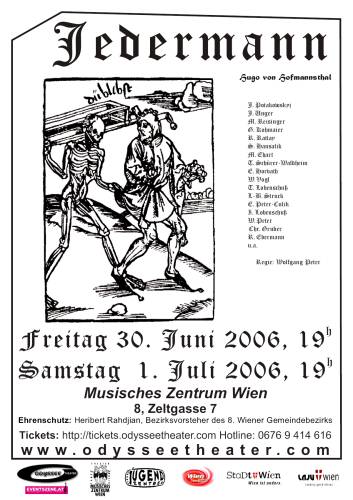
Nonetheless, in my own moments of decompression, I dig through so much from Bateson's lecture, especially her reference to the Salzburg Festival's adaptation of Everyman, the mystery play, still one of my favorite medieval-British pieces of drama.
In this Austrian-baroque version, mounted in the center of town with actors declaiming from towers and turrets, "Jedermann" plays out the allegory of our Final Destination. On a voyage of redemption, he must prepare to meet Death with the help of the Virtues in order to purge himself of Vices, so to enter into the Kingdom. He must do penance through literal lashing of the body, the drawing of blood like unto that of Christ himself.
And then, the proclamation from his adversary: "I AM DEATH, THAT NO MAN FEARS." (I remember this line from the play and the GRE, which asked if Death fears no man or if no man fears Death…well, which do you think???)
This is our common destiny, and not one restricted to Christians. This is our paradigm of universal human journey through life. This is the kind of globalized thinking we are trying to accomplish here, to imagine ourselves interconnected instead of fragmented, and all on the same path going THAT way.
Remember, also: "Jeder Mann macht eine kleine Dummheit!"
My charge now: To find the script of Jedermann in German, to read it and practice my Deutsch, so I can come back next year to the Salzburg Festival and go on this allegorical journey too, to imagine where I shall one day end and how I will have walked these few miles, however many, left on my meandering way to wherever I am going.
SALZBURG DASH-OFF
Notes scattered between suitcase and cerebrum, I dash off my final thoughts on Salzburg from the tail-end of the Global Seminar and my experiences at the International Studies Program.
On my last night out, the cab back to the Schloss from Salzburg Zentrum putts along with a driver from Sierra Leone in West Africa. He has lived here 30 years and has a family of his own, as well as cousins and assorted relatives. We chat in German for the five-minute ride, because he doesn't have much English (though he speaks Austrian Deutsch and two of the nine or so dialects in Sierra Leone). He is a kind, wise soul who helps me along with my sentence structure.
This is part and parcel of my experience, to come to Österreich and meet someone from Africa who teaches me Europe.
And when I finally arrive back in my Chicago cloister, a telephone conversation with my sister clues me into my own true global identity, as she has researched our genealogy and found a sailor great-grandfather who came to Matamoros, Tamaulipas, directly from a part of Spain settled by Sephardic Jews. And we have great-grandparents also from the Chichimecas of Morelos, México.
Through Spain, I am Jew and Moor, European and African. Through México, I am indigenous, pre-Columbian, First People, and on back to the Siberian land bridge, which gives me Asia.
A conversation from Salzburg remains with me, in which a colleague talks about the Chicano sense of "Our People," but this is not my conception, for I can tap into greater sense of self, a true global citizenship, than just noting the obvious: my American racial, ethnic, and class background. "My People" are greater than just my skin tone. My new sense of global identity makes me so much more than someone bound by a crude sense of "community" rooted only in the historic adversity of North America.
My People, for example, congregate in transitory zones of movement and self-transformation, maybe at a bar in Salzburg where Germans want to distinguish themselves from Austrians and vice-versa, where music students from Malmö, Sweden, pick up hip-hop and East Asian tastes, where others yet hunger for jazz created by African-Americans yet produced and distributed by Jews, all influenced by the heritage of Wolfgang Amadeus Mozart and the classical culture scattered across the globe by anti-Semitism, coming all the way back, full-circle, when we hear the creative re-interpretations of classical structures brought to us by Louis Armstrong, from New Orleans, from the Creole and Euro and Juden whose blood and passion forged hearty, dynamic diasporas.
And now, to pick up all the pieces and put them together, to gather my scattered notes and see if I missed something, perhaps to stroll to the lake and read my new colleague's ruminations on Satchmo Meets Amadeus, to think about yet another new colleague's potent analysis of what I should do next, to pursue my global citizenship through acquiring greater power and position in the interests of leadership, leverage for progress, and (ultimately) a sustainable Earth for us all.
To start with the tongue, with true code switching, not just the limited and pained kind pushed by Chicano brethren, but with every lingo I can wrap my lengua around. Because one can make any language one’s own, but with an effort based in the desire to know, respect, and assume these cultures as “one’s own.”
To put myself out there and continuously turn my world upside-down, like at the Salzburg Global Studies Seminar, where I had the most intense presentation of my life in front of my new world heroes.
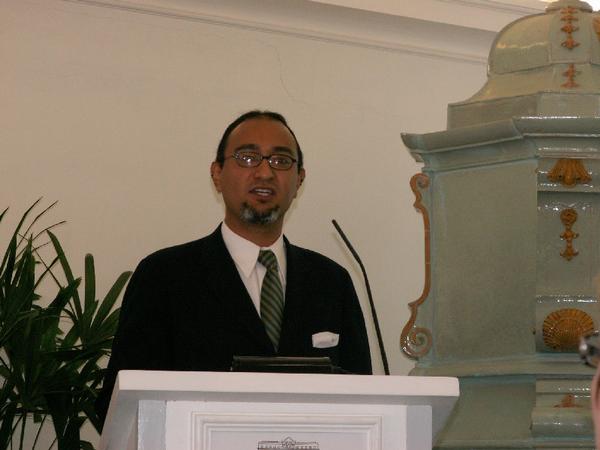
[...photo thanks to ISP CD, Salzburg Global Seminar]
(On one side, the panel with tough questions; on the other, the yellow and red cards of over-time execution; in front of me, hard-working representatives from American colleges and universities; and me in the middle, a “flyboy in the buttermilk” who could have never anticipated this moment back on those dusty, South Texas streets.)
To make the connections when I see a concert like our ISP final banquet treat, a precious gem of a show with pianist and singer Valerie Capers and bassist John Robinson -- especially when I hear Cuban charanga and an entire salsa combo unleashed from only two musicians, themselves geniuses and ambassadors of world culture.
To add German and multiply by Spanish, just for starters, and then repeat. Wiederholen Sie bitte.
Allow me some time to turn piecework into a plan. Allow me leeway to wring juice from my soul that will nourish a greater sense of self, more rootless and cosmopolitan yet more unified and pacific and gustatory, integrated and plugged into this great world.
Grant me, dear reader, the time and space to connect with you in the most meaningful way, one that envisions an equitable world for us all and speaks to you with the respect and filial affection due My People.
[VIDEO: Closing footage of yours truly, shot by yours truly -- CLICK PLAY.]
END QUOTE
"Everybody keeps on talking about it... nobody's getting it done
I'm tired, tired, tired now of listening, listening... knowing that the ship's gotta run
...
Everybody keeps on pushing and shoving... nobody's, got the guts
You owe me ti-ti-time, now they're writing me in... I'm gonna act like I should
...
Everybody keeps on listening in... Nobody listening up
...
Everybody keeps on talking about it... nobody's getting it done
...
I'm tired, tired, tired now of listening, listening... knowing that the ship's gotta run, just gotta run...
Yeah, yeah, yeah, yeah-yeah, yeah-yeah, yeah... yeah, yeah-yeah, yeah-yeah, yeah
Yeah, yeah, yeah, yeah-yeah, yeah-yeah, yeah... yeah, hey, hey, hey, hey"
--"Yeah," LCD Soundsystem
San Antonio Travel Blog
...from a trip down south, June 2007...
Part One: Coolin’ at the icehouse
Not here 10 minutes, and I'm already scratching dried sweat off my ass.
My sister doesn't get in for a few hours, so I take a taxi to Taco Cabana -- the best Tex-Mex fast food EVER -- and chill with the diabetics drinking Lone Stars. On the way over, the driver says pretty much what I read in the San Antonio Express-News: "Yeah, the whole world thinks the Spurs are boring, but I bet they wish they were boring as us, with four championships, ey!"
The newspaper puts it down like this: "So the Spurs are considered unremarkable, uninteresting and downright unwatchable. Today, San Antonio fans survey the bored landscape beyond their city limits and offer a succinct reply. So what?"
After sucking down a tub of Dr. Pepper, I decide to walk to the hotel, like a leisurely stroll, but I soon remember how much hotter and stickier it is here. Just my walk is equivalent to a vigorous jog in terms of the sweat I work up.
Amalia shows up, and we hit the streets with all the gathering Spurs fans. Downtown SanAnto isn't very modern looking, so you can almost imagine walking into, variously, the 19th or early 20th centuries. And the city is obviously so much more brown in its aesthetics, tastes, and people: Spanglish, also, is the norm, so much that after a while I don't even notice the easy, lax switching between Spanish, English, and Tejanismos.
The Riverwalk is flooded with brown folks rocking Spurs regalia, and when we find our spot to watch the floats and fanfare, cheers go up for Plácido Domingo busting out with the Star Spangled Banner. After a bit, we're able to see Coach Pop, Manu Ginobili, Tony Parker (with Eva in tow), and then Bruce Bowen and Tim Duncan, who acknowledges my sister from his floatboat with a cool, finger-pointing triple-nod.
Loaded up on Spurs, we slog to Southtown and dehydrate our way to La Tuna icehouse. Sedimented, rusted bottle caps crunching underfoot, we find our way to a picnic bench and watch the tough stray cats, freight trains, old-school veteranos, and hick hipsters sucking down brews like water. La Tuna, like so many other buildings strewn along rugged streets with yellowed grass, is a bit rickety and lurching toward collapse, but unassuming and done up with the trinkets, posters, and cast-off art from a deep Tex-nexus of down-south brown funk.
Willie Nelson plays over the speakers from a portable turntable.
We meet up with my sister's friend Maria, a theater chick, and drink until closing, what seems a lazy, satisfying pace of sweating and consuming. After a bit, Rudy Galindo -- the Chicano Tom Sizemore -- comes by to crack us up, and they all talk theater tech. This morning, we roll out and see Laura Varela, a filmmaker friend of ours, at Taco Haven over fresh, homemade tortillas (FINALLY!). It's great to sit and listen to these folks talk with my sister, hurriedly catching up mainly on projects and performances -- so much shop-talk about getting art off the ground.
Later today, shopping. Maybe tomorrow, the slam I created back in 1999, which will be weird since I have not set foot near that beast since I made it happen and rocked Nationals with my team in 2000. Thursday, maybe a drive to Corpus Christi or Port Aransas, to dive into the Gulf and get oceanic.
Part Two: “Please do not throw away the fajita skillets”
The Taco Cabana trash insignia speaks to SanAnto's conservation efforts in the trenches of grease gravy. After walking the downtown "Alamoland" area -- a hyper-real tribute to history that never really happened -- my sister and I survey the coonskin caps and faux mission arches that define much of S.A.'s central skyline radiating outward from the Marriott and Riverwalk Mall.
Time for tacos.
Random word-picante now infects my speech, as we take on the voices and verbals of people around us. (Overheard on the bus: "Ey, uh, when you shave a vato's head, do you like have to put some vaselina or lotion on that?")
We trudge to Sunset Station near the Alamodome at dusk, but the air is still sticky and heavy with heat impervious to paltry breezes. We arrive for the Dinosaur Jr. show, but they already opened, so now it's The Black Keys from Akron, OH, a duet popping big-beat blues and weltering guitar dynamics.
Amidst the rock, we meet up with various old friends -- artists, writers, rockers -- like my buddy Phil Luna, late of Worm, 1.0, and the Shit City Dreamgirls. It's a puro SanAnto cadre, and we reminisce about Tacoland (R.I.P.), the SWC Club (and its recent ruckus), and assorted homies.
Next morning, my Stanford compadre Professor Ben Olguín shows up at the hotel with Greg Barrios, a former Express-News reporter and playwright. We hit Taco Haven and then Ruta Maya on the Riverwalk, later joining up with Laura Varela at her office at ONE9ZERO6 Gallery, near Gallista Studios in the Southtown arts district. We stroll art spaces and peruse the paintings, prints, silkscreens, installations, contraptions, drawings, sketches, and objets by a variety of MexChicano artists.
Later, at one of countless taco huts in a cave-like casita near Southtown, carne guisada and Wolf-brand beef-chili flavor the air in a free-form art chat, about Laura Varela's Vietnam veterano movie coming up on PBS within a year, and Greg Barrios runs down his encyclopedic knowledge of Chicano music from the Vietnam era.
Amalia's boyfriend Kip flies in from L.A., and we're thinking Gulf Coast, we're thinking Mex, we're thinking cosmic.
While Amalia works on a poem for tonight's slam, Kip and I visit the San Antonio Museum of Art, forged in 1981 out of the original 19th century Lone Star Brewery. (Yes, art and beer go hand-in-hand here, literally.) We check out the Fernando Botero exhibit, mainly of the Colombian artist's religious and culturally inspired oil paintings. With heavy Latin American baroque influence, Botero plays with fleshy proportion, as in the rotund corpulence of a bronze statue titled "Smoking Woman." (The cylindrical slightness of her cigarette gets smothered by chunky overflowing of breasts, buttocks, and thighs spilling out onto a velvety blanket.)
Of course, we're in SanAnto, a very military wing-nut town built on “The One True Faith,” and so the Botero exhibit excludes his controversial 2004 Abu Ghraib series, depicting American soldiers torturing prisoners -- in these pieces, voluptuous sensuality turns to agony of the flesh, reminding of his still-life paintings where juicy fruit carries blemishes of worms, flies, and rot.
I check out these pieces in the museum bookstore, though they are not on exhibit, and the images stay with me when I finally crash for a heatstroke-nap.
Part Three: “No’ombre, SHUT UP!” -- Puro SLAM Redux
I'm at Sam's Burger Joint waiting for S.A.'s poetry slam to start, and I'm doing something I NEVER do in Chicago. I'm watching a Cubs game. Ads for the minor-league Missions pop up with a big draw for fans -- come to the game and tackle a guy running around the park in a huge puffy taco costume. (That should've been my job back when I lived here.)
Over nachos soaked in grease and golden cheese-stuff, I study German for my upcoming trip to Salzburg. (What was that line I memorized years ago for no great reason? "Als Zarathustra dreissig Jahre alt war, verlass er seiner Heimat und den See seiner Heimat, und ginge in die Gebirge…")
Well, I've returned from my own Gebirge, and here I am full circle at the rhyme-spot I started in 1999. But an Express-News article posted on the wall says different, naming Phil West as the "creator." Impossible -- in 1999, that guy was in his promised land of alt-landia otherwise known as Austin, the most over-rated Texas town ever but like a Branson, Missouri, for weirdos who you could just as well find in Seattle or SanFran. (I.E. Fuck Austin -- don't even ask me if I visited there while in Texas, and don't come near me with that shit...)
No matter -- people in SanAnto tend to care little for facts, and I note many other such errors in the article that writes me out of this secret history of how I created one of the hottest shows still running after eight years.
Why did I do it? The thing never benefited me near as much as it did so many poets and fans who rocked 100+ turnout every week of my tenure as "slammaster." In the end, the thing was a huge pain in my ass, and I felt like people got over on my hard-earned juice, most notably when I ended up ass out.
No matter -- I'm here for my sister, who likewise returns to the roots of her own poetry career to bust out a bilingual poem and see if she can rock the crowd.
It turns out to be a great time. Raucous, weird, off-color, anti-PC, and totally run by audience participation. Just like I did it back in the day.
I run into a handful of old friends -- Dan Allen, the bisexual atheist who rails against pederast priests every week; Rich Perin, the Australian madman who jumped ship from Austin and joined Team SanAnto for our romp at the 2000 National slam; Anthony Flores, a genuine poetic soul who told me the story of how he read about the slam in a newspaper one night years ago and hopped a cab after work to check it out, how it got him doing poetry. And so on.
They buy me beers and actually thank me for creating this thing. It actually, genuinely touches me to get this long-delayed simple thanks. And Rich Perin even calls it an "honor" to have me back for one night. I can't say now how much this means to me, to have this sliver of recognition when I thought they all forgot about me. After all, I created this show for this city, for "my people" of San Antonio, and gave it away as you would any meaningful gift from the heart.
And what about the show? "It's a fucking slam," Anthony reminds me, waxing nostalgic about the days when I used to whip the crowd into a froth.
(And now, Anthony and his daughter slam together for Team SanAnto! Cool!)
Like the old days, a few of us head back to my hovel for a party into the wee hours, re-telling tidbits of the best moments. (Like when Wyle Killshire, known back in the day as "Mr. Fuck," heckled a Chicano political poem by howling, "DROP THE CHALUPA!")
It's a good scene, and it was exactly my plan so many years ago to create something that would live long after me, even if I was forgotten and eaten up in the process of creation like a catalyst, like so much electro-chemical residue…
Part Four: Tacopalypse
Late-nite Cabana crunching has taken its toll, as my pants tighten and stomach readjusts to heavy treats laden in silky-rich manteca. Of course I know what's really making the tacos taste so damn good and so making my tummy turn -- lard -- and I wonder if the local Pig Stand sandwich shoppe closed because all their customers succumbed to diabetes.
Though my stomach can't quite keep pace with how much my mouth savors puro Tex-Mex flavor, I keep throwin' down the homemade flour tortillas with liberal chasers of Shiner Bock and Lone Star.
Sluggish chugging at Bar América nicely two-steps in time with the jukebox 45s rolling Hank Williams, Flaco Jimenez, Robert Earl Keen, and so on…
Next day, on our way to see the South Side sights of Spanish Missions and stray cats, we stop at the Instituto Cultural de México at HemisFair Park, near S.A.'s UNAM campus. The current Instituto exhibit features "Sensacional Mexican Street Graphics" -- a smorgasbord of signage, placards, and commonplaces from Mexico's anarchic street-level visual-design universe. Much of it reminds of the border, of bilingual beaux-arts crafted out of on-the-line mixes of color palettes, cultural touchstones, and hand-made typeface fabrication on everything from instructional broadsides to hyper-violent comic books to rather unappetizing restaurant signage barking right off the sandwich board.
Some of it even reminds of Chicago, specifically all those chicken shacks with the animated neon depicting terrorized poultry and portly cooks in puffed-up chef hats rocking hatchets.
But my favorite feature of the show is video footage of urban street parties, where New "New Wave" Mexican electro-rockers mix banda with beats and vocoders to pump up a kind of Mexicano crunk-dancing coming straight outta the gutter. The master of ceremonies -- a man known as Silverio -- sports a semi-automatic mullet and leads his spandexed compadres in a schizophrenic quebradita. Call it bandido body-rock.
SEE Silverio's hit at:
"YEPA YEPA YEPA".
After the Instituto, Kip, Ami, and I trek down to the South Side for a stroll at the Spanish Missions. SanAnto's most famous relic from the 18th century is of course Mission San Antonio de Valero, a.k.a. The Alamo. But four other Missions sprawl down the San Antonio River and mark the original founding of this town as a frontier buffer. Though the Missions were pretty much a failure in Texas, they were meant to bring in the natives and close ranks against attack, while establishing a spiritual base in this New World.
At Mission San Francisco de la Espada, we see an old, blown-up snapshot of mestizo kids receiving instruction at the end of a nun's wooden ruler. The caption makes clear that these holy bulwarks were here to transform Indios into "productive servants of God." And a hand-written card posted in the background gives the class its most intimate imperative: "SPEAK GOOD ENGLISH!"
With a side trip to the "Haunted Train Tracks" and a ride through the ravines and wild-weed patches of forest in fruitless search of the Donkey Lady, we end up later at cowboy karaoke, where Ropers and Wranglers roll out under Stetsons and Shiners.
And the SanAnto skyline never seemed to make me crave just one more taco quite as keenly as it does now…
Part Five: “…ending up somewhere/ That looks like home”
"I made a pledge to be drug free
The day I started at H.E.B.
The work is hard and the days are long
I justa wish I could grab my bong
I'm gettin fatter every day
And I got no place to stay
God what has become of me?
I'm livin in misery!"
--The Swindles, "H.E.B."
Loaded up on local CDs, my playlist features Sunny y los Sunliners (Chicano doo-wop), Boxcar Satan (experimental noise-blues), Sir Doug with Groover's Paradise (Tex-Mex Nuevo Wavo), and garage rock by the Swindles, with my favorite ode to working retail (at the "H.E.B." grocery store) just to have a shot at rockin' on the weekend.
When last I lived here, I ended up in much misery, when all I was trying to do was find a place just a little like home. Of course, there is no going home. So what am I doing here? Maybe I can answer that a bit later, when I'm back in Chicago.
For now, I meet up with Prof. Olguín, Ami, Kip, and Notre Dame Prof. Javier Rodriguez, to check out the San Pedro Playhouse production of Los Angeles writer Luis Alfaro's Electricidad. This adaptation of Greek mythology transplants Electra and Orestes to East Los, a sort of cholo epic that attests to "who we are and where we come from," as the chorus chant goes.
But I'm not quite sure where this play is coming from when the comadre chorus swigs Big Red and peppers their speech with more SanAnto than Califas. (Is there even Big Red in Cali?)
It's also an uneasy shift from comic Spanglish one-liners to full-on tragedy. And why, oh why, do "our" issues always boil down to sociology? Can't we, too, have epic lust and greed, larger-than-life human motivations that aren't reducible to the barrio? This goes back to one of my central problems with much Chicano drama -- it's melodrama masquerading as tragedy.
Even so, my problem here is not with the cast and this particular production -- the players and crew give it their all, and this piece goes over much better than the last few plays I've seen in Chicago. Afterwards, I cool out at the Acapulco Drive-Inn icehouse and then Bar América, running into L.A. David and jotting down his number so I can hang out at his studio space later and maybe buy a painting.
Much later still, I rendezvous with Ami, Kip, and the play cast, that includes our buddy Maria Ibarra, comadre extraordinaire. Overloaded on karaoke, we crash an art-space studio party and end up on the rooftop, sucking up the skyline and tossing back Shiners under stray streetlamps and purple cloud cover.
And my second installation of the Pig Stand at 5 a.m. keeps me nice and full through early morning dawn and then a stretch of afternoon today jogging through the humid, misty rain spatter.
Time to check out the S.A. Underground Film Festival at the historic Aztec Theater, take in the reunion of Glorium (famed local rockers from a few minutes ago), and then finally hook up with my friend Wendi Kimura at her rooftop art-space coctail party tonight.
Part Six: S.A. EPILOGUE -- “Groover’s Paradise”
"Got out on the highway
found myself a ride…
I wanna go back to Texas
Where cosmic cowgirls play
I wanna have some fun
in a good ol' Texas way"
--Sir Doug
I arrive back in Chicago for rainbow congestion up and down the block with all flags flying, as the Pride Parade is in full swing and someone else's party reminds me that everybody has their own “Groover's Paradise."
Mine is back up the road apiece, where deep-brown tattooed Indias flash straw hats and cool off with beer-bottle condensation. Where metal still rules and the street cats are tougher than some folks up north. Where history upon secret history replays a kind of Texas revolution, a sort of cultural freebooting that cares not where pavement ends and gravel begins, just up the dirt road apiece where you see that hand-printed sign for brisket, beer, and brown blues.
Saturday kept us chasing those brown blues, but we had just a bit much to do. Famed rockers Glorium are reuniting for a rare set, and then at some other spot über-veterans The Sons of Hercules play a memorial gig for Ram (R.I.P.), whose Tacoland cantina shut down with his shooting death on June 24, 2005, the night of S.A.'s last Spurs glory. (A MySpace bulletin straight outta SanAnto: "FUCK June 24th…")
Both shows will surely overflow with local punk/garage rock cognoscenti, but Kip, Ami, and I check out the S.A. Underground Film Festival first, at downtown's beautifully restored Aztec Theater. Cine-wunderkind Adam Rocha started this like 13 years ago, and I covered it once as a journalist. I get a chance to talk to him and his uncle, Al Rocha, who tells stories about sneaking into the movies downtown during the heyday of a now touristed-out centro.
Tonight's big feature (and grand-prize winner) is the doc Get Thrashed: The Story of Thrash Metal. S.A. should be the epicenter for this flick getting screened, since they built this city on puro metal back in the day, and of course quite a few heavy denizens show up for dark-room rockin'. The movie starts with a long recount of the big four -- Metallica, Megadeth, Anthrax, and Slayer -- and the audience barks, "TURN IT UP!" The sound kicks up to "11" for a solid 99 minutes of more than I ever really wanted to know about thrash metal.
Afterwards, Robb Chavez is on hand to shoot interviews for his long-running cable-access show, Robb's Metal Works, the closest thing to Wayne's World around.
(When Robb puts me on camera, I enthuse, "My favorite part, ey, was when the crowd yelled 'TURN IT UP!' and they, like, turned it up pero PINCHE LOUD!")
"Thank you, San Antonio, for being so metal!" says the filmmaker.
Ami, Kip, and I are pretty fried and still nursing beat-up stomachs, so we do Thai and try to work out our all-night rooftop fiesta fallout. We're not quite in rocker mode after all, so we head over to see my old buddy Wendi Kimura, whom I met as a writer when I lived here. She's an all-around artist now, like so many in puro SanAnto, and she even teaches her daughter Zoe how to tag. Funny full-circle enough, I even interviewed her boyfriend Shek about graffiti when he was a teenager.
Her rooftop overlooks San Pedro Park, giving good perspective on the central downtown basin. Mad crew shows up, and various vatos mark up strings of stickers with pictures and tags for posting later. Wendi notes how I've done lots of tourist stuff and suggests I come back to see the real SanAnto, and I'm always down for real SanAnto, especially if it involves hopping rails and seeing art go up under darkness before it ships out around the country with long, haunting locomotive whistles.
A nice surprise rounds out the waning hours of my visit when DJ Jester, the Filipino Fist (a.k.a. Greg Michael Pendon), rolls in from Austin. I refuse to believe it when, reminiscing, Jester tells me that he wouldn't still be spinning today if not for me.
So what does all this mean to me? Like my friend Ben Olguín asked, "How do you feel about coming back?" Well, I can never really come back. Every big city starts out as a small town, and you can sort of pretend that S.A. never really got big, even as it sprawls out of control up Austin-way. It's an ever-flowing river I can dip a toe into but never re-capture.
And I won't try to claim S.A. as "home," whatever that means. There's no going there. And there's no glorious return. I'm a tourist, and SanAnto is a sort of Cancún for my taste to get out of Chicago every now and then, to find refuge somewhere that resembles "home."
In Chicago, too, I am a sort of outlander. Not from here or there. I am the fabled "rootless cosmopolitan," and I cannot even begin to act like I still have some claim on Tejas -- no, I'll leave that to Sandra Cisneros and whomever else washes up in SanAnto from the outer reaches of art-colony hell.
As much as I love my memories of Texas and SanAnto, this visit has been an exercise in reminding me that I am now and forever from nowhere. In this moment of clarity, I realize how I must discover more of this nowhere, by trying to go everywhere. After my quick sojourn in Salsaburg, USA, I'm off to Salzburg, Austria, in a week or so.
Let this be the beginning of a quest to chase my own tail down the road to self-recognition. Let me try London, then Tokyo, and always Mexico City. To keep building what I am, and to soothe that part of my soul that will forever mourn "home."
SúPER-EPILOGUE
The vatos locos rock cowboy hats and boots plus wife-beater tank-tops, and they spout straight Spanish over their Tom-Yung soup and Thai noodles. I turn to my sister: "You would NEVER see shit like this in Chicago…"
THE END…
COMING SOON: "No Country for Old Men"
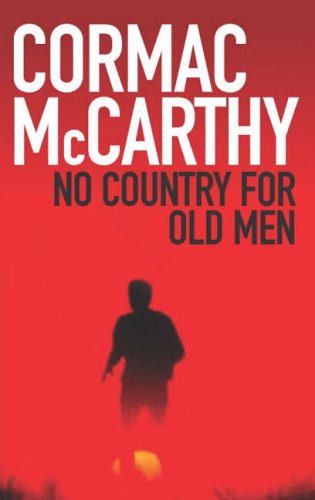
I wandered onto the following trailer late last night...
Cormac McCarthy is one of this country's greatest living authors, and the Coen Brothers are an excellent choice to direct his recent work, No Country for Old Men (2005). The Coens should deftly capture the book's surreal touches (as in Barton Fink), matter-of-fact morbid humor (Blood Simple), brutal iconography (Miller's Crossing), and Southwestern swagger, especially the laconic twang and slackjaw poetry of a pointedly lax drawl (Raising Arizona).
Like many of his books, No Country is set in Texas, but in the more contemporary '80s, spinning a border drug-thriller yarn with Mexican narcos and booted bandidos. Whereas in one of his earlier novels you read slowly, underlining so many notable passages and incredibly crafted lines that read like a classic, in No Country you breeze through with the storytelling as prime mover.
While out game hunting, trailer-dweller Lewelyn Moss wanders onto the remains of a drug deal gone bad and manages to make off with the loot and hoof it on the run, but not before various factions sniff out his trail, including a psychotic, relentless, and impassively creepy assassin who will wipe out anything and everything in his way to bring down Moss like a trophy.
As usual, McCarthy's deep, thoroughgoing, and lyrical appraisal of the landscape underscores the only truly impassive and heartless player in the story -- the earth itself -- that bears bloodshed and atrocity as it has over the centuries with unflinching equanimity, showing up man's primal bloodlust and inclination toward total annihilation.
McCarthy likewise loads his story with gun symbology, his "old men" carrying old-faithful rifles and shotguns in their pick-up trucks, versus the new-and-improved bad guys who can run down any good old boy with automatic submachine guns and SUVs. Even so, the earth watches deadpan as every man's bones crumble underfoot into the pulverized fossils of futile human ambit.
This book is not as profound as Blood Meridian (1985), McCarthy's masterpiece, but it's more a straight page-turner dipping into the well of McCarthy's dark worldview. Native Texan and McCarthy fan Tommy Lee Jones stars as Sheriff Ed Tom Bell, a sometime narrator and "old man" who won't be around this country much longer. Great lines abound for Sheriff Bell, a true peace officer who reads the demise of his own kind in the trail of bullet shells and shattered bones left by the narcos on Moss's trail. His voice, sewing together the narrative, is the story's moral center, but one that cannot hold and will not last.
The show comes out in November and also stars Josh Brolin and Woody Harrelson. Also shot on location in Marfa, Texas, it should be a good movie based on a solid book by a great American author.
R.I.P. Rorty
American philosopher Richard Rorty died June 8. Here's a link to a brief news report (Rorty obit), and a small excerpt that says a lot about Rorty's inspiration particularly for me:
"Rorty forged ahead on the path cleared by American pragmatists, particularly John Dewey, in asserting that ideas are tools; the ones we call 'true' are simply those that help us cope best with our present circumstances. Politically liberal, he especially admired Dewey's focus on social activism—his famous urging that intellectuals shift their attention from 'the problems of philosophy' to 'the problems of men.'"
For those of you who knew and read Rorty, this is a loss to our American brain trust, and to public intellectualism everywhere.
I first recognized an affinity for Rorty's pragmatism in college, when I attended one of his talks at Northwestern. Up to that point in my senior year, I had been steadily absorbing continental Euro philosophy, especially deconstruction and post-structuralism. I'm sure that I, like others, marveled at my own dexterity in reading Derrida. But what relevance did that stuff have to my life?
Rorty launched a broadside on post-structuralism at this particular talk in 1992, and I remember the entire room of academics shifting in their seats, looking for rocks to throw and knives for stabbing.
"We need to give up these master grand-narratives of ultimate human liberation, whether it's Marxist revolution or post-structuralist paradigm-trumping." He argued that academics should, instead, roll up their sleeves and lend their expertise directly to the nuts-and-bolts work of making the world a better place.
Of course, his nutshell assertion provoked all sorts of conniptions and begged many questions. But his manner -- unflinching and bulldoggish -- got me. What the hell were we doing, after all, talking so much nonsense about reversing and displacing the world's agonies?
Rorty got me back to my American intellectual heritage, that of Dewey and James. He reminded me that philosophy doesn't have to get dressed up in French to have meaning for many people, to be relevant in ways most academics shrug off after tenure's said and done.
He was an intellectual giant whose profile I can't hope to touch in this tiny format.
But like many, I have been influenced and changed by Rorty's interventions. Especially realizing that intellectual work and academic life can have central significance for whatever liberation we'd hope to have, and that the work intellectuals do should speak up loud in public for all to hear and respond.
He reminded me especially post-college that intellectual work is not a luxury but a calling that should be answered in the clear, provocative, and squarely public voice of the American scholar, like Emerson and many other great Americans before him.
Blogging ≠ writing
The blogosphere as it currently exists is that infinite warehouse of proverbial monkeys tapping on typewriters until Shakespeare randomly coalesces on page like a chaos fractal. In this scenario, art happens by accident, not design.
Blogging proper is to dash off thoughts quickly, the fingers matching thought-speed and perhaps exceeding critical faculty. Instinct supersedes careful thinking, with mixed results.
One of those results is the willful confusion of public-versus-private registers. In places like Iran or China, such confusion can be revolutionary. In the west, it's just another toxic luxury. But that's a topic for some other blog post.
Another result is product – shot out on electric impulse and juiced by every laptop flipping open – that looks and even feels like writing. But it's not.
Blogging is not writing. In gastric metaphor, it's more like e-farting. Except without a smell, which is what makes farting a bit more authentic by contrast.
So what's writing, then? I can answer that with the fundamentals of what I teach – and what I teach comes directly from what I've learned as a journalist, writer of poetry, and essayist. (In other words, these ideas do NOT come from some teaching theory I studied or read in a book.)
Writing is
1. re-writing
2. working with a teacher/editor
3. communicating to a general audience
Students are always surprised when I tell them that writing is NOT dashing something off and then turning it in. Real writers pore over every single word multiple times and go through drafts like so much two-ply in an extended toilet session. Writing is revising. Writing is an act of expansion, and this can be dangerous because it just might produce something you didn't think of or didn't want to be reminded of.
OK, so someone might now think of Jack Kerouac, arguing that true writing is keeping to one's own authentic voice without censorship or emendation. On the opposite end would be William Burroughs's Naked Lunch, a novel of vigorous editorial work. In the real world, where most Jacks and Bills toil, we are all somewhere in between. In other words, we all have to do a mix of authentic expression AND panning for gold – putting genuine stuff on page while moving it around to match the most wondrous gems you still have locked up in your mind.
True writing is also working with a teacher or editor. That's really the ONLY way to improve as a writer, to have someone collaborate with you as a kind of coach. In the real world, I never put one past the goalie on page without working heavily with an editor. And to tell the truth, that's really how I've made any progress at all. Bad editors have always left me feeling like I wasted my time, even if I got paid and published. Good editors made me feel like I was doing something worthwhile, and getting really good feedback for free!
Self-publishing, blogging solo, or pushing out endless screeds without some sort of crafting – by contrast – is like playing with Lego. You might end up with some interesting looking castles and skyscrapers, but nothing will be truly original or shine beyond the sheen of brittle plastic.
Writing, finally, is communicating to a general audience. One you do NOT know. One you never anticipated. One that surprises and often fills you with anxiety. Who are these people? That's what you should be asking of all who read you. Writing, thus, is a surprise, a gift, the unexpected visitor whose presence is welcome but whose little habits might be somewhat annoying.
If you're writing just for your buddies, you're not getting much in the bargain.
Possible refutation: The instant feedback of blogging, from potentially limitless audience, acts as a balance to self-indulgent e-publishing. MAYBE. But not likely. Blogging's comment button – a welcome piece of druggish indulgence for anyone who wants to be a writer – is more like a cheering section than a reality check.
And I remember Nelson Algren's comment, that "writing is not a social hour," or some such. Maybe he said it's NOT happy hour. That would make sense. Writing of any value happens in a very lonely, private, and unheralded place.
And if it ever sees the light of day, it becomes something else altogether in the eye of the reader. Something you have entirely no control of, up to and including the very name you typed at the top of the work to claim as your own.