"Laugh Riot" (Chicago Reader)
"Laugh Riot:
Pushing the Borders of Performance Art"
By Benjamin Ortiz, for "Our Town" in the Chicago Reader
September 19, 1996
A TV screen flickers with the static-scratched image of a meeting in a dimly lit brick basement. Figures in black work clothes exhale steam through their ski masks. One steps forward and spits out, "In the tradition of Pocho Villa, the lesser-known cousin of Mexican revolutionary Pancho Villa, Chicanos grow up today in occupied Aztlan: confused yet fierce, defending our gente, our land, and our pet Chihuahuas. A pocho is a Mexican growing up in the U.S. who is considered tacky and uncouth by both Mexicans and gringos. Pocho Villa was the first hero to stand up for the right to be Chicano, not a Mexican with their perfect Spanish-language skills and taste for bad pop music, not a gringo with their inability to share and taste for bad pop music, but shunned by both! Subcomandante Chuy wants you, Raza! Join the totally chingon forces of the Pocho Villa Liberation Army! Be a revolting pocho and help liberate Aztlan!"
Next to the screen stand Esteban Zul and Lalo Lopez, two soft-spoken emissaries of the PVLA. The pair are also the creators of Pocho Magazine, which they describe as "a Mad magazine for mad Chicanos." Since 1990, Zul and Lopez have managed to squeeze out seven issues. Turning a term of derision into a badge of honor, Pocho's strategy of Chicanoizing popular culture and traditional Mexican folkways satirizes life on both sides of the border. It offers a culturally schizophrenic pastiche, taking jabs at everything from barrio life to U.S. immigration policies. While the zine has been in limbo for nearly a year, the Pochos have blossomed into a multimedia operation. Lopez, cofounder of the Chicano Secret Service performance troupe, writes the "Mexiled" column for L.A. Weekly and draws the cartoon L.A. Cucaracha under the name Lalo Alcaraz. Zul heads up the Berkeley-based hip-hop group Aztlan Nation. Together they've performed on Pacifica radio and produced videos with other artists. The Pochos also run a site on the World Wide Web called the Virtual Varrio (silcom.com/-tonkin/pocho/varrio.html). Recent posts include Dia de la Independencia, inspired both by Mexican Independence Day and by this summer's blockbuster movie; sombrero-shaped spaceships zap the White House with a jalapeno laser ("The next time you call them aliens might be your last!"). Since affirmative action has been eliminated in California, the page also advertises the "National Pochismo Institute," which offers classes in Transcendental Lowriding, Pochteca History, and business ("Raza Swap Meet Technology").
After the revolution, there will be no more lost luggage. But Lopez and Zul have arrived an hour late for their appearance at the University of Illinois at Chicago after tracking down their bags at O'Hare. They're here for a conference organized by the Mexican Students of Aztlan.
"I think that since our audience has been waiting so patiently we shall reward them," Zul announces in his raspy voice, prowling the stage in sneakers, baggy black jeans, and a T-shirt that reads "Gypsys & Thieves Cover the Earth!"
Lopez unloads a cardboard box of jingling bottles and proclaims, "Malt liquor for everybody."
Hoots and hollers come up from the crowd, and one homeboy in a hoodie and baseball cap exclaims, "Orale! I've been waiting for some liquor all damn day!"
"I gotta tell you, we are all about free malt liquor," Zul says. "It enhances our product and loosens the pocketbooks at the end of the show when we sell our merchandise." Plastic cups are passed out, and Zul walks around pouring from a communal 45-ouncer. Most heartily welcome the ghetto-style aperitif.
"Don't you think you're promoting some bad habits here and supporting the liquor industry that loots our communities?" someone asks.
"Hey, I don't promote it," Zul answers. "I just pour it." Those familiar with the Pochos know how they feel about the alcohol industry targeting the barrio. One parody centers on a drink marketed to poor whites: Dead Gringo Malt Liquor ("Dang, it's tasty!"). In April 1995, the last time the Pochos came through town, they performed Chorizo of the Gods at the Mexican Fine Arts Center Museum and ended up serving malt liquor at the nearby Jumping Bean Cafe.
The redundancy of proving their point again doesn't seem to be a problem tonight, as the crowd quickly gets behind the Pochos. "If you didn't know already, this is our first piece here," Lopez says, pacing the stage. "It's called 'Malt Liquor Machos,' a group collaboration with some of the art students at UIC."
"It's been a great show so far," someone drawls.
"That's what you call arte," Lopez explains. "Art so good you have to spell it with four letters." He introduces the next video, "some animation by one of our Pocho agents, Alex Rivera from New York, and it is called Cybracero." Lopez explains that the film takes off from the bracero program, which promoted immigration during World War II when Mexican arms [brazos] were needed for agricultural work. From this program came the mass importation of braceros, contracted laborers from Mexico. Cybracero uses stock footage of the actual bracero program, news clips, and slick editing to depict a future in which Mexican labor can be employed to pick crops via the Internet. An enthusiastic narrator says, "The United States Government Department of Labor is excited to announce a new program to get the job done: the Cybracero Program. The presence of braceros contributed to a climate of racial and economic suspicion; evidence of major tension was not hard to find." The video cuts to footage of last April's brutal beating of Mexican immigrants by Riverside County sheriff's deputies in El Monte, California. It then switches to an animated sequence showing robots in sombreros picking fruit in southwestern orchards. "Through the new program, Mexican workers can, from their Mexican village, watch their live Internet feed, decide what fruit is ripe, what branch needs pruning, and what bush needs watering. For the American farmer, it's all the labor without the worker. In American lingo, cybracero means a worker who poses no threat of becoming a citizen, and that means quality products at low financial and social cost to you, the American consumer!" The video shows a little blond girl drinking orange juice, then fades to black.
The lights come up, and Lopez begins to introduce the next video. Zul interrupts, "But first: does anyone need more beer?" Zul pours refills while Lopez describes their own "cybracero" work on the last feature. "Yeah, our homeboy Rivera works with archival film footage, and all he had to do was mimic the actual narration from a real government flick. I sent Rivera the scripts and the images for other cartoons over the Internet, and then he put them into his Mac, processing with animation programs, etcetera--the two of us sending bits of sound files and visual clips back and forth. The Pocho animation ventures go under the subsidiary title Animaquiladora, and our logo is a bunch of workers drawing in a sweatshop."
Lopez segues into the next subject. "I recently went to the GOP convention as my character Daniel D. Portado, who is the former head of the group Hispanics for Wilson and current head of HALTO, Hispanics Against the Liberal Takeover. D. Portado is this right-wing freak. You've seen these people on TV, these right-wing Latino spokespeople that are...uh..."
Someone yells out, "Coconuts," a reference to people who are brown on the outside and white on the inside.
"Yeah," Lopez agrees, "but they work for a paycheck, popping up at English-only rallies, and they're held up as representatives from the community by politicians, so we thought it would be funny to spoof these people 'cause they're very annoying.
"During the campaign for Proposition 187 in California, we were all pretty pissed off and wanted to think of a way that we could attack pro-187 people and get free publicity doing it. So we thought we'd take it to the point of absurdity and become militant self-deportationists."
Zul picks it up. "We put out newsletters and press releases on the Internet and sent them to radio and TV stations, saying that we believed in deporting ourselves. We told them stuff like we wanted to get rid of Linda Ronstadt because her garbled Spanish yodeling attracts too many immigrants to this country, Mexican food is just too unhealthy for you, there's too much banda music. We promised that before we self-deport we'd train all the white people to work in the hotel and gardening fields, and then we'd have an event with Pete Wilson called the 'Run for the Border 10K' to repatriate Mexico."
Surprisingly both the left and the right took the Hispanics for Wilson hoax seriously, and the Pochos received death threats as well as praise on their hot line. "We felt kinda bad with some of the calls we got from shocked and enraged Mexicanos taking us dead serious," Lopez admits, "and then we got calls from MEChistas." He's referring to the student activist group known as MEChA (Movimiento Estudiantil Chicano de Aztlan, or the Chicano Student Movement of Aztlan), born out of the Chicano civil rights movement. Lopez repeats one death threat. "'187 bitch! I'll kill you motherfuckers!' And I met one of the dudes who placed the call at a MEChA meeting in Sacramento. He was really embarrassed! I just said, 'Hey, congratulations, you made your first death threat.'"
In November 1994, the Pochos pushed the envelope further when a TV station in Salinas, California, invited Hispanics for Wilson onto Sevcec, a Spanish-language talk show televised on the Telemundo network in 22 countries. The show featured an immigration debate, though the Pochos in HFW disguise were the only 187 advocates to show up. "Everyone else canceled," Lopez says. "All their pro-187 people realized, 'I'm not going into a room of angry Mexicans!'" Lopez went as Daniel D. Portado, clad in a suit, an Old Glory necktie, and mirrored shades, claiming to be Pete Wilson's former gardener. Zul followed as his bodyguard, Rudy Rico, who was introduced as a former Los Lobos roadie. "It was the longest half hour of my life," Zul recalls. "They took us into the studio, and the whole time they were screaming at us. There were these kids sitting behind us saying, 'You guys are coconuts, eh! Take off the sunglasses! You're a sellout, eh!'"
Having successfully passed as Hispanics for Wilson, the Pochos decided to make a video mockumentary about the group. "We had no script," Zul says. We just kinda made up scenes as we went along." The video, titled Hispanics for Wilson in "Walk Softly, Pedro!" features clips from the Telemundo show, which are hilarious yet uncomfortably surreal. Activist Juan Jose Gutierrez electrifies the audience, unleashing his anger on the stone-faced Pochos, who somehow manage to keep from laughing while they decry "crimigrantes" (Pocho-speak for illegal immigrants) and the physical dangers of banda dancing.
Lopez made an encore performance as Daniel D. Portado at the Republican National Convention, where he was accepted into the GOP family. "They loved us, but some liberal photographers there talked shit to me, and we almost got our asses kicked by Chicano Brown Berets in San Diego." Hispanics for Wilson did not end with the ill-fated Wilson campaign--they continued to solicit donations on the Pocho Web page for their political action committee, WETPAC, to promote the conservative Hispanic-American agenda through reverse immigration, affirmative inaction, pro-Olestra cookouts, and a Million Mexican March to the border. Though some of their critics see the hoax as outright mockery of Latino efforts for immigration rights, the Pochos maintain that their performances portray right-wingers as buffoons while injecting a sense of humor and irony into the sometimes preachy, self-righteous cant of Chicano activism.
"OK, let's get the next video on," Lopez says wearily, sounding a bit tired from all the traveling involved in the Pochos' 1996 Bandwagon Tour across the U.S. There's some confusion in the back of the room, and someone jokes that the VCR operator has fallen dead drunk. Lopez leaves to check out the problem, and the homeboys in attendance start demanding entertainment from Zul. "Bust some rhymes!" they shout, asking him to demonstrate the skills he's learned with Aztlan Nation. Zul tilts his head back with the microphone pressed against his lips and lets loose a lyrical flow: "I'm the original gangsta politico / sometimes analytical / like to write graffiti / so sometimes I'm known as criminal!" The crowd rocks to the beat until Zul winds it down and jumps off the stage to start a collection for another beer run.
Lopez introduces the next video, Unmasked! The Pocho Villa Liberation Army, with more stories of Pocho hoaxes gone awry. "Daniel D. Portado went to this right-wing media conference in LA for this group called AIM, Accuracy in Media, so I could report on it for my column, and they had a panel called 'Is There an Aztlan in Your Future?'"
Zul breaks in, "And they said stuff like, 'These Mexicans are like the Intifada: bombing, babies being killed, children dying in the streets! That's what's going to happen in your neighborhoods! These Mexicans will stop at nothing to get Aztlan, and we've got to stop them!'"
"These people think that MEChA and all Chicano organizations are the biggest threat, like we're going to take over the southwest next week," Lopez explains. "When I was in MEChA we couldn't even have a carne asada sale without fighting amongst ourselves. I mean, c'mon!"
After he was unmasked as a fraud at the AIM conference, Lopez claims that the Pochos have been tailed by right-wingers who believe the duo are in the vanguard of an illegal-immigration conspiracy involving the Zapatistas in Chiapas, MEChA in the U.S., and the virtual Pocho Villa Liberation Army, led by Subcomandante Chuy and based in Bakersfield, California. "Before getting thrown out, I got my hands on an info packet that had clippings from Chicano activist newspapers," Lopez says, laughing. "And they had a clip from Pocho Magazine with a communique from the PVLA. The packet said 'Know thine enemy.' They actually thought we had an armed force of insurgents!"
The Pochos flip the video on, and Subcomandante Chuy rants about liberating Aztlan through the use of bad poetry. PVLA demands include a claim to the tortilla patent (and eventually rights to all corn products), and it threatens to use the deadly manteca (lard) bomb and hold the editor of Hispanic magazine hostage. The video takes some bizarre twists and turns, with karaoke Nazis taking over bars with white-power lyrics and various scenes from shows on the Pocho TV Network, including a program for men who love to dress like Frida Kahlo, a cooking show for cholos (homeboys) called "Juan Can Cook," and the Tio Taco Players in "Taco the Town."
Future Pocho projects include a feature-length video now in preproduction called The Mexecutioner, a spoof combining 60s sci-fi films and Mexican lucha libre wrestling flicks. A sketch-comedy pilot called "Channel Zero" is in the works for cable TV, and Pocho Magazine may soon be resurrected with issue number eight. Zul and Lopez also plan to crash the Latino Marcha in D.C., a civil rights march scheduled for October 12. "We're just trying to get people to think a little more critically and to raise the level of appreciation for irony and satire," Lopez says. "We want to talk to cholos as much as academics." Mexico has yet to put down the Zapatistas, and now the norteamericanos must face the ski-masked, manteca-throwing wrath of the Pocho Villistas.
Preview: Cheech & Chong (Chicago Tribune)
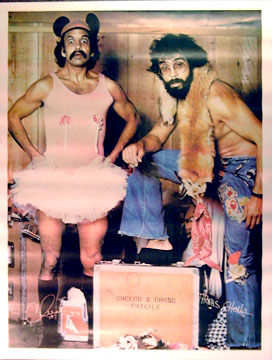
Comedy preview:
"Cheech and Chong lighting up stages again"
By Benjamin Ortiz, Special to the Chicago Tribune
Section: On the Town
Date: November 7, 2008
They were just two wild-haired vatos locos—crazy, heavy-duty dudes—who got their heads together in the '60s and decided to smoke dope and play music for a living. Along the way, they jammed with Hendrix, opened for the Stones, bopped around London with Peter Sellers and shot hoops against Kareem Abdul-Jabbar and Bob Dylan.
Mixing Laurel and Hardy with The Merry Pranksters, they created "hard rock comedy," a fusion of musical counter-culture and improvisational sketch-humor, planting the seeds for Beavis and Butt-Head, Harold and Kumar and the picaresque weed-run as epic cinematic quest.
After nine top-selling records and a Grammy, eight feature films and their ascent to pop-culture icons, followed by a quarter-century of being broken up, the hippie and the low-rider are back on the road. Richard "Cheech" Marin, 62, and Tommy Chong, 70, are passing the peace pipe for their Light Up America Tour, a flashback more than a generation in the making.
"I remember very vividly taking Cheech's hand to do a bow at the end [of our last show], and that was it," Chong says in a telephone interview. "But there was something we had together. … I guess time heals all wounds."
In separate interviews from Los Angeles, the duo confirm that they've sparked the creative flame once again, working out the artistic differences that split them up. "Even the day before we decided [to tour] we had a big blowout," says Cheech. But the tour "had to be now or never, because we're not getting any younger."
The passing of George Carlin creates a backdrop for their reunion as "foot soldiers for the cultural revolution" of their generation. As Cheech puts it, "We're the last of a dying breed."
Even their first meeting sounds like a joke: A hippie Chinese-Canadian Motown guitarist (Chong) and a draft-dodging Chicano pottery artist (Cheech) walked into a Vancouver strip joint in 1968. Cheech said their "cultural outsider point-of-view" fueled their art.
After their mid-'80s break-up, Cheech pursued a more conventional career in movies and TV ("Nash Bridges"), while Chong continued doing stand-up, with a detour on "That '70s Show" and a nine-month prison stint from a federal bong sting. Chong wrote about it in his best-selling "The I Chong" (2006), followed by this year's "Cheech & Chong: The Unauthorized Autobiography."
He still wasn't talking much to Cheech when he penned that rollicking tale of smoking pot, jamming and playing basketball with a wild cast of characters like in their movies, from Redd Foxx to Geraldo Rivera. But in e-mail exchanges moderated by his son Paris, Chong said to Cheech, "If we can't work together, why can't we just be friends?" This started them on the path to reconciliation, but there still is tension. Chong says, "My son e-mailed my response to Cheech, so it wouldn't be nasty."
Reunited, they stay focused on their work over their egos, and the pair seems to be enjoying the road. Chong says the key is "staying true to the dregs of society. When we tried to move away from those characters, we lost." Expect their new show to pair old musical numbers (like "Mexican Americans" and "Born in East L.A.") with updated sketches, blended into something like a "Latino Bollywood," Cheech says.
"In a struggling economy we're selling out every show and adding second shows without the benefit of an album or movie," Cheech adds. Upcoming projects will likely keep Cheech and Chong together into the next decade.
"We're doing a DVD of the tour, a roast for the TBS Las Vegas comedy festival and maybe another movie, maybe a stage show along the lines of 'Spamalot.' … We might make an animated video of 'Save the Whales,'" Cheech says.
FRONT-PAGE TEASER
"Got the munchies?"
Cheech and Chong have ended their feud—well, they've put it on hold at any rate—and are back on the road. Richard "Cheech" Marin, 62, and Tommy Chong, 70, are rolling along on their Light Up America Tour, a wild flashback that took a long time to come to pass.
"Even the day before we decided [to tour] we had a big blowout," says Cheech. But the tour "had to be now or never, because we're not getting any younger."
The comedy veterans are doing old musical numbers ("Mexican Americans," "Born in East L.A."), along with updated sketches—all churned up into something like a "Latino Bollywood," Cheech says. Story, page 4.
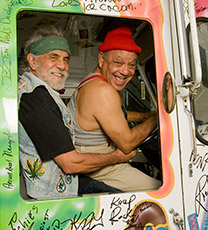
Cheech and Chong
When: 7:30 and 10:30 p.m. Saturday
Where: Rosemont Theatre, 5400 N. River Rd., Rosemont
Price: $39.50-$59.50; Ticketmaster.com
Chicago Performance Poetry (Chicago Tribune)
"Fighting words: Checking in on the sass and spirit of the city's open-mic battlegrounds
Hiss, grunt, snap—become well-versed"
By Benjamin Ortiz, Special to the Tribune
Section: On the Town
Date: April 4, 2008
Eternal poet laureate of Illinois Carl Sandburg said it from the jump of the 20th Century: My city can kick your city's butt. Just listen to the rusting, hulking lilt of Sandburg's "Chicago Poems" and you can hear a city set to brawl, a pugilist ready to hit the mark and make his name.
Our city still is ready for a tussle. A mix of ancient Greek ritual, Shakespearean bawdy groundling humor and Wild West saloon burlesque, Chicago's open-mic poetry spots appeal to a rowdy audience. Sandburg's boast bears fruit in this poetry scene that has its ups and downs yet keeps its fists up.
April is National Poetry Month, so it's a good time to check out the spirited events. If you go, be prepared for the "feminist hiss" from women in the crowd in reaction to anything sexist or wielded ironically, and the "masculine grunt" from guys getting Frankenstein-esque about lines that are instantly deemed good or bad. And if you hear stomping while delivering your verse, it's time to get better or get gone.
Poets like Carl Sandburg, Nelson Algren and Gwendolyn Brooks long ago articulated the essential myths of Chicago as a big-shoulders modernist, a city whose literary ballads to the working class define our profile every bit as skyscrapers set against Lake Michigan do. Through the first decade of the 21st Century, Chicago still stands tall as a square-jawed bard, with poetry like fighting words.
THE OLD DOGS
Hailed as the great grand-pappy of performance poetry, the Uptown Poetry Slam has been kicking at the Green Mill since 1987, the work of venerable SlamPapi Marc Smith, a construction worker who started the show in reaction to arrogant academic poetry. Bristling at the idea of having to have a degree or published work to be taken seriously as a poet, Smith brayed Sandburg-like with a big, fat "SO WHAT."
And that's how he continues to do the show—every time he says "I'm Marc Smith," the crowd joyously responds, "SO WHAT!" This and other such rituals surround the slam, like the snapping fingers and pounding feet that let a poet know the end is near, or the "feminist hiss" and "masculine grunt" from the audience that evaluate poetry on the spot.
"I always manage to make it new for myself," Smith says of hosting every single week. "I consider myself a servant to my audience." At a recent slam, Smith climbed the bar and scaled tables with signature crowd-busting vocal fanfare, backed by his Rootabaga jazz combo.
" 'Til I die," he says about slamming. "[I'll be] up there in a wheelchair doing the same old shtick." Smith invokes prairies and penthouses, smokestacks and neon skylines, littered in a long, quixotic free-verse line that feels like it could go on forever.
Competing for stage geriatrics and attitude, Weeds Tavern hosts a slam-style poetry harangue that will probably die about as hard as Smith. Weeds' arch-ritualized, bluest of Mondays includes zombielike repetition of the bar address plus the frequent, profanity-ridden refrain of just how much they "don't give a good ***damn."
Smith admits the zany stuff doesn't happen much anymore in Uptown, but Weeds Tavern is just the sort of poetry "Twilight Zone" to keep social disorder set to verse—it's a neighborhood bar without a neighborhood, a pub in search of a people. Like one of its handmade poster-broadsides reads, "Tricky, Turbulent, Tribal."
Bartender Sergio Mayora holds forth at the reading, where he's known to do the same two poems (penned in junior high) every week. Mixing aggressively juvenile anti-white protest with the equally adolescent observation that "we all came out of a hole" when we were born, Mayora declaims rapidly and robotically, usually because the crowd is busy rapping out lines from his greatest hits.
Host and Chicago poetry veteran Gregorio Gomez is a literary chameleon who regularly gets around town for Latino-themed readings at more sedate spots, but at Weeds he's all animal, with off-color jokes, remixed clichés, political punditry and off-the-wall, on-the-fly nonsense rattled out like a repo-lot bulldog howling at his own shadow.
Despite the irreverent performance style, Gomez says: "I stand for hundreds and hundreds of poets who will never be famous. I like to consider this still an underground poetry spot." Open-mic poets also get their few minutes to shine from out of Weeds' funky murk, answering the call of its carny-barking muse.
THE YOUNG TURKS
Gomez and Mayora claim poetry has been going on at Weeds since 1984, which would make it the main contender for longest-running series against the Uptown Slam. Back in the day they were buddies with Smith, even doing a few shows together before their huge personalities went in separate directions.
Like their elders, younger poets have cross-pollinated a few shows that carry the torch, especially with their openness to pure entertainment mixed in with the poetry. The '90s Chicago poetry scene hit a high point with various popular venues, and one of them yielded a slam team to compete against the vibe and verse of the Green Mill: Mental Graffiti.
Ebbing and flowing over the years, Mental Graffiti moved around venues mainly centered in Wicker Park, with a dedicated weekly hipster crowd and more of a hip-hop/urban-DJ atmosphere to match Uptown's jazz. Now in River West, the series has gone monthly, with a trio of organizers who got their chops in the spoken-word trenches around town.
Joel Chmara regularly pushes the envelope with über-ironic meta-commentary on poetry and the scene, and his self-deprecating Midwestern sort of Bob Newhart-style draws in the crowd. Chmara and co-organizer Tim Stafford work the Chicago social scene in general to draw "both cool people and poets" to Mental Graffiti. "New people we don't know show up," says Chmara, "a younger crowd and more of a party atmosphere, including an Arsenio Hall-style Dog Pound cheering section."
The multimedia PolyRhythmic arts collective has been doing an eclectic weekly open-mic in Wrigleyville for almost seven years, with roots in the old Mental Graffiti. The show—Safe Smiles—feels nicely tucked away from sports-bar-land, and yet the DJ sets, hosting and performances have a raucous, crowd-pleasing edge.
Collective member Drew Perfilio says they like to mix up the show with poets, musicians, clowns, comics and avant-garde madness.
MULTICULTURAL MISSION
Itself a monument to Chicago's greatest writers and literary achievements, The Guild Complex fosters the next generation of local poets through various programs, and its multicultural mission reaches out specifically to the Latino community with the monthly Palabra Pura series. Executive director Ellen Placey Wadey notes the need for a venue where Chicagoans who mix Spanish and English can enjoy bilingual poetry, the reason the Guild started the series in February 2006.
With definite community warmth, last month's Palabra Pura in the back-room lounge at the California Clipper featured local and touring poets, in addition to open-mic readings in English and Spanish, sometimes mixing the two. The roving series moves next to the Center on Halsted, with celebrated poets Lorna Dee Cervantes and Rigoberto Gonzalez.
In Rogers Park, poetry gets paced to the elevated train that hugs the Heartland Cafe and shoots sparks in symbolic praise of restless night. With slightly younger, 18-and-up energy, the wide-eyed literati darken the main dining room and share something between a drum circle and speech-and-drama squad experience.
Here at In One Ear may be our next great Chicago voice, struggling to the head of the sign-up list to get heard.
INFO
“In One Ear” open mic
Wednesdays, 9:30 p.m., $3, 18+
Heartland Café, 7000 N. Glenwood, 773-465-8005
Mental Graffiti
Third Mondays, 8 p.m., $5, 21+
Funky Buddha Lounge, 728 W. Grand, 312-666-1695
Palabra Pura reading series
Third Wednesdays, 8 p.m., free
Next event: April 16, Center on Halsted, 3656 N. Halsted, all ages
PolyRhythmic Presents “Safe Smiles”
Tuesdays, 10:30 p.m., $3, 21+
Trace Lounge (upstairs), 3714 N. Clark, 773-477-3400
Uptown Poetry Slam
Sundays, 7 p.m., $6, 21+
Green Mill, 4802 N. Broadway, 773-878-5552
Weeds Poetry
Mondays, 10 p.m., free, 21+
Weeds, 1555 N. Dayton, 312-943-7815
Bible Thumping the Gangbangers
"The new blood-soaked theatrics of that old-time religion splatter Benjamin Ortiz."
A young Latin loco, sagging x-large, steps with attitude up to the local rock dealer. Recognizing his customer, the dopeman pulls a sack from his pocket and shakes it like a dinner bell. "My man, Joker," he croons, "look what I saved for you special." Joker strikes a defiant pose as his homeboy creeps up behind with a drawn shotgun. "Your crew blasted my boy the other night," Joker snarls. "It's payback time, punk!" BOO-YA!
The shotgun explodes, dusting the dopeman. The audience breaks out in screams, cheers, killer thrills. Joker runs off, right when Satan and his black-robed minions arrive to haul the fresh soul away. "Help me, Jesus, forgive my sins! Aiiiieeeee!" dopeman howls. "TOO LATE!" someone in the audience roars, and the crowd busts up laughing.
Just another day in the 'hood? More like a taste of "Inner City Madness," a performance staged last Friday night by Victory Outreach ministries, a Humboldt Park Pentecostal group. Passing through a metal detector at the Kelvyn Park High auditorium, I notice that the boyz working security are all ex-bangers and knuckle-heads turned Christian. Homeboy waves me through, and I spot the placazo (tattoo) between thumb and index finger. The crowd of mostly Latino and African-American teens fills the 1,300-seat venue beyond capacity. An R&B combo on stage wails holy hype, and many respond with singing and clapping. After a call for prayer, ministers take the mic and shout out tales of prostitution, drug addiction, gang-banging, broken families, and hopelessness: "I tried everything – PCP, marijuana, heroin, LSD – but I was lost until I found the Lord." Cheers, hands lift to the heavens in praise. A Christian hip-hop set bombs the bass. "God's the original 'G'! Jesus Christ in tha houuuuuuse!" Two youngsters belt out a flow of street knowledge about the saving powers of Christ, and the divine fly-girls rip it up.
Then the play starts: BOOM! opens a cycle of violence and addiction, spiced with real weapons discharging blanks, building to a Tarantino-esque standoff between enemy thugs. When a minister breaks the tension with a Bible thrown between gun barrels, the gangs finally submit to the Gospel. Laura P. Sánchez of Victory Outreach says the play's goal is "to revive hope through Jesus as Savior." But doesn't the spectacle appeal to violent emotions with its depiction of gunplay? "You have to relate to the crowd by going to their level," she answers. The audience whoops as Satan carts away more freshly buckshot ghosts.
I leave with permanent hearing damage. But the voice of one character echoes in my mind: "What do you want, preacher? I can't read or write! All I know is the gun!" And I wonder if anyone else noticed that Jesus never appeared to answer that question.
—by Benjamin Ortiz
NewCity 9 November 1995
"Del Corazón Festival"
Since its performance space opened in 1990, the Mexican Fine Arts Center Museum has featured artists across the spectrum of time and tradition, from folkloric to avant-garde, through regular events and spring/fall festival series. This season's ninth annual Del Corazón Mexican Performing Arts Festival features a diverse multimedia lineup, including a solid musical component with two Chicago debuts.
For the first time in these parts, celebrated Mexico chanteuse Jaramar visits on May 10 and 11 at 7 p.m., bringing Spanish Moor/Christian music and interpretations of poetry by Sor Juana Inés de la Cruz and Nezahualcóyotl. Similarly, the spoken-word/jam troupe of California's Taco Shop Poets pull double-duty for the Center and the Guild Complex's "Musicality Of Poetry" series, on May 17 and 18 and 7 p.m. With contemporary groove/hip-hop style, these poets break down the fourth wall with confrontational verse culled from guerrilla performances at taquerías in their native San Diego and Tijuana.
Most Del Corazón events appear at the Mexican Fine Arts Center Museum (1852 W. 19th Street, 312.738.1503), though the standout Los Angeles combo Quetzal will unleash a fiery mix of Mexicano, R&B, Afro-Caribbean, and Chicano folk-protest music at the HotHouse on Sunday, April 21, at 7 p.m.
April 2002, Illinois Entertainer
Live Review: David Hernandez & Street Sounds
Twenty-four-year-old Pilsen poet AidÈ Rodriguez seems "stuck between cornfields and prickly pears," as she says in one of her compositions, looking down the barrel of a microphone with rows of audience on one side and her own arsenal of words on the other. She has the tough job of opening for middle-aged veteran David Hernández and his perennial spoken-word combo, Street Sounds, at their CD release party for Satin City Serenade (Street Sounds Media Group). Her poems evoke images of nopales wrapped with barbed wire rooted in Midwestern concrete, referencing indigenous and Illinois literary touchstones in the same breath. But she doesn't want to get stuck on her own words -- she just wants to get offstage so she can watch the main attraction. Her unassuming presence fits the evening's theme -- "Poets Across Generations," as the Guild dubs it -- because she is the humble rookie whom the elders always put out first to break the ice.
Though a literary lineage between Rodriguez and Hernández is never made clear, their generational differences play out best through performance personae, especially since their cultural sources (though Latino in general) are more contrasting than congruent. Hernández has staked his Chicago performative claim in the Puerto Rican community, mainly circulating in nostalgia for his upbringing in the long-since-gentrified Lakeview and Lincoln Park neighborhoods of the '60s and '70s; Rodriguez of course has no established poetic identity, but her pieces ring with echoes of Mexican 18th Street, especially in the context of her own combo -- avant-punk/poets Sonido Ink (Quieto). In that group, Rodriguez duels with her partner in spoken-word vocals, Brenda Cárdenas, while a rock outfit (including a turntablist and a former member of Los Crudos) wrings out a soundscape that ambles like a South Side barrio stroll with young "crazy vatos, rucas, punks, artfags, hippies, poetas, and musicians" (as the liner notes to their recent release put it).
Rodriguez's opening set at the Chopin is relatively tame, but that's more a function of the programming than her chops. Whether black or Latino, young poets can sometimes get thrown into the same all-purpose lit ghetto, and though the Guild Complex does a good job of integrating youngsters, Rodriguez's opener is presented as an afterthought. Accordingly, she's nervous, immobile, and recites with a typical poetic-newbie delivery. She also makes a brief, vague, and touchingly courteous reference to CDs and an anthology that carry her work; Hernández, by contrast, has the merch pitch down to an art of its own, especially for the new CD that prominently cites him as a "Famous Poet," also dubbing Street Sounds as "Chicago's Premiere Poetry/Music Group."
Certainly, Hernández is a living piece of Chicago history who has paid his dues, and the new release is as much a tribute to the city he loves as to his own respectable place in it. Guild Complex executive director Julie Parson-Nesbitt introduces Hernández with a call to make him the new poet laureate of Illinois, and the modest crowd responds lovingly to his tight, competent combo's weaving of words with smooth jazz and jÌbaro roots-folk. But his pieces speak largely to family history, bygone doo-wop days at Lakeview High School, and adventures on an Armitage Avenue that once smelled of beans and rice rather than Starbucks coffee beans. His poetry is nonetheless relevant and powerful, though the night's program (within a stone's throw of new gentrification frontiers in West Town and Pilsen) is more sentimental than prescient.
For a dialogue that really crosses generational borders and speaks to cultural continuity, the program might have paired Street Sounds with the promising Sonido Ink (Quieto), especially since Rodriguez's group also has a new CD -- Chicano, Illinoize: The Blue Island Sessions (deSPICable Records). West Side Puerto Rican salsa rock and South Side Aztechnopunk might have made for an interesting conversation, giving a dynamic sense of Chicago Latino soul and speaking to "the music of stories/ rippling from pens/ that send bassy vibrations from floor to tambor over two-flats,/ skyscrapers, liquor stores/ Our acrobatic musical scores," as Rodriguez memorably puts it.
28 November 2001, Illinois Entertainer
Make the Word Go BANG!
Lights dim, shimmer, fade, and revive - pulsing with breath as if to match the steadily roaring grumble of a capacity crowd at the Paramount Theatre in Austin, Texas. Showers of raucous catcalls pour from all walls in rivulets of rage, furor, and nail-biting tension. This 1,324-seater is sold out, and people are looking for blood like sharks who have inhaled fear, thundering like sports fans who taste a touchdown or a piledriver with hands clapping against the backs of chairs and shoes stomping on concrete. The auditorium could almost crack open and swallow itself from stage to balcony.
The crowd spews choice phrases at the slightest show of weakness, and yet they're prone to abject sing-song hypnosis and moments of crushing pathos, especially when their heroes melt under a collective magnifying glass of audience scorn. They're oddly tame when an emcee takes the microphone.
AUDIENCE: DO YOU SOLEMNLY SWEAR TO TRY TO INFLUENCE THE JUDGES' SCORING THROUGH YOUR UNBRIDLED ENTHUSIASM?
"Hell yeah!" the house echoes. But the audience is not worked up over a football game or wrestling match; they're here for a verbose brawl, a battle of wits, metaphorical bloodsport, an endurance contest fought, won, and lost with the travel of words from mind to mouth to mic to the mob.
Believe it or not, they're here for poetry.
The ringmaster has no clothes, so to speak, except for a porkpie hat and scrubby facial growth. He's the zookeeper, word pusher, the Ayatollah of Slam-ola, guardian of the poetry-temple exchange rates. New York City poetry impresario Bob Holman speaks: "Hey hey hey! Everyone wants to know how come when you get these poems up here, these THINGS of beauty, which we have asked the whimsically selected judges to adjudicate for us, that these THINGS of beauty can become their numerological equivalents - doesn't that mean that the life gets kicked out of it? Absolutely! It's a poetry slam!"
JUDGES: DO YOU SOLEMNLY SWEAR THAT YOUR SCORES WILL BE BASED SOLELY ON YOUR OBJECTIVE EVALUATION OF THE POETRY AND PERFORMANCE, AND NOT HOW MUCH BEER YOU HAVE BEEN BRIBED WITH?
Jeering whistles clash with hands clapping, but Holman devours all responses: "This is a poem that is dedicated to all of us, all the poets who have come up here, read their poems, and gotten screwed! It's called 'Why Slam Causes Pain and Is a Good Thing':
because slam is unfair
because slam is too much fun
because poetry because rules
because poetry rules
because I could do that
because everybody's voice is heard ..."
AND LASTLY, COMPETING TEAMS: DO YOU REALIZE THAT YOU HAVE GIVEN THE POWER TO DECIDE WHAT IS GOOD POETRY TO FIVE ARBITRARILY CHOSEN PEOPLE WHO WILL GET DRUNKER AND DRUNKER AS THE EVENING PROGRESSES? DO YOU REALIZE THAT THE DECK IS STACKED AGAINST YOU IN AN OBSCENE NUMBER OF WAYS? IF YOU REALIZE ALL OF THIS, WILL YOU PLEASE SHOUT WITH CONVICTION: IT'S A FUCKING SLAM!
Holman continues with inspired froth:
"because Pepsi and Nike have conflicting ideas about slam team uniforms ...
because Patricia Smith has more truth in her little finger than an entire
Boston Globe front page ...
because rap is poetry and hip hop is poetry ...
because local heroes finally have national community...
because best poet always loses!!!"
A tsunami of noise washes over the auditorium with echoes of echoes, as the lights go down and come up on one solitary mic when a disembodied voice commands:
LET'S GET RRRRREADY TO RRRRRRRUMMMMBLE!
"We gonna get it on, because we don't get along!"
- Muhammad Ali to George Foreman
I arrive at Austin's Ruta Maya cafe on Thursday, August 20, for a preliminary bout in the 9th annual National Poetry Slam. It's the biggest such event yet, with 45 teams (of four people each) competing for the grand prize of $2,000, plus 14 additional individual competitors going separately for $500. Poets from across the U.S. and Canada arrive here upon qualifying in local and regional competitions held throughout the year at home-based reading series. For many, the national slam is a pilgrimage that draws repeat contenders, but for others it's a brave, new world, as with the New York City team based out of the Nuyorican Poets Cafe, which generates new teammates every year.
Arguably, the slam's origins are co-terminous with poetry itself, but the slam as a distinctly U.S. phenomenon goes back to the '70s and '80s when hard-nosed midwestern poets experimented with taking poetry from salons to saloons. Former Chicago construction worker Marc Smith was one of those poets who helped breathe new life into poetry after experiencing stale literary and academic gatherings where the spoken word was treated reverentially, like the word of God. In dada-esque reaction, Smith and others organized events in which poets donned boxing gear and sparred in wrestling rings where they honed the art of verbal one-upmanship. Smith encouraged the crowd to voice consent or dissent with the poet's vision, or to just howl drunkenly if that's what they felt like doing.
By the mid-'80s, Smith had launched a regular weekly slam that eventually found a home at the Green Mill (Al Capone's former speakeasy, by the way). From there, it spread to the coasts, and the Chicago style of performance poetry was cross-pollinated at newly christened slam cafes and bars across the country. It wasn't long before the first national slam competition convened in San Francisco in 1990.
I think about the slam's humble beginnings when I elbow my way into Ruta Maya's packed environs full of young scribes-wanting-to-be-oracles chomping at the bit for a piece of the action. When all of a sudden, I'm asked to be a judge for this bout between San Francisco, Roanoke, and Seattle. Should I remain "objective" or dive in head first? As the constant refrain, mantra, and all-purpose disclaimer goes: it's a fucking slam!
Five judges are chosen randomly from the audience to give an Olympic-style score of 0-10 for each three-minute reading in four rounds, where each team member gets a reading slot. The high and low scores are dropped, and the remaining three judges' scores are added. Poems over three-minutes long are penalized, and group performances are allowed in place of an individual reading. Props, costumes, and music are against the rules. Reading from memory is the norm, but scripts are allowed. The team with the highest cumulative score wins. Sounds simple, right? Before the weekend is over, these basic rules will serve as the nexus of debate, division, and unbridled animosity. Protest is as much the rule as the rules themselves.
The heat is on. Literally. Poems spit forth like steaming asphalt, fast and furious, increasing the Texas humidity with lip friction. Four-time individual slam champion Patricia Smith serves as emcee and introduces the judges: "this might be the only time you'll want to applaud them." I get used to the booing and hissing as if this article has already been released to a room full of poets. "Thanks for attending this bout at the hottest place on earth," Smith jokes (she must not have visited SanAnto before). The bout closes with San Francisco on top (106.5 points), ahead of Roanoke (98.4) and Seattle (96.6).
The standout poem in this round is "Fallen Catholic Fix," by SF's Russell Gonzaga, a 29-year-old Filipino whose excitement at attending his third national slam matches his energy to win this year. We talk after the round and manage to sweat out the heat that will make poets faint throughout this weekend's tournament.
Gonzaga teaches in an after-school program for mostly at-risk youth, a background he himself shares. The slam seems to be both a channel for and target of the rage he has worked through since his gang-banging days. He talks specifically about poetry readings for the slam versus poetry readings in communities of color: "I have slam work, and I have work that I do for the community, people of color, and I keep the two fairly separate. With a slam poem, I don't get too spiritual. If I do, it's interweaved with something that's more mainstreamish, and that's the one thing that's strange about the slam: it's defining a mainstream poetry, which is kind of odd."
Addressing racial issues and other topics of importance to communities of color is a difficult if not self-defeating undertaking at the slam, says Gonzaga. "Subjecting oneself to the scrutiny of the dominant culture is one thing," Gonzaga points out, "and not only that, they're giving you number scores, which is even more problematic." Paul Devlin's excellent movie, Slam Nation: The Sport of the Spoken Word, documents the opinion at the 1996 national slam that poems on race from people of color score low. But then again, conventional wisdom says that the judges always suck, and the argument goes that the best teams are the ones who can win despite and because of this fact.
In fairness, Gonzaga admits that folks of color participate widely in the slam, and that only females won the individual competition up until last year, when Cleveland's Da Boogie Man, a young black male, won the title. But the question remains: why divide oneself between work devoted to home community versus this relatively new community called the national slam? "I'll describe it in terms of experience," says Gonzaga, "my first national slam at Ann Arbor, Michigan, walking into an auditorium filled with like 1,000 people, to see poetry! I had never experienced that in my life." Ultimately, he feels that he must support the slam's popularizing and democratizing effects for poetry.
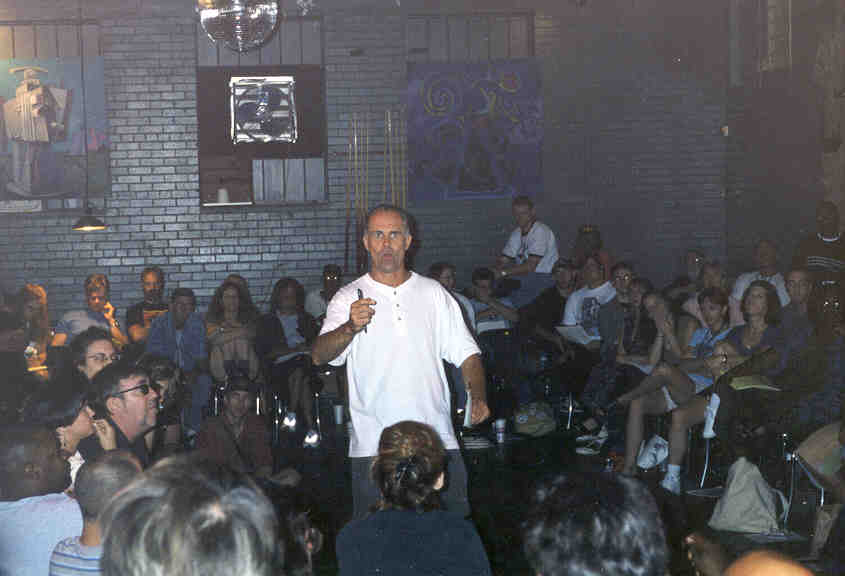
[Marc Smith, photo by Benjamin Ortiz]
Devlin's film vividly captures the glory of poetry elevated by spectator flash, as the documentary follows Team New York City on its trip to the 1996 nationals in Portland, Oregon. The film's title foregrounds the "sport" aspect of the slam, which makes sense since Devlin is an award-winning sports documentarian. But the film also does a good job of kicking different opinions around; some see the slam as a vehicle to advance literature, others see it as a poetry and performance hybrid art form unto itself, while others thrive on the slam as pure, no-holds-barred competition. Slam Nation also puts Marc Smith on camera, sagely suggesting that the slam works if it creates a community of poets.
But to get to the nationals, a year's worth of local competition is
required, with poets keeping stats on themselves and others like running
backs. Poets sometimes "riff" on each others' works, voicing criticism
often to the point of pissing each other off, and all the while provoking
each other to perform in top form like a race horse pushed to the limit,
requiring some element of strategy and even more stamina. Ultimately, the
slam is a community created by local and regional winners, who further put
the national gathering to the test of what community means and how it can
survive the contentious head butting that competition breeds.
Bob Holman, 1998 Team Manhattan slammaster (slamspeak for local
venue organizer), has been criticized and hated in some circles for
cheapening the slam and appealing to pure spectacle, as well as exploiting
gray areas (loopholes in rules). He helped found Mouth Almighty, the first
and only label devoted to spoken word artists, along with producing The
United States of Poetry for PBS and master-minding last year's Manhattan
slam team, named Team Mouth Almighty, who won the championship. His
promotion of poetry's commercial viability through corporate sponsorship
and merchandising has further been a source of controversy, with arguments
in his favor that this is merely an extension of the slam's mission: to
popularize poetry. Sometimes, his emphasis on glitz and celebrity runs up
against Marc Smith's blue collar character and emphasis on an honor system
in respecting rules.
But where does riffing cross the line between competitive edge, on
the one hand, and violation of a poet's integrity, on the other? Where does
community give way to competition, that which both brings people together
and potentially divides them? Are rules to be taken advantage of, or
respected as law? Should the slam have a singular vision of poetic
integrity, or revel in creative division? When does poetry lose its
literary value and become pure performance? And how much corporate
sponsorship is too much?
These are questions that stem from the slam and fuel its fire,
questions that will never be answered definitively. But each and every
individual's answers constitute a leap of faith in the slam that keeps them
coming back and contributing their diversity to the national community.
Community within community
Through light sprinkles of rain and ominous lightening, I travel
after the Ruta Maya bout with friends to Resistencia Bookstore, a haven of
progressive literary events proverbially situated "east of the freeway," as
in the poetry collection of the same name by raulrsalinas. At 64, Salinas
is one of few remaining elder statesmen of Chicano poetry who has traveled
extensively to create networks of solidarity between African-American,
pan-Latino, and Native-American activists.
Part of his unofficial training in political and literary struggles
comes from Puerto Rican independentistas he met while imprisoned in the
U.S. federal prison system. Given the early passing of such poets as Jose
Antonio Burciaga, Ricardo Sanchez, and San Antonio's own Jose Montalvo, the
reading for tonight will be an historic draw for Latinos from Austin and
SanAnto - Miguel Algarin, one of the founders of the Nuyorican Poets Cafe,
will headline a reading with the New York City slam team - all in "occupied
Mexico," as Algarin calls it.
Straight out of Manhattan's Lower East Side, the Nuyorican Poets
Cafe began in 1974 in Algarin's apartment, where poets of the Puerto Rican
diaspora gave voice to a new urban identity captured by the term
"Nuyorican" taken up by now-legendary poets Miguel Piñero and Lucky
Cienfuegos. The Cafe sat closed for most of the '80s but was jump-started
in 1989 after the death of Piñero, one of its co-founders. In partnership
with Algarin, Holman instituted the
cafe's weekly slam and brought new life to the venue. Ed Morales, a Village
Voice writer who has worked with Holman, charts how the cafe became popular
to the point of super trendiness under Holman's direction, and how it was
criticized for losing the Puerto Rican community base that was once the
founding principle of its existence.
"Algarin willingly allowed Holman to turn the cafe into a circus on
Friday nights when he ran the slam," says Morales. Algarin's taxing battle
with HIV and the demands of his professorship at Rutgers eventually took
his attention away from the cafe, where Holman was left to take credit for
its newfound notoriety. This was when relations between Holman and Algarin
became strained; Holman's style began to supplant recognition of Algarin,
which made for a contentious relationship. Finally, a mutual schism over
Holman's leave of absence to work on other projects got him booted in 1996
from the cafe's board of directors. Morales admits that Holman helped make
the cafe a success in the '90s, and that its original aesthetic has
subsequently evolved into the hip-hop ethos drawing the city's young black
poets.
But tonight, at Resistencia, Algarin seems charged by the energy he
shares with the next generation of Nuyorican poets on the 1998 team. With
his left arm in a cast - reportedly from a street scuffle where he
interceded on behalf of a woman being harassed - Algarin takes the stage
with a jazz combo of saxophone and coronet to interpret poems by Salinas.
"Street corner dude makes jaaazzzzz Latino sounds," Algarin intones with a
horn-trilled accent, as he simulates the cadence of congas, one-upping
Salinas's Beat-jazz sensibilities with Afro-Latino rhythms and sensual
playfulness.
"I dare Raul to come up and read these poems better," he says, in a
joking spirit of competition that forebodes the slam semi-finals coming up
tomorrow. Raul doesn't take up the challenge, but instead he shares a few
poems before urging people to buy Algarin's books and talk to him while
he's still around, before they "catch the bus" with poets who have retired
from the struggle.
An open-mic reading begins, led by New York City slammaster Keith
Roach, who introduces the Nuyorican team and a host of other slam poets who
share in the evening's festivity. A Nuyorican expatriate now on Team Los
Angeles, Gerrie B. Quickley arrives and hugs Keith Roach. Poets from
Montreal, Toronto, and Austin read until almost one in the morning despite
intermittent drizzle, sharing the calm of this community within the greater
slam community. It's the calm before the storm.
Cold comfort community
I start Friday with breakfast at El Sol y la Luna next to the
Austin Motel, where poets are dragging themselves out of bed for a feast of
events in addition to the semi-finals bouts. Team Boston's Gary Hicks, a
Christian Marxist who has a distinctive salt-and-pepper beard, joins in the
bouts today that will weed four finalists from the 18 teams who have made
the cut. "I'm in a state of existential shock," says Hicks between coffee
refills. Today's events include a head-to-head haiku slam, gay/lesbian
readings, and a "Chocolate City" showcase of African-American poets, among
many other open-mics and mini-slams. And then there's the yearly softball
game, where poets prove they're not true athletes.
But I head off to Book People bookstore to hear a reading with
Patricia Smith, emcee from the bout last night. I walk into Book People
just as the reading has started, and I notice that Smith is reciting her
"Note of Apology" that was printed in the Boston Globe following her
resignation as a metro columnist in June. Aside from being widely
recognized at the national slam as a pillar of this community and a slam
poet par excellence, she has also become known nationwide as the Pulitzer
Prize-finalist who admitted to fabricating characters and quotes in four
columns. In the note - her farewell column - the 43-year-old journalist
suggests that the ambition to achieve motivated her decision to "slam home
a salient point" from time to time with fabrication. "Finally, I'd like to
apologize to the memory of my father, Otis Douglas Smith," she reads,
continuing with slight defiance, "and that's his real name - you can check
it."
Enthusiastic cheers issue from the crowd in obvious compensation
for the sense of loss Smith expresses. She mentions the support she has
received from the poetry community: "in the end, that was really the only
community that mattered." Continuing to read poems laying bare what's been
on her mind in the wake of the Globe incident, she admits to thoughts and
fears of the worst in moments of heartbreaking vulnerability: "My penance
is that I will keep living to see myself keep dying. I can see the
headline: disgraced, ousted, sinful ex-columnist just doesn't get it. I
hide the gun on a bookshelf behind one painfully alphabetized row of poetry
volumes."
Smith takes some time to switch papers, shaken somewhat. "Perhaps
you don't understand. I am the face of American journalism slapping
journalism's American face ... I have been nationally declared a liar,
which means that this must be a lie and that me telling you that this must
be a lie must be a lie also." Light, sympathetic laughter urges Smith to
keep reading with strength, but tears form at the corners of her eyes, as
her pained voice reads on: "These are words that I can still use: fluent,
funky, anemone, android, penis, shogun, sonnet, chisel, shield .... These
are words that I can still use: petal, candle, murmur, apple, tongue,
refrain."
Now choking back tears, she forces the words to come out in a
litany, a catalogue of language she reclaims as her own: "scat, lullaby,
hands, adultery, vibrate, history." She struggles to keep the string of
words coming, and then in thick staccato: "Man did not give me this gift -
man cannot take it away," repeating this refrain to the point of
gut-wrenching emphasis, throwing her script to the ground, and finally
breaking out in tears that are met with open sobs from the audience. The
reading ends with a standing ovation and extended cheers.
Team Santa Cruz members Kelly McNally and Meliza Bañales openly
break down and cry with Smith. Afterwards, they say she's a scapegoat in a
profession where journalists misquote and make far worse mistakes all the
time. Says Bañales, "She admitted she was wrong, and it takes a very human
person to admit mistakes. It's also easy to demonize people for mistakes
because they're in a public position." From their reactions to her reading,
I wonder if they're personal friends, but McNally points out that they just
met her: "She's very open and giving, and she's given us a lot of
encouragement since we're only one of two all-female teams, and we're going
into the semis."
After the event, I head to Mojo's cafe for a caffeine refill and to
see what's happening next. I end up recounting Smith's reading to a few
poets and an east coast slammaster. The slammaster voices a different
opinion on Smith's appearance at this year's slam: "She's milking poets for
sympathy, because poets are dumb-asses. They don't read the newspapers. I
mean, what she did wasn't a mistake - it was blatant, calculated
fabrication." Pointing out that there's no need to fabricate material for a
metro column, he also clues me in to claims from the Boston Globe's editor
that 20 more columns by Smith appear to have been fabricated. What's clear
is that Smith's career turn has become something of a rallying point in the
slam community.
Jivin' with the pre-bout jitters
After the caffeine jolt, I wander over to Fringeware, a bookstore
next to Mojo's, and run into Bob Holman chewing the fat with an old friend
of mine, Reggie Gibson. The 1996 film Love Jones was based loosely on
Chicago's black poetry scene and featured poems by Gibson, whose
rhythmystical lyricism was a main source of inspiration for director
Theodore Witcher. Reggie has a bout this evening as part of Team Bellwood
(a Chicago satellite) and in the individual semi-finals, so we talk about
his strategy until a semi-finals update is posted in the windows of
Fringeware.
Very bad news: a computation error in scores has completely
rearranged the semi-finals bouts. Two teams, Santa Cruz and the Ozarks
(Arkansas), have been cut from the semis given the corrected scores, while
Manhattan and San Francisco's Mission District team have joined the semis
bouts - all only a matter of hours before the bouts begin. I notice Russell
Gonzaga looking at the update. "This is bad - this is so very bad," he
mutters exhaustedly. His San Francisco team will now go against Cleveland
and SF-Mission District, whose slammaster is one of his teammates.
Gonzaga mentions the possible conflict of interest his teammate,
Tarin Towers, has between her SF team and the Mission District slam, which
she organized to produce their team. He also claims that Team Mission
District formed when individuals didn't make the San Francisco team, and
suggests that their representation of the Mission District (a once
predominantly Latino neighborhood newly gentrified) has negative racial
overtones. Team Mission District member Daphne Gottlieb tells me later that
the team formed legally under slam law, which 1998 National Poetry Slam
co-director Phil West confirms. According to West, the local Mission slams
did happen after the San Francisco slams, but Towers had contacted West
prior to the San Francisco qualifiers and approved the formation of a
Mission Disrict Team.
"It was known that both teams would be appearing at the nationals
for at least a month," says Gottlieb, "[and] the Mission team thought that
any conflicts had been ironed out prior to departing for Texas." But
Gonzaga maintains: "There remains doubt as to the truth of their claims of
having an open slam. Some sources in SF have told me that there were no
qualifying open slams for these spots, and that they never intended for
there to be any ... I, and others, are convinced that there were no open,
advertised, public slams to qualify the three other spots on the team
[aside from the fourth spot slammed by Lauren Wheeler]. I voiced my dismay
with my team and the slam master [who] told us that the team was registered
and we could not protest the team unless we were directly affected by them,
in particular ... I was content with this, being fairly sure that we
wouldn't have to compete against them."
He moans, "I don't want to do this round," but his teammate Omolara
consoles him and says "we knew this bout could happen, and it's no big
deal." Gonzaga doesn't seem convinced.
Back at Mojo's, an impromptu reading has started as poets from the
Chocolate City showcase spill out of the cafe. Reggie Gibson, Cleveland's
Da Boogie Man (who is sitting out this year's competition), Kent Foreman
from Team Bellwood, and others are sharing a circle of poetry like family
reunited, and the call-and-response style of some poets creates an
evangelistic revival atmosphere. Which reminds me: poets just can't get
enough of poetry. This goes on for a few hours, through the mugginess and
threatening storm clouds, until Gibson announces, "Oh shit! It's time for
semis!"
Smash-mouth poetry comin' at ya!
The math error now pits Albuquerque against Manhattan against
Bellwood, a bout that should prove to make poetic sparks fly with the
talent lined up, and so I'm at Blondies, a skate store, where Albuquerque's
Kenn Rodriguez is flexing for the match. He doesn't seem visibly worried
about the re-match with Manhattan, who beat Albuquerque last year. "If you
want to win the national championships, you got to beat the nation," he
says matter-of-factly. He mentions the corporate taint to the Manhattan
team, since they were sponsored by Mouth Almighty Records while other teams
had to hold fundraisers to scrape up money for nationals. And then there's
the infamous incident last year when a Team Mouth Almighty member simulated
a penis by using a belt buckle suggestively, which tested the prop rules
but drew no penalty.
"We're a pretty poor team, so if anybody should hate them, it's
us," says Rodriguez, "because we're from one of the poorest states in the
nation. But you can't go at it that way. Last year, we were built up with
hate, because a lot of people wanted us to beat them, but it didn't help us
at all - in fact, it hurt us." He sums up by saying that Albuquerque will
feel good about the bout if they perform well with integrity.
Team Bellwood's Chuck Perkins, on the other hand, is in a state of
agitation. "I'm an ex-football player," he grumbles with playful, mock
menace, and he looks the part with his shaved head and Fridge-Man frame.
"There's terminology we use as ball players, like smash-mouth football. So
I'm out to let that transpire to poetry. I want, like, smash-mouth poetry -
I take no prisoners. I don't play, and that's why I dropped out of grammar
school: I didn't like recess." He busts up laughing and breaks from his
act, still talking about how a poet can step up to the mic with venom and
leave the stage sizzling. He's here for the pure sport of it - that, and
the wine, women, song, and such that the national slam entails.
But it's time for Perkins to show us the money. The teams draw for
order, and the emcee skips through the spiel repeated prior to every bout:
"A perfect score of 10 would be an earth-shattering text performed
perfectly, and a zero would be the worst poem you could possibly imagine
performed by someone who should not quit his or her day job."
Manhattan's Beau Sia takes the mic first and works himself into a
frenzy with a piece he read in 1996 finals: "When I get the money, I'm
gonna have iced monkey brain in Madagascar with Uma Thurman and Spock, and
me and Tarantino are gonna buy the bones of Bruce Lee and put them in a
movie called THE BONES OF BRUCE LEE ARE ALIVE ... and I'm gonna be the
Asian male hustler on the Real World [on] Mars, and I'm gonna do sold-out
haiku poetry jams in Vegas! ... when I get the money, I'm gonna own MTV,
and sure, money can't buy you love, but love can't buy you shit!" Manhattan
partisans whoop it up, urging him into more and more of a rabid recitation.
Different sides of the room ring with applause when the teams
rotate and poets step up, while coaches mark time with stop watches and
hold up color-coded cards to let the emcees know who's on next. Albuquerque
takes the stage with a group poem: "From where I'm sitting, I haven't seen
any poem that can make me feel safe at night ... I haven't seen any poem
that could feed, bathe, or clothe a homeless man." Syncopated voices switch
off between the four team members lined up: "I haven't seen any poem that
could stop police dogs from ripping chunks of flesh off a ten-year-old
boy." Neck veins and pressured eyes bulge, as they comment on their
situation as poets, with dangerously close judgment of their own craft:
"when are we going to stop talking assertively and start acting
assertively? ... when are we going to stop posturing behind staticky
microphones and finally start getting our pristine hands dirty? ... I've
never seen any poem that could stop oppression ... but I am ready and
waiting with an open heart and open mind."
Manhattan comes back with a team piece pairing Amanda Nazario and
Beau Sia. In the performance, Nazario tries to convince Sia that he's gay,
while Sia adamantly professes his heterosexual love for her - until she
asks, with the microphone demonstratively used for emphasis, "would you
love me if I had a dick? ... If I was a man, and I had a dick, you'd touch
my dick?" Sia follows through the logic and breaks down, with Amanda
congratulating him on his admission.
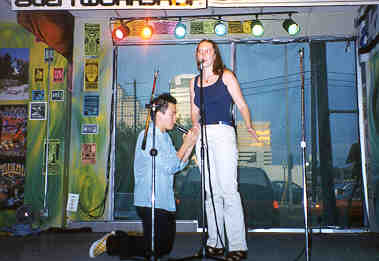
[Amanda Nazario and Beau Sia from Team Manhattan, in Austin 1998, photo by Benjamin Ortiz]
The round stops, as the emcee announces a protest lodged by someone
in the audience: possible violation of the prop rule. Someone from the
audience utters, "sometimes a microphone is just a microphone." The emcee
adds that Nazario's performance slot was mostly taken up by Sia, and that
the authorship of the poem is in question which makes for another protest
by Albuquerque; Manhattan might have violated the authorship rule.
While the protests are being discussed, Bellwood's Dan Ferri takes
the mic with a touching, meditative piece inspired by his work as a
sixth-grade teacher, speaking to the precariousness of young minds and
energy: "a room full of boys is a box full of mouse traps with a ping-pong
ball set on each spring aching for release ... girls circle, gathering,
dancing new molecules, negotiating solar systems - they are a tag team of
young Venuses, I am a weakening sun." After his reading, a friend of Team
Bellwood whispers to me that he should have read "The Bald Guy," a
crowd-pleasing take on Ferri's hairlessness. The judges score the piece,
which hovers around 8.7. Ferri walks out of Blondies with heavy emotion on
his face, recognizing that Bellwood won't come back from this blow.
The emcee gives a protest update, mentioning that Sia's
participation in the duet is legal if Nazario is the primary author of the
poem. On the prop protest, he reads from rulebook: "Generally, poets are
allowed to use their given environment and the accouterments it offers -
microphones, mic stands, the stage itself." Interestingly, he doesn't read
the part stating that the rule's "intent is to keep the focus on the words
rather than objects."
The bout continues with round four and another group poem from
Manhattan. "This is the great first line which sets the tone of the poem,
grabs your attention," they announce while tag-teaming on lines in
self-referential commentary, "And this next funny line doesn't let you down
- no, no, it's funnier than that first line! ... You see, the gist of the
poem is we're writing a generalized poem because, because who can be
specific about a topic like 'blah blah blah'?" They seem to respond to
Albuquerque's impassioned plea for politics: "when suddenly the poem got
political," they exclaim, while droning "POLITICS POLITICS POLITICS"
repeatedly, adding "Knock-knock, who's there? Emotional manipulation,
snappy one-liners ... leaving no button un-pushed - family: I hate my
father, I love my mother, I miss my sister!" With playful mocking of other
poems, they close: "This is the end line that makes you cream your pants
... throw your panties on stage, and: fuck me after the show!" Howls,
jeers, and semaphore of hand-gesturing incredulity burst from the crowd,
but the scores are in: Manhattan with 110.3, Albuquerque with 109.3, and
Bellwood with 106.8.
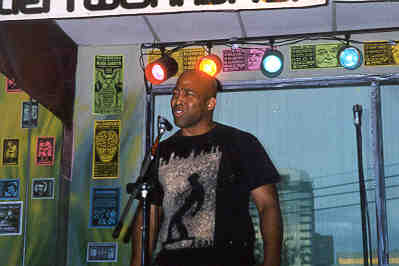
[Chuck Perkins from Team Bellwood, photo by Benjamin Ortiz]
An exodus of poets meets a crowd waiting for the next semis bout,
and as I make my way outside I notice Marc Smith surrounded by a gaggle of
poets evaluating the prior match. "It's not about the writing anymore,"
says Smith, "it's about how many different ways can you say 'suck my
dick.'" I walk away with Dan Ferri and Reggie Gibson, who console each
other. Ferri is visibly upset, but enthusiastic: "We did what we did with
integrity." Gibson answers, "I was so glad you dropped that piece! You
nailed that motherfucker!" Ferri agrees, "I wouldn't have been able to
forgive myself if I had read 'The Bald Guy.'" Ferri is talking about
nailing points versus staying true to the word. This is the double-edged
sword of combining poetry with performance, iambs with slams, writing with
shucking & jiving. A fan comes up and says, "your writing blew away
anything around you - you guys should have won," and the Bellwood boys seem
consoled.
It ain't over 'til it's over
I'm at the Electric Lounge, the home of Austin's local slam, for
the individual competition semi-finals. The place is packed, and few chairs
are available to the mostly standing audience. Organizers have brought up
an interlude of mariachis for "local flavor," and I have to excuse their
ignorance to the truly Tejano sounds of conjunto because the mariachis are
doing a cookin' version of "Jailhouse Rock." Chuck Perkins grabs my tape
recorder so he can mock-interview some ladies, and so I head out to the
parking lot where poets are mulling over the semi-finals wreckage.
I marvel at the variety of backgrounds, persuasions, identities,
political viewpoints, and professions from around these states represented,
as folks sit on concrete abutments and talk shop. Congratulating Keith
Roach on New York's triumph in their last bout, Albuquerque's Danny Solis
also seems to comment on Team Manhattan when he says, "I'm so tired of this
soulless pop culture bullshit Real World MTV crap." A few minutes later,
Bob Holman walks by Keith Roach, and they shake hands like old buddies. As
I walk back into the lounge, Tarin Towers rushes the door, citing a
"security problem."
I squeeze my way back just in time to see scorekeepers tabulating
maniacally as people from the crowd jump to correct math errors. Reggie
Gibson takes the stage next, as he dedicates the following poem to James
Marshal Hendrix: "Burn it down, burn it down, burn it all the way down,
Jimi, make us burn in the flame that became your sound, Jimi, grabbing ol'
Legba by his neck forcing him to show you respect, hoochie man coochie man,
strangle him coochie hoodoo man, wrangle him voodoo child ... and the
purple haaaaze ran through your brain and drained into the veins of
trippers, daytrippers turned acid angels by the gift of little wings from
you ... and the musing brews of your sadomasochistic blues would ooze
through pores and LSD doors ... one more time before it's your last time,
brother ... TO DIE YOUNG, TO DIE HIGH, TO DIE STONED, TO DIE FREEEEEEEE."
He repeats this last refrain and wails into an air-jammed guitar
simulation, as the crowd jumps from their seats to affirm Gibson's ultimate
number-one standing going into finals.
Back in the parking lot, poets sit in circles with backpacks like
cashed-out ravers, while New York and Albuquerque team members discuss the
protests against Manhattan. New York City's Stephen Colman mentions to
Danny Solis that he once saw Beau Sia perform the duet from the semis bout
as a solo piece, which would bolster Albuquerque's protest that Sia broke
the rules by being primary author of two poems performed. The discussion
gets heated when Colman says he doesn't want to get involved in the
protest. Solis yells "fuck you," as teammates restrain him and try to cool
down the argument. Kenn Rodriguez later tells me that "it's not about us
getting into the finals. I think the Albuquerque team would gladly sit it
out if that's what the slam community wants, because for us it's about the
integrity of the slam and its rules."
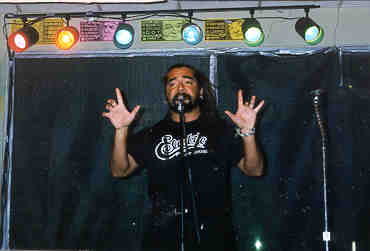
[Danny Solis from Team Albuquerque in Austin 1998, photo by Benjamin Ortiz]
On another front, Russell Gonzaga shows up with worry written all
over his face. It turns out that his match with the Mission District and
Cleveland turned into a score-settling blowout, after an attempt at a
formal protest against the Mission District failed. Deciding to read a poem
titled "Goodbye Kiss to the So-Called Western Civilization" especially for
that round, Gonzaga started off by saying "fuck the points - this is
personal: so-called 'Mission District team,' your deceit has broken my
heart," and ended the poem with "I will make you wish you were never born."
The poem went way over time, which destroyed San Francisco's chances to win
- though Gonzaga had learned that numerically the two teams had little
chance of making it into finals anyway - and some of his own teammates
cried as he read the poem, which was perceived by Mission District female
teammates as a real threat of rape and physical harm.
The Mission District's Eitan Kadosh argues that the poem itself was
a violation, commenting that "During the course of his meandering piece,
describing how much he 'hated the Mission Team,' he explained, in explicit
detail, how he would come into our homes and tie us to our beds, while
carrying out assorted acts of violence."
Others, including Kelly McNally of Santa Cruz, suggest that Gonzaga didn't
mean his poem as a real threat. "What I witnessed that night was not a
'threat to rape and cause physical harm,'" says McNally. "What I saw was
the performance of a horrifyingly well-written poem that was designed to
elicit a response of emotional pain, which it did entirely too well, using
graphic images of metaphoric violence."
Regardless, Gonzaga has gotten himself barred from walking into the
Electric Lounge tonight, and he says that Mission District teammates have
called the police. While we talk, Tarin Towers walks out, and Gonzaga tries
to call her over to explain himself, but she turns around and walks back
into the lounge with a hurried pace. Mission District teammates will later
stay up all night worried for their safety at the slightest sounds down the
hallway of their hotel.
Slammin' Super-8 style
I, on the other hand, will stay up all night in a search for even
more poetry. Chuck Perkins insists on checking out the Super-8 Motel, where
Team New York City is reportedly chilling poolside. We head out with Da
Boogie Man and Cleveland slammaster David Snodgrass, a 29-year-old
industrial machinery worker with stringy hair sprouting from underneath an
oily baseball cap. It's about 1:30 a.m., and Boogie repeatedly gets calls
and answers pages from Ohio on his cellular phone. "What's up?" he answers.
"I'm at the national poetry slam, dog, like I told you!"
When we arrive at the Super-8, some folks have already dipped into
the pool, but they gather to start a round-robin reading. Poets riff off of
each other reciting treatises from memory, and Team Montreal's Debbie Young
says, "Damn! We're some poetry fiends here!" Just when I'm about to nod off
in a parking lot oil puddle, another poem starts up. The reading goes on
until about 5:30 a.m. when Kenn Rodriguez arrives with Albuquerque
teammates. He's back from the protest meeting, where Manhattan was found
free from penalty. Kenn looks like death warmed over, and neither team has
made it into the finals.
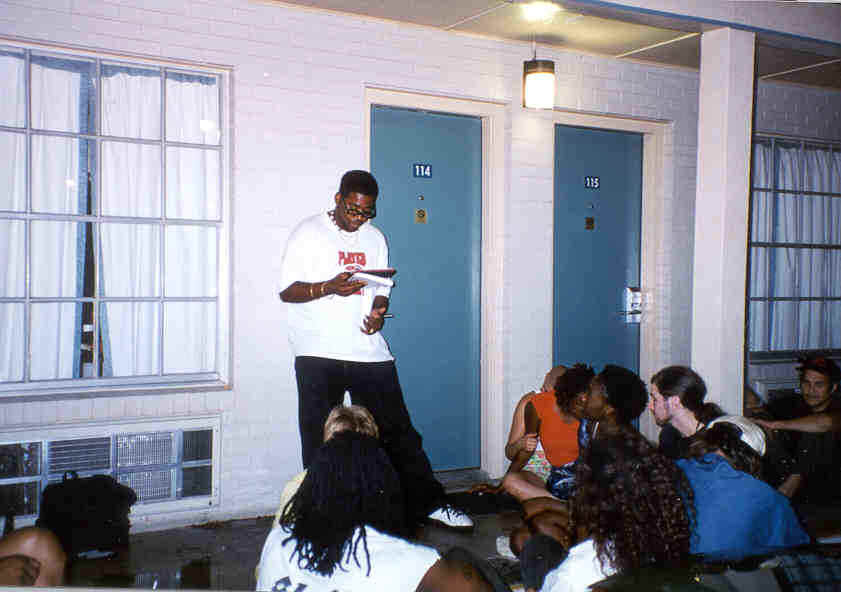
[Da Boogie Man from Cleveland, slammin' at the Super 8, photo by Benjamin Ortiz]
The republic rolls out of bed
Despite last night's revelries, everyone convenes at the Electric
Lounge at 10:30 a.m., dodging the light spritz that becomes a lawn watering
and later a downpour. Every participant is welcome to the slammasters
meeting, one of two yearly gatherings to decide rules and take care of
business. The other meeting happens in the spring in Chicago, where the
National Slam Executive Council presides. But this meeting is where
democracy in the fullest sense takes precedence, where every participant
can voice concerns and vote on immediate business. Less a formal convention
than a measuring of the communal vibe, this meeting is meant to take care
of the bad blood and conflicts that have come up before the slam heads into
finals tonight, where Los Angeles, New York City, Cleveland, and Dallas
will be competing for the championship.
Over bagels and coffee, participants take turns going around the
room to pose questions about what qualifies as an ongoing venue and what
qualifies as a team. Marc Smith, president-for-life of the national slam,
explains regulations in his down-to-earth nasally rusty Chicago accent. He
expresses discomfort with the idea of creating more rules on top of rules,
which is against the spirit of the slam.
Suggestions are made to hire independent auditors to eliminate math
errors. As comments go around the room, someone voices a hopeful "Peace for
all poets." Everyone responds enthusiastically, but reports follow of slam
poets serving as judges in some of the bouts, a possible violation of the
slam's honor system. More suggestions: David Snodgrass calls for opening
the national budget to scrutiny.
The issue of stripping during a performance is brought up, since
the option is not available equally to women as to men. That's when Team
Austin's Genevieve Van Cleve lodges a complaint against Clebo Rainey, a
Team Dallas member who ripped his shirt off during a semi-finals reading of
his poem "Rarefied in Arkansas." Taking her own shirt off and standing
topless, she reads from a statement in an emotionally charged voice: "in
all his rarefied glory, no one would accuse Clebo of using his breasts to
get a better score or a better job. I know, the slam is not responsible for
righting the inequities of our culture ... however ... we must assure that
our words are not enhanced or underscored by a nakedness not available to
the entire community ... I swear, if that shirt equaled two-tenths of a
point, if that shirt had stayed on my very very good friend's body, I might
be on the stage at the Paramount tonight performing poems ... The prop law
needs to be changed at slammaster's in the spring."
In her comments, she suggests that Team Dallas benefited unfairly
from Clebo's stripping, though Team Austin member Ernie Cline comments, "We
lost to Dallas fair and square. The opinions Genevieve expressed about the
competition being unfair are her own." Regardless, Van Cleve's statement
opens a floodgate of issues to debate, including the prop and costume rules
and whether a new rule needs to be made. Marc Smith breaks in: "This is a
scenario where part of our community has to be sensitive to other parts; we
have to listen to what the women are telling us." Attention then turns to
Rainey, a black-clad potbellied musician-turned-poet who drawls in
response: "last year at slammaster's meeting this came up, and I stood up
and said to everyone, 'Just tell me what the fucking rule is, and I'll do
it.'" He mentions also that he had the poem and his stripping approved by
slam officials before he performed it. But for tonight, since the issue has
forced his hand, he'll perform "Rarefied" without stripping, as a gesture
of concession to Van Cleve and Team Austin.
Cheers follow and die down when Russell Gonzaga raises his hand to
speak, apologizing to Team Mission District: "I'm so sorry for what I did
last night ... I turned it into one of the worst experiences that I ever
had with poetry." He apologizes to his own team as well, and admits that
his actions were inappropriate. Applause meets his apology, and afterward
people congratulate Gonzaga for his admission. One poet says that she had
been similarly insulted at a prior slam, but that no one had apologized to
her. Gonzaga accepts comments with a weary, defeated look.
Before the meeting moves on to deciding sites for subsequent
nationals, Danny Solis makes a statement: "This is a feast, and when you
have a feast, wolves will come. Some people want to make a living off being
in the gray area. So be it. But I think we need to ... eliminate those
areas as a family, so we won't be dishonored and exploited ... I invite
everybody to put everything aside - if you had bad experiences, enjoy
tonight."
Someone follows up with the comment, "watch what you say to the
press, because nothing is off the record." He cites past coverage that
painted the nationals as an orgy of sex and drugs. "Don't let them paint us
as degenerates!" From the back of the room, a chant goes up: "We are
degenerates!" As I walk out to catch some fresh air, I notice that Dan
Ferri has a T-shirt on that reads: "The points are not the point; THE POINT
IS POETRY." Plato wanted to cast all poets from his republic, but what
about a republic made entirely of poets? This republic has met its on-going
crisis of legitimation, and has survived. Just in time for the finals
Meeting the master
Amid waves of chaotic aural overload, a jelly-roll-shaped white guy
in tights and a lucha libre Mexican wrestling mask with thick-framed
glasses holds up an individual slam championship belt heavy with fake gold
plating as the Paramount crowd roars to see El Poeta (as this year's mascot
is known) get down and dirty with the rest of the poets. Skimming camp
humor from Mexicans rankles me a bit - especially since El Poeta's Boston
accent mangles the pronunciation of his Spanish name - so I head out to the
lobby, where rent-a-cops are watching the doors like attack dogs. I manage
to convince them to let a few recognizable poets in without hassle.
Outside, faces are pressed with distortion against the glass doors,
as rain falls over an impromptu poetry reading with poets holding up a
banner that reads: "YOU HAVE THE RIGHT TO BE LOUD." The banner mixes with
cardboard signs announcing the need for an extra ticket. And there's
scalpers - people scalping tickets to see poetry!
Back in the auditorium, a pre-competition poetry showcase includes
Amanda Nazario and Beau Sia doing the protest-drawing piece from
semi-finals. Before they can start, someone yells "NO PROPS!" This audience
hasn't necessarily been following the whole event, so this comment is lost
on most, though it doesn't pass without scattered snickering.
Phil West emcees the first few rounds of the team competition,
looking dead tired with the demands of keeping the slam running. After the
first round, New York City leads with 28.3, while Dallas follows (28.1),
with LA in third (27.9) and Cleveland trailing with 27.1. The second round
begins without missing a beat.
Dallas steps up with a group piece on phone sex, verbally and
physically simulating spankings and masturbation: "I'll jerk you off with
my words." In an interesting juxtaposition, New York's Lynne Procope
follows with commanding presence and gravity in her words: "We be
pretenders, pretenders to the position of prophet, we don the mask of poets
late at night, and between the smokes of the lyrical jokes we slam up on
this mike." Her serious tone plays off the hoots and hollers from the prior
piece: "we forget that this shit goes beyond Gil Scott, it goes beyond that
grand slam finals pot, this goes beyond all these half-ass rhymes you've
long forgot ... everything we say must be the truth, because the innocents
are listening, and it will all be held against us, which we do not hold for
ourselves ... do you know the definition of your revolution, or are you
just pretending when you step up to this mike? One-two, one-two: this thing
is on."
At the end of the second round, positions have shifted slightly:
New York at 57.3, LA with 56.8, Dallas with 56.6, and Cleveland still
trailing with 56. Tension is high, but an intermission follows with poets
pouring into the lobby for drinks or outside for smokes. Vancouver's swank
Ms. Spelt, a pale skinny boy, shows much love in the lobby with his taffeta
skirt, boa, and silky dinner gloves. Delirious embraces are exchanged, and
hallucinatory sleep deprivation makes for an edgy vibe when poets file back
in for the individual finals.
Marc Smith takes the stage to emcee, saying "My name is Marc
Smith," greeted by a resounding "SO WHAT!" Patricia Smith joins him to
handle the six indie finalists who will go two rounds each for the
championship. Derrick Brown, from Laguna Beach, goes into an abstract
absurdist piece that thrills the crowd with its suggestive rhythm: "I am
the punk in your trunk and the if in your riff and the or in your gasm ...
I am the tears extracted by Johnson & Johnson, I am the cuts on the fists
of Mr. Charlie Bronson ... I am the last thing JFK tasted." Brian Comiskey,
a roofer from Boston, reads a softly compelling poem on stealing car
stereos and how he became a poet - "the poet who once stole songs." Reggie
Gibson repeats his Hendrix poem to a standing ovation and shouts of "10!
10! 10! 10!!!"
In an under-rated performance, Vancouver's Cass King takes the
stage and endures catcalls at her appearance: "Nice dress baby!" She opens
with a rendition of "The Girl From Ipanema": "and when she passes, each one
she passes goes: 'HEY MOMMA, YO MOMMA, COME ON, WHAT'S UP BAAABEEEE!"
Strutting and dancing around, she explodes into a cabaret-style scat like
she was expecting to get heckled and had her words ready to counter, with
the crowd clapping along to her rhythm and rhyme.
In the second round, Roanoke's Patricia Johnson expresses the most
volatile engagement of racial issues yet, bringing up the incident in
Jasper, Texas, and her own cousin's violent death, challenging the audience
to right wrongs and be accountable. Her poem goes crushingly over time and
dooms her to last place, but Patricia Smith notes: "Sometimes you got poems
you just gotta do." She also mentions that journalists Molly Ivins and Dan
Rather are in the house. Cheers and cross-cheers fill the house, with the
audience taking sides on who should win, but the championship ultimately
goes to Reggie Gibson, with Derrick Brown in second, and Brian Comiskey in
third.
"This is sadistic," says Marc Smith, "we got these other teams
backstage waiting to come out!" They've been waiting for over an hour,
strategizing and deciding which pieces to throw at the crowd, anticipating
the other teams' moves. Guy LeCharles Gonzalez brings another engaged poem
from New York: "Mumia's plight is a hollow slogan to hook a poem on / as
the revolution is compromised by wannabe rap stars disguised as slam poets
/ pandering to the crowd / telling them what they want to hear / instead of
what they need to hear." It's an incredibly gutsy poem to read in a house
full of slam poets, especially with randomly picked judges, since Gonzalez
seems to take the whole slam to task for the art it produces: "You're not a
poet, you just slam a lot / cram a lot of senseless rhyming / soulless
pantomiming / saying shit like Tommy Kills-niggers / 'cause it's always
fashionable to lay blame elsewhere / especially if it'll get a laugh and a
couple of extra points." At the end of the third round, New York is still
on top with 86.5. Dallas follows with 85.7, then LA with 85.6, and
Cleveland with 85.3.
In the final round, Dallas comes back with a group poem: "Look, up
in the sky! It's a bird, it's a plane, it's a bad motherf - SHUSH yo mouth!
I'm just talking about my black superhero, baby!" As the piece progresses,
they go through archetypes for a black, redneck, and gay superhero, as with
the redneck: "I'll clothe myself in black, expose my butt crack, and walk
with the swagger of Johnny Cash!" Rising euphoria of the crowd makes the
house feel like everyone should jump on stage and join in the fun, and
rumbles of "10! 10! 10!!!" delay scoring. Team Dallas's GNO rushes across
backstage like he's flying during the cheering, which draws cries of "Team
Dallas is trying to influence the score!" No matter: Dallas scores a
perfect ten.
But it's not over yet: for New York City's final entry, Alix Olson
rushes the microphone, not letting the chaos die down from the Dallas
reading. Slightly hunched over and jabbing with her free hand, Olson
snatches the mic as if she wants to catapult her poem off the vibe from the
former piece, reading with furious energy: "it's a remote control America
that's on sale 'cause standing up for justice can't compare to 'I can't do
it from a lazy chair' ... we're closing out this country the way we began,
so step up for the hottest selling commodity - that's right, no waiting
lines for HIV - condoms and needle exchange, they're a hard-to-sell thing
for the right wing, so if you're a junkie or a fag, rent to own your own
body bag - now, while America's on sale ... with buy one shmuck get one
shmuck free in the capitalist party, and there's nothing left to get in the
way, of a full blue-light blowout of the U-S-of-A, there's a know-nothing
back guarantee, a zero-year warranty when you buy this land of the freetos,
ruffles, lays - this home of the braves, the chiefs, the reds, the slaves,
so call 1-800-IDON'TCAREABOUTSHIT or www.fuckallofit to receive your credit
for the fate of our nation ... where the almighty dollars sparkle and shine
in the Starbucks land, I'm proud to call it mine, but America's selling
fast, shoppers - buy it all while you can, 'cause America's been downsized,
citizens, and YOU'RE ALL FIRED."
The scores pile in, and poets mob the stage when New York takes
first place with 116.2, with Dallas in second (115.7), Los Angeles in third
(115.1), and Cleveland in fourth (114.9). Debates will continue to rage
through the coming year about rules and definitions of poetry, and the
conflicts will never entirely be resolved. But the question, as Cass King
put it, remains: "I know it's entertainment, but is it A-R-T - is it
AAAAAART?" That's the leap of faith. But in this auditorium, through the
agony of defeat and the grandeur of victory, all of that has been put to
the side. These slam poets - the new griots, storytellers, shit talkers,
neighborhood sages, and village idiots all - replay and relive the communal
underpinnings of the spoken word. On this stage, they meet their maker, and
this moment is pure.
September 1998, San Antonio Current, Word: The Monthly Guide to the Arts in Dallas, and LiP Magazine