"Sex, Drugs & Video" (Café Magazine)
"Sex, Drugs & Video"
By Benjamin Ortiz, for Café Latino Lifestyle Magazine
August/September 2010
The buxom bombshell named Sabrina Solano stops her man Chuy drop-dead cold with impeccably arched eyebrows and a sizzling point-blank glare, as piercing as an actual bullet. “Even the worst of men has someone who would cry for him if he died,” she gasps.
Sabrina’s words prove prophetic when Chuy and his partner, Mauricio, brutally execute their rich kingpin rival, the ruthless Oscar Solano – Sabrina’s father. But Chuy makes the mistake of falling for her.
In a reckless blaze of pistol fire and automatic blasts that fill the streets with shells and gore, the partners dodge ambushes and out-drive the Federales, even faking their own deaths to fool the cops. “From here,” Chuy says philosophically, “you end up either dead or in jail.”
But right when it looks like they’ve escaped, Sabrina guns down Mauricio and mortally wounds Chuy in a double-cross they didn’t see coming. As Sabrina walks away with all the cash, the credits roll while a ballad kicks in, retelling the story of Chuy and Mauricio. Their exploits now live forever in song and on screen, in the movie “El Chrysler 300” (2009) by Mexican director Enrique Murillo.
Welcome to narco-cinema, an endless chain of B-movies that has come out of Mexico for decades, from “La Banda del Carro Rojo” (1978) that featured Los Tigres del Norte singing “Contrabando y Traición,” to the parody of straight-to-video, on-the-fly, cheap, absurdist shootouts in Robert Rodriguez’s “El Mariachi” (1992). Offering home video for the large portion of Mexico that can’t afford to go to a movie theater, these high-octane action flicks have long been considered disposable fodder for the masses.
But with the consolidation of the Mexican drug trade last century and its more recent up-tick of violence, corruption and a grisly body count, narco-trafficking has become a subject for mainstream treatment on both sides of the border. From its influence in American movies (“Traffic,” “No Country for Old Men”) and TV shows (“Breaking Bad,” “Weeds”), to big-budget television series that are busting viewing records in Latin America and the U.S. – and now to award-winning narco-novels – narco-cultura is reaching global audiences, reflecting the reality of the trade, its villains and consumers who just can’t get enough.
It all started, really, with the creation of the border, the forging of modern Mexico and United States in a dialectic relationship of power and domination. In consolidating its boundaries and commerce, the U.S. found it necessary to guard the border against fugitives from the law, deserters, revolutionists and those trading without sanction. By the early 20th century, folk minstrels started singing about smuggling, banditry and illegal crossings in the Mexican corrido ballad tradition whose roots stretch back to medieval Europe and the legend of Robin Hood.
RIGHT FROM THE HEADLINES
Reflecting on the current state of the drug trade, musician and corrido expert Elijah Wald thinks narco-trafficking and its culture are here to stay. “I don’t see any possibility that Mexico can solve its drug problems,” Wald says, “as long as the United States is next door with the kind of money that’s over here and the kind of demand that there is for drugs.”
Wald, author of “Narcocorrido: A Journey Into the Music of Drugs, Guns, and Guerrillas” (Rayo, 2002), first heard of this ballad tradition as a peace observer with the Zapatistas in 1995. He points to Los Tigres del Norte’s 1997 double-CD, “Jefe de jefes,” that included songs about politics, drugs and the plight of Mexican immigrants in the United States as an example of how the corridos rip stories right from newspaper headlines.
“I was listening to [“Jefe de jefes”] over and over,” said Wald, “and just got to thinking that it really was, I thought, the most complex and interesting literary document of present-day Mexico, and nobody was treating it as serious literature. It just began to strike me that when anyone talked about modern Mexican literature or poetry, they talked about Carlos Fuentes and people like him, who, frankly, a tiny, tiny proportion of Mexicans are even aware of his work, and they never talked about people like [corrido composer] Paulino Vargas, whose songs everyone in Mexico knows, whether you like them or not.”
Regardless, the Mexican government has succeeded in banning many of these songs from radio play. Even though narco-traffickers themselves sometimes commission corridos and even fund some of the B-movies that end up adapting songs to the big screen, Wald says blaming the drug problem on art is simply posturing. Despite censorship, narco-corridos still sell, and with YouTube the ballads now go viral, as artists are using electronics and hip-hop beats to fiddle with the centuries-old minstrel tradition.
A similar backlash is happening with the adaptation of narco-culture to major Latin American network television, as politicians decry what they consider glorification of the violent, materialistic, drug-peddling cartels. Coming out of a long heritage of soap operas depicting melodramatic domestic intrigue, the new narco-telenovelas are lavish, heavily budgeted series flush with expensive sets and costumes, plantation-size landscapes, military-grade props and seductive cumbia rhythms.
Created by FOXTelecolombia and picked up by Telefutura, the series “El Capo” depicts a narco-trafficking kingpin who will make Colombia forget about Pablo Escobar, as the promotional material puts it. With a sprawling cast of characters in a labyrinthine plot of double-crosses, bloody gun melee, torture and cartel treachery, “El Capo” hit a fevered pitch with its grand finale (the highest rated in the network’s history) in June, pulling in 2 million viewers and helping the network beat NBC Universal’s Telemundo in primetime demographics.
THE TIP OF THE ICEBERG
But there’s more. Telefutura’s “Asuntos Internos” portrays the travails of an internal affairs police unit in Rio de Janeiro trying to root out corruption while taking drugs off streets ablaze with cartel competition, depicted with fast-cutting panache and the violent grit of bloodletting. Gunfire likewise counterpoints cumbias and high-heeled opulence in “Las Muñecas de la Mafia,” another Colombian show on Telefutura that focuses on the women behind two narco-clans – wives, daughters, girlfriends and mistresses – and their tangled web of affairs, murder, betrayal and lust for a designer-label lifestyle fueled by drugs.
And this is just the tip of an iceberg that includes “Rosario Tijeras,” “El Cartel de los Sapos” and the upcoming Telemundo adaptation of “La Reina del Sur,” a novel by Spanish writer Arturo Pérez-Reverte, who lived in Sinaloa to study the drug trade and paired up with famed Mexican writer Elmer Mendoza, whose narco-themed work is also being adapted to screens both small and large.
Likewise, the adaptation of a Colombian novel and telenovela into the series “Sin Senos No Hay Paraíso” in 2008 drew big numbers – 1.9 million viewers at its peak in November – for Telemundo. The show became Telemundo’s highest-rated novela in network history at the time.
Alex Nogales of the National Hispanic Media Coalition met with Telemundo president Don Browne before the series began airing to urge them to reconsider the show’s original title, “Sin Tetas No Hay Paraíso” (“Without Tits There Is No Paradise”), the name of the novel by investigative journalist Gustavo Bolívar. The coalition, a media watchdog group based in Pasadena, Calif., that advocates positive representation of Latinos in the media, objected to the title saying it was crude and appealed to the most vulgar aspects of machismo in Latino culture. “I object to the content as well,” Nogales says, “but it’s being presented in a way that is not glorifying the narco-trade.”
The show’s main character, Catalina, is a young woman who falls into prostitution to pull herself out of poverty. After becoming a pre-paid call girl managed by her best friend, Yésica, Catalina learns the women with large breasts are the most successful and have better chances of leaving the business for a life of luxury as girlfriends or wives of wealthy drug kingpins. She yearns for breast implants and wins the affections of a rich and seemingly successful drug lord who will pay for her surgery and help her to achieve her dreams of fame and fortune. But the road is often difficult and takes her into very dark places, and her dreams fall apart when she realizes she’s been used as a drug mule and her implants have to be removed. In the end – feeling angry, betrayed and alone – Catalina plans Yésica’s assassination, but changes her mind at the last minute and steps in dressed as her friend so that she receives the fatal bullet instead.
“When you look at it from that point of view,” says Nogales, “there’s a redeeming heart to it … What I object to is when they glorify criminals versus basing it on that culture, the drug culture, and coming out with a moral point to it.”
Nogales connects these images of the drug trade with the actual incidence of violence and incarceration of Latinos, as well as the recent increase in hate crimes against Latinos in the United States. “The reality is that Latinos are being accused now of everything that is wrong in America,” he says. “This is not the time for us to show our worst garbage [in pop culture].”
Despite the outcry, these shows have always been big business, prompting Fordham University anthropology professor O. Hugo Benavides to ask why so many people are watching them if they are so terrible and trashy, as some have argued. His book, “Drugs, Thugs, and Divas: Telenovelas and Narco-Dramas in Latin America” (University of Texas Press, 2008), contends these programs and movies depict the human pursuit of dignity in life despite an undignified and inhuman social reality.
“I think narco-dramas are expressing a problem,” Benavides says. “And the problem is us, so if we turn that around and actually make the narco-dramas the problem, we’re really not doing anything, because the problem’s going to remain, and there will be another cultural form that’s going to express the same kind of violence.”
Benavides says the important thing is that it’s very close to the reality many know and have grown up with. “There is something very close [culturally speaking] and comfortable about these images that is immediately understandable,” he says. “I keep arguing, however, that it’s this ambiguity that is the big seducer for the soaps, and the narco-dramas as well … And I do believe it is that eerie, uncanny feeling that sell the shows even more.”
Besides, says Benavides, “once you see a couple of episodes, you get really hooked.”
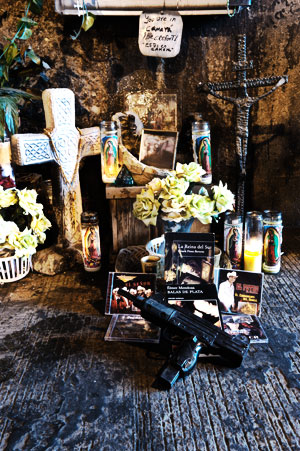
SIDEBAR: LA SANTA MUERTE
Beyond the videos and literature, narco-cultura has its own patron saints and spiritual realm. The hybrid religion of the Americas developed its unique spin on Catholicism long ago, and the process of syncretism – or fusion of beliefs – continues with saints bubbling up from folk practices that the official church has neither canonized nor sanctioned. For example, the figures known as Jesus Malverde and Juan Soldado have been venerated in Mexico as the patron saints of banditry and border-crossing, respectively. But the ultimate saint of Mexico’s dark social reality and narco-violence has become the figure of Death herself, La Santa Muerte.
In his book “Santa Muerte: Mexico’s Mysterious Saint of Death” (Fringe Research Press, 2010), folk-religion documentarian and law-enforcement consultant Tony Kail describes the movement throughout Mexico and U.S. Latino communities to venerate the representation of Death in icons, shrines, amulets, tattoos, prayer cards and votive candles with variations on the skeletal figure typically recognized as the Grim Reaper.
“While there are many that are using the image as a form of protection for criminal activities, there are far more that follow her as a source of spiritual comfort,” Kail says. His work charts the transformation of Death from her role as a symbol of comfort to that of the patron saint of crime. “The cartels seem to be embracing her as sort of a rallying symbol for power,” Kail argues.
Santa Muerte worship, he says, constitutes “an evolving religion that … is manifesting in front of our very eyes” – even if this image now appears on tennis shoes and in rap songs.
Chicago Latino Theater Profile (Café Magazine)
"Talk About a Revolution"
By Benjamin Ortiz, for Café Latino Lifestyle Magazine
June/July 2010
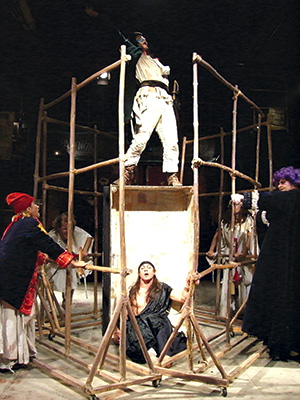
Six women talk about patriarchy, language, motherhood and men, about princes and princesas over bubbly mixed with sangría. They switch between codes not only of two different tongues but from across generations, continents and traditions long forgotten in ranchos and campos that might not even exist anymore.
“Not in my house! We were a matriarchy!” The response: “But you know what, though, here’s the difference: Matriarchs with men having the final say … They still have the power!” They talk about brothers who didn’t have to make the bed or do the dishes. They swear and laugh and animate their stories with gestures and tearful mimes that bring their families to life, including the stepdad whose wife picked the chicken bones out of his caldo.
Brazilian, Mejicana, Boricua – diverse Chicagoans working on a script titled “Generic Latina,” they are ensemble members and lab students of Teatro Luna, the 10-year-old all-Latina theater troupe that creates original works from autobiographical content, poring over stories all can relate to from our own piece of the American experience.
The whole Latino theater scene started something like this – with conversations in the community among those who wanted to talk about and turn their stories into art for a people who are now a quarter of Chicago’s population and growing.
Latino theater in Chicago has a long and rocky history. But now, Chicago is poised to become the center stage of a massive Latino theater revolution. The past year alone has seen an explosion in activity, talent and recognition.
The 2009 smash run and critical triumph of Kristoffer Diaz's “The Elaborate Entrance of Chad Deity” at Victory Gardens led to Teatro Vista mounting an off-Broadway version in New York City. Teatro Luna co-founder Tanya Saracho's adaptation of Sandra Cisneros' “The House on Mango Street” was produced by The Steppenwolf Theatre Company in late 2009 with a ground-breaking first for the storied organization – an all-Latino cast. Then, in March, Steppenwolf awarded its inaugural Mellon Grant to two playwrights, including Saracho, commissioning two new plays over the next few years.
Polly Carl, the Steppenwolf’s director of artistic development, confirms that they are serious also about mounting Saracho’s work on their stage. “She’s going to bring work that surprises us,” Carl says, “and when you’re working in the theater, that to me is the most thrilling part of working with writers who will give you access to stories you haven’t already heard.”
And now, the 5th biennial Latino Theatre Festival at the Goodman brings together its typical menu of international and local talents to showcase performance arts from a community that can no longer be denied its representation on stage.
Goodman artistic associate Henry Godinez, long a fixture at the Goodman and an advocate for more Latino works in the mainstream, credits consistent support and commitment from the Goodman, while saying that his mission has been “to fight the good fight and to make sure that our voice is heard, and sometimes you got to pound your fist a little harder than others,” he says.
Godinez believes the time is right for Latino theater: there are now more Latino companies that are strong and young, while mainstream houses are also more open to Latino programming. In general, Chicago’s theatre scene is “the best theatre community in the country,” says Godinez, “not just because of the size or the scope or the variety, but I think it’s a healthy community.”
Mutual support, respect, clarity of purpose, and truthfulness are all a part of this healthiness, according to Godinez. It’s a place to create without the pressure or commercialism of New York and Los Angeles. “And when you succeed, others are genuinely happy, excited and supportive,” he adds.
WINDS OF CHANGE
But mainstream and non-Latino houses were not always so welcoming, and there was a time when Latinos had no stage or company to call their own. In a 1992 Chicago Tribune article, Achy Obejas reported: “Professional Latino theater may have started in Chicago when, due to a lack of Hispanic roles, a Latino actor auditioned for the role of an African-American [at Victory Gardens in the late 1970s] … A church, student group or neighborhood organization might put on a performance, but nothing was on-going. Productions were modest, in Spanish, and usually filled with social-service messages. Local professional companies would sometimes produce work by Spanish playwrights like Federico García Lorca, but rarely offered scripts by Latin American or U.S. Hispanics. And Latino actors had few opportunities.”
That began to change in 1979 when the Latino Chicago Theatre Company formed, later owning its own space (a refurbished firehouse in Wicker Park built around 1894) from 1987 to 1997, when the building caught fire and ended the city’s first Latino troupe. “Even today,” says former managing director Gregorio Gomez, “outside of Aguijón [Theatre Company of Chicago], there’s no other Latino theater company in the city that that owns its own place.”
Gomez calls that first company “the icebreaker” for Latino theater in town, and he speaks nostalgically about the social, political and artistic inroads that the group created. It’s fair to say that it was a beacon for Latino artists and artists of color. And it helped spark the conversations that led to Aguijón and Teatro Vista being founded around 1989.
Although sometimes some of these conversations led nowhere. Tanya Saracho remembers that when she first started shopping the idea of an all-Latina theatre troupe around town in late 1999, she “knocked on a lot of doors at first, and the Latino males that I talked to all scolded me – ‘Why women? We’re not there yet, the movement is not there yet.’ … I don’t know if they were threatened or what, but I was not encouraged to make it all women.”
Undeterred, she joined forces with Coya Paz to found Teatro Luna in 2000. There was, at first, the difficult task of collaborating with an ensemble of women who disagreed about their collective identity. “We could not define ourselves – were we Hispanic or were we Latina? Well, that took eight months to decide,” recalls Saracho. Differences in self-definition, from Cubana to Chicana, became the very substance of their art – ethnographic enactment of personal stories.
Beyond these initial challenges, the group had to operate with a tiny budget, like any small theatre company, and Saracho says that word-of-mouth publicity about their unique pan-Latina perspective brought immediate popular interest, audiences and invitations to festivals. Now celebrating its 10th anniversary, Teatro Luna is busier than ever. Even though Saracho stepped down as artistic director this year, Teatro Luna kick-started their Lunadas Series of staged readings with Brazilian playwright Petrucia Finkler's "Brilliant Cut."
NEW DIRECTIONS
Marcela Muñoz, co-artistic director of Aguijón, saw her mother Rosario Vargas create the company that just celebrated its 20th anniversary. Muñoz came aboard in 1991 and moved with the company to its current location in 1999. She says that their mission remains “to produce work in Spanish here in the United States – that’s already taking a social stance on the importance of culture,” referring to the company’s roots in stinging and agitating the conscience of audiences.
Muñoz points out that they have focused in their last couple of seasons on the identity of Latinos in the United States, even producing transposed and translated versions of Tennessee Williams and Arthur Miller plays.
“We’ve kept a lot of our core audiences," says Muñoz. "We’re also getting younger and younger audiences. We’re seeing a sort of shift: where before it seemed that the younger generation didn’t speak Spanish as much, or were not as interested in learning Spanish, they’re now listening to more radio in Spanish, watching more TV in Spanish, and they’re coming to more Spanish language theater.”
Though Aguijón’s first three productions for the Goodman Latino Theater Festival were Lorca works, they’re moving in new directions, this time with “Las Soldaderas,” based on texts by author Elena Poniatowska.
Teatro Vista, likewise, will produce “El Nogalar,” a work by Tanya Saracho inspired by Anton Chekhov’s “The Cherry Orchard.” Godinez, reflecting on Vista’s origins and how he co-founded the company with current Vista artistic director Eddie Torres (who he met while acting in a Goodman play), says the two were interested in Latino plays such as those being written by José Rivera and Octavio Solís. "We were also interested in collaborating and sharing audiences with mainstream theaters," Godinez notes. "We were about bridging the gaps between non-Latino and Latino audiences."
Teatro Vista did a production with the Goodman of José Rivera's "Cloud Tectonics" shortly before Godinez was invited in 1996 to join the company as its first Latino artistic associate. With the birth of his first daughter and full-time teaching duties starting at Columbia College, Godinez left Teatro Vista for the Goodman. “I very much realized that by going on staff my job primarily would be to champion Latino works and to promote the building of a Latino audience,” he says.
After seeing an international theater festival in Miami, Godinez approached executive director Roche Schulfer and artistic director Robert Falls with the idea of doing exactly that kind of major event at the Goodman. “We had moved to a new building,” he remembers, “and it was after 9/11, and we were trying to jump-start our Latino initiatives.”
The Goodman hadn’t had Latino programming since 1999’s run of “Zoot Suit,” directed by Godinez, so they ran with the idea, and the first Latino Theatre Festival was born in 2003. Fast forward to this year, Godinez highlights Teatro Buendía of Cuba as one of the more exciting components of the festival. Also, an adaptation of Eduardo Galeano’s “Memory of Fire” directed by Godinez will be featured, with the Grant Park Symphony Orchestra providing a soundtrack for the production at Millennium Park.
“Over the last 10 years, everything has doubled: the audiences who come to see it, the amount of time we devote to the festival, the budget that we allocate for it and the amount of media attention we receive,” says Robert Falls of the Goodman.
Commenting generally on local Latino productions, Falls points out that “the success of some of the more established Latino companies and artists [in Chicago] has attracted more Latino artists to the city.”
That’s exactly why Dominizuelan decided five years ago to move here from Miami, citing good feedback from critics and support from Second City, Chicago Dramatists and Teatro Luna, who will be producing their work.
“We like to eat and we like to be funny, and so Chicago just seemed like the best choice,” says Wendy Mateo, who has also conspired with partner Lorena Diaz to create their own company, Tall Hispanic Short Hispanic Productions.
Mateo says the question for her is this: “Why would you ever leave Chicago? … Here, I can walk into iO [formerly Improv Olympic] Theatre, I order a shot of whisky and beer and I can sit down and chill out … that’s what we love about Chicago.”
Likewise, other groups of newcomers and locals have brainstormed to create the Urban Theatre Company (based mainly in the Humboldt Park neighborhood), Salsation Theatre Company (running sketch-comedy and improv-inspired shows out of The Second City and Gorilla Tango), Las Divas Productions and several other initiatives popping up.
Even the old Latino Chicago Theatre Company that started it all will get its second act, with plans by founder Juan Ramirez to open a full arts center on Chicago's West Side. Looking back, Tanya Saracho remembers how she started in theater by interpreting poems in English that she didn’t fully understand. Now, she says, with demonstrative facial gestures and dramatic deep-breaths, Chicago is on the verge of having a real Latino theater movement. “Let’s hope we can meet here in five years and say the Tony winner is a Latino who came from Chicago," she muses. "Or maybe a Latina."
Andrés Amador Profile (Café Magazine)
"Surf 'n Turf"
By Benjamin Ortiz, for Café Latino Lifestyle Magazine
April/May 2010
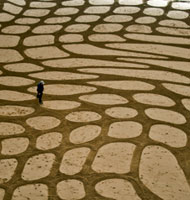
Chaos fractals, moiré patterns, Islamic arabesques, crop circles, mathematical iterations and the divine geometry of sacred spaces: When San Francisco artist Andrés Amador started doodling with a stick in wet Hawaiian sand seven years ago, these ideas took hold and led him to stake out the tides and diurnal cycles, so he could transfer the intricate configurations in his head onto grainy canvasses stretching across 500 by 300 feet of Ocean Beach.
Like the Nazca Lines of Peru – expansive landscape glyphs with enigmatic etchings – Amador’s works suggest grand designs that are at once unearthly yet rooted in the natural movements of terra, sun and moon. That is, of course, until the tide rolls in to wash all of his work away forever. In the tradition of sandpainters from across indigenous cultures, Amador sketches ephemeral art onto beach topography as a lesson on life’s natural impermanence.
“Allowing the process to unfold as it will is a huge lesson,” he says in a phone conversation. “Everything that I do on the beach, all the art works that I do, all the art forms that I engage in are features of my own life.”
At 38 years old, Amador is a third-generation San Francisco native of Ecuadorian descent who grew up in the Mission District. But he didn’t go to the beach and had no artistic influences as a kid. “We were definitely below middle class,” he says of his upbringing, which made him very goal-oriented and focused on a practical career.
He imagined working as a park ranger and earned a degree in environmental sciences from University of California, Davis, but travels to Alaska and then Ecuador (on a Peace Corps assignment) helped him open up to chance digressions. In 1999, he started doing art, inspired by Nevada’s Burning Man festival. The big, alternative desert party features art installations and on-the-spot collaborative creativity. Also, participants strike the location completely when the party’s over.
He later got involved with the Bay Area’s underground music and DJ scene, leading to experiments with psychedelic party design and light sculptures as elaborate decorations. He still makes such pieces, using string, light, sticks and principles of mathematical graphing. The sculptures got him thinking about cultural designs, harmonic patterns and geometry.
It was a short leap from that to the sand doodling experiences, and he’s now done more than 100 beach pieces. When the lunar phase allows for time between high and low tides, so the sand can absorb water for optimal contrast, he uses various kinds of rakes with adjustable tines, plus ropes, stakes and other implements, to bring the plans and sketches from his notebooks to life.
Crowds sometimes show up to observe and even cheer him on, and he began to invite collaborators. Working with teams, he realized that his art would end up completely different than what he planned. “When I try to impose too much control, I might get what I’m looking for,” he mentions, “but I won’t be open to surprising myself with something entirely new, and by adding people to the mix who were essentially unpredictable, that was the element of chaos that I was needing.”
Even though the works disappear back into chaos, Amador shoots photos to transfer the art onto postcards and prints for sale. Like a meditative mandala architect, he has learned through the artistic process to let go of obsessive need for control. “I’ve grown more into the awareness that you can’t know where something is going to end up, because if you do, then it takes the heart out of it on some level, and not knowing is more interesting, has more potential,” he says.
"The Elaborate Vision of Kristoffer Diaz" (Café Magazine)
"The Elaborate Vision of Kristoffer Diaz"
By Benjamin Ortiz, for Café Latino Lifestyle Magazine
April/May 2010
Once upon a time, “in hip-hop’s earliest days, there was a Boricua— I’m sorry, you might not know what that means — there was a Puerto Rican woman who could rock a microphone in English and Spanish with only herself as her DJ …”
That's how Kristoffer Diaz kicks off his latest play in production like a hip-hop fairy tale, following up on “The Elaborate Entrance of Chad Deity,” his first-ever full-length work to get produced. Chicagoland critics and audiences loved its 2009 run at Victory Gardens Theater, and now New York City is producing it off-Broadway. Simultaneously, Diaz comes home to the very first play he ever wrote, “Welcome to Arroyo’s,” at the American Theatre Company (ATC).
“There was a lot I needed to figure out when I was in college and then graduate school about my place in Latino culture,” says Diaz in a phone conversation from Minneapolis, where he currently resides. “I think ‘Arroyo’s’ is the play that, as I was writing it, really helped me figure all that out.”
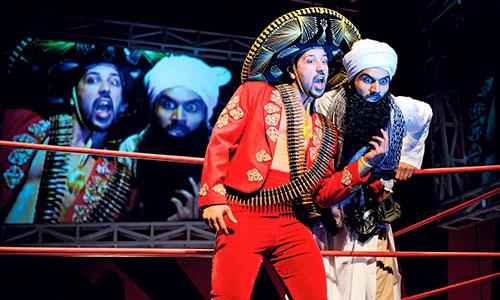
While “Deity” mixed geopolitics and searing racial satire with authentic, live, pro-style wrestling on-stage, “Arroyo’s” will transform the ATC into a party lounge, with live DJs, interactive freestyling, breakdancing and actual graffiti writing. Diaz’s story will spill out from the stage and involve the local hip-hop community, artists and more than 800 high-school students, through the ATC’s American Mosaic program, which works the production into Chicago Public School'sninth-grade literature curriculum.
This program was one reason Diaz chose to work with the ATC. He considers his play to be about family and community foremost. He says it’s “the first time I wrote something where I started to understand the value of not just having characters sitting in a living room talking to each other, but having them break the fourth wall, having them interact with the audience … with ‘Arroyo’s’ or with ‘Chad,’ I think of those in a lot of ways as musicals … in ‘Arroyo’s,’ instead of singing, they’ll play some music, they’ll rap or they’ll use some hip-hop techniques.”
Born in Manhattan and raised mostly in Yonkers, Diaz sees himself as a suburban kid who roamed the metro-NYC area, visiting relatives in the Bronx and his grandmother on the Lower East Side. These places and their pan-cultural populations inspire his characters, settings and the overall swagger of the dialogue. In “Arroyo’s,” the main locale is a bar whose owner considers it “the nerve center” of the neighborhood, a sort of community center with alcohol.
Owner Alejandro Arroyo tries to keep the business running, while his sister Molly tears through the neighborhood with teen angst and an itchy spray-paint finger. Suburban egghead Lelly Santiago shows up at the bar to validate her own existence as an assimilated academic by proving that a Puerto Rican woman named Reina Rey helped create hip-hop. (Reina Rey also may or may not have been the Arroyos’ mom, who quit rapping to raise a family and run the bodega that Alejandro later turned into a bar.) “Arroyo’s” B-boy hip-hoppers Trip and Nel infuse the action with commentary like an urban Greek chorus, rewinding and re-mixing scenes with sampled and scratched dialogue.
ATC artistic director PJ Paparelli calls Diaz a “fusion artist” whose work fully realizes the company’s commitment to American stories that engage the question of what it means to be American in a global, multicultural country. “‘Arroyo’s' is a working-class story,” Paparelli adds. “Whether you’re Latino, whether you’re white … I think the idea of embracing who your family is and figuring out who you are is something we all go through.” Paparelli also points out that rehearsals in Logan Square will open the doors to the community on Fridays for spoken-word open mics, while the actual run will feature post-performance DJ sets.
ATC ensemble member and “Arroyo’s” director Jaime Castañeda — a Texas native who bops around between Chicago, New York and Los Angeles — says Diaz is creating a new and different kind of Latino theatre that taps into our own diversity as multiracial, multicultural people. Castañeda worked with Diaz on a smaller-scale mounting of the play in New York, but he says the ATC production will fully realize all of the challenging technical, artistic and spatial aspects of the work, down to creating a party atmosphere that pulls the crowd in. Similar to the splashy wrestling spectacle of “Deity,” “Arroyo’s” hip-hop exposition will be “like sitting at a rock concert or a hip-hop show,” says Castañeda.
Like Castañeda, Eddie Torres thinks Diaz “has pushed the envelope” of both conventional theatre and Latino identity with provocative artistry that doesn’t beat you over the head. Torres cofounded Teatro Vista, which collaborated with Victory Gardens in mounting “Deity,” and he directed the work that he now takes to New York City.
For someone poised to hit Broadway soon at the ripe age of 32, Diaz doesn’t seem worried at all about topping the profusely rave reviews of “Deity.” He mentions that he spends a lot of time in bars, both writing and hanging out with friends. He also blogs regularly about theatre, baseball and one of his favorite TV shows, “The Wire”: “This is like the nerdiest thing, but that’s sort of what I do for fun.”
MORE ABOUT DIAZ
You can read Kristoffer Diaz's musings at http://kristofferdiaz.wordpress.com
IF YOU GO
Welcome to Arroyo's
When: April 15-May 26
Where: American Theater Company, 1909 W. Byron St., Chicago
Showtimes: Thursdays and Fridays, 8 p.m.; Saturdays, 3 and 8 p.m.; Sundays, 3 p.m.
Admission: Previews (first week of performances), $30; Thursdays, Saturdays and Sundays, $35
Info: (773) 409-4125, www.atcweb.org
The Elaborate Entrance of Chad Deity
When: April 26-May 20
Where: Second Stage Theater, 305 West 43rd St., New York
Showtimes: Tuesday, 7 p.m.; Wednesday and Saturday, 2 and 8 p.m.; Thursdays and Fridays, 8 p.m.; Sundays, 3 p.m. (except May 2 when there will be two shows at 2 and 7 p.m.)
Admission: $15-$70
Info: (212) 246-4422, www.2st.com
"Laugh Riot" (Chicago Reader)
"Laugh Riot:
Pushing the Borders of Performance Art"
By Benjamin Ortiz, for "Our Town" in the Chicago Reader
September 19, 1996
A TV screen flickers with the static-scratched image of a meeting in a dimly lit brick basement. Figures in black work clothes exhale steam through their ski masks. One steps forward and spits out, "In the tradition of Pocho Villa, the lesser-known cousin of Mexican revolutionary Pancho Villa, Chicanos grow up today in occupied Aztlan: confused yet fierce, defending our gente, our land, and our pet Chihuahuas. A pocho is a Mexican growing up in the U.S. who is considered tacky and uncouth by both Mexicans and gringos. Pocho Villa was the first hero to stand up for the right to be Chicano, not a Mexican with their perfect Spanish-language skills and taste for bad pop music, not a gringo with their inability to share and taste for bad pop music, but shunned by both! Subcomandante Chuy wants you, Raza! Join the totally chingon forces of the Pocho Villa Liberation Army! Be a revolting pocho and help liberate Aztlan!"
Next to the screen stand Esteban Zul and Lalo Lopez, two soft-spoken emissaries of the PVLA. The pair are also the creators of Pocho Magazine, which they describe as "a Mad magazine for mad Chicanos." Since 1990, Zul and Lopez have managed to squeeze out seven issues. Turning a term of derision into a badge of honor, Pocho's strategy of Chicanoizing popular culture and traditional Mexican folkways satirizes life on both sides of the border. It offers a culturally schizophrenic pastiche, taking jabs at everything from barrio life to U.S. immigration policies. While the zine has been in limbo for nearly a year, the Pochos have blossomed into a multimedia operation. Lopez, cofounder of the Chicano Secret Service performance troupe, writes the "Mexiled" column for L.A. Weekly and draws the cartoon L.A. Cucaracha under the name Lalo Alcaraz. Zul heads up the Berkeley-based hip-hop group Aztlan Nation. Together they've performed on Pacifica radio and produced videos with other artists. The Pochos also run a site on the World Wide Web called the Virtual Varrio (silcom.com/-tonkin/pocho/varrio.html). Recent posts include Dia de la Independencia, inspired both by Mexican Independence Day and by this summer's blockbuster movie; sombrero-shaped spaceships zap the White House with a jalapeno laser ("The next time you call them aliens might be your last!"). Since affirmative action has been eliminated in California, the page also advertises the "National Pochismo Institute," which offers classes in Transcendental Lowriding, Pochteca History, and business ("Raza Swap Meet Technology").
After the revolution, there will be no more lost luggage. But Lopez and Zul have arrived an hour late for their appearance at the University of Illinois at Chicago after tracking down their bags at O'Hare. They're here for a conference organized by the Mexican Students of Aztlan.
"I think that since our audience has been waiting so patiently we shall reward them," Zul announces in his raspy voice, prowling the stage in sneakers, baggy black jeans, and a T-shirt that reads "Gypsys & Thieves Cover the Earth!"
Lopez unloads a cardboard box of jingling bottles and proclaims, "Malt liquor for everybody."
Hoots and hollers come up from the crowd, and one homeboy in a hoodie and baseball cap exclaims, "Orale! I've been waiting for some liquor all damn day!"
"I gotta tell you, we are all about free malt liquor," Zul says. "It enhances our product and loosens the pocketbooks at the end of the show when we sell our merchandise." Plastic cups are passed out, and Zul walks around pouring from a communal 45-ouncer. Most heartily welcome the ghetto-style aperitif.
"Don't you think you're promoting some bad habits here and supporting the liquor industry that loots our communities?" someone asks.
"Hey, I don't promote it," Zul answers. "I just pour it." Those familiar with the Pochos know how they feel about the alcohol industry targeting the barrio. One parody centers on a drink marketed to poor whites: Dead Gringo Malt Liquor ("Dang, it's tasty!"). In April 1995, the last time the Pochos came through town, they performed Chorizo of the Gods at the Mexican Fine Arts Center Museum and ended up serving malt liquor at the nearby Jumping Bean Cafe.
The redundancy of proving their point again doesn't seem to be a problem tonight, as the crowd quickly gets behind the Pochos. "If you didn't know already, this is our first piece here," Lopez says, pacing the stage. "It's called 'Malt Liquor Machos,' a group collaboration with some of the art students at UIC."
"It's been a great show so far," someone drawls.
"That's what you call arte," Lopez explains. "Art so good you have to spell it with four letters." He introduces the next video, "some animation by one of our Pocho agents, Alex Rivera from New York, and it is called Cybracero." Lopez explains that the film takes off from the bracero program, which promoted immigration during World War II when Mexican arms [brazos] were needed for agricultural work. From this program came the mass importation of braceros, contracted laborers from Mexico. Cybracero uses stock footage of the actual bracero program, news clips, and slick editing to depict a future in which Mexican labor can be employed to pick crops via the Internet. An enthusiastic narrator says, "The United States Government Department of Labor is excited to announce a new program to get the job done: the Cybracero Program. The presence of braceros contributed to a climate of racial and economic suspicion; evidence of major tension was not hard to find." The video cuts to footage of last April's brutal beating of Mexican immigrants by Riverside County sheriff's deputies in El Monte, California. It then switches to an animated sequence showing robots in sombreros picking fruit in southwestern orchards. "Through the new program, Mexican workers can, from their Mexican village, watch their live Internet feed, decide what fruit is ripe, what branch needs pruning, and what bush needs watering. For the American farmer, it's all the labor without the worker. In American lingo, cybracero means a worker who poses no threat of becoming a citizen, and that means quality products at low financial and social cost to you, the American consumer!" The video shows a little blond girl drinking orange juice, then fades to black.
The lights come up, and Lopez begins to introduce the next video. Zul interrupts, "But first: does anyone need more beer?" Zul pours refills while Lopez describes their own "cybracero" work on the last feature. "Yeah, our homeboy Rivera works with archival film footage, and all he had to do was mimic the actual narration from a real government flick. I sent Rivera the scripts and the images for other cartoons over the Internet, and then he put them into his Mac, processing with animation programs, etcetera--the two of us sending bits of sound files and visual clips back and forth. The Pocho animation ventures go under the subsidiary title Animaquiladora, and our logo is a bunch of workers drawing in a sweatshop."
Lopez segues into the next subject. "I recently went to the GOP convention as my character Daniel D. Portado, who is the former head of the group Hispanics for Wilson and current head of HALTO, Hispanics Against the Liberal Takeover. D. Portado is this right-wing freak. You've seen these people on TV, these right-wing Latino spokespeople that are...uh..."
Someone yells out, "Coconuts," a reference to people who are brown on the outside and white on the inside.
"Yeah," Lopez agrees, "but they work for a paycheck, popping up at English-only rallies, and they're held up as representatives from the community by politicians, so we thought it would be funny to spoof these people 'cause they're very annoying.
"During the campaign for Proposition 187 in California, we were all pretty pissed off and wanted to think of a way that we could attack pro-187 people and get free publicity doing it. So we thought we'd take it to the point of absurdity and become militant self-deportationists."
Zul picks it up. "We put out newsletters and press releases on the Internet and sent them to radio and TV stations, saying that we believed in deporting ourselves. We told them stuff like we wanted to get rid of Linda Ronstadt because her garbled Spanish yodeling attracts too many immigrants to this country, Mexican food is just too unhealthy for you, there's too much banda music. We promised that before we self-deport we'd train all the white people to work in the hotel and gardening fields, and then we'd have an event with Pete Wilson called the 'Run for the Border 10K' to repatriate Mexico."
Surprisingly both the left and the right took the Hispanics for Wilson hoax seriously, and the Pochos received death threats as well as praise on their hot line. "We felt kinda bad with some of the calls we got from shocked and enraged Mexicanos taking us dead serious," Lopez admits, "and then we got calls from MEChistas." He's referring to the student activist group known as MEChA (Movimiento Estudiantil Chicano de Aztlan, or the Chicano Student Movement of Aztlan), born out of the Chicano civil rights movement. Lopez repeats one death threat. "'187 bitch! I'll kill you motherfuckers!' And I met one of the dudes who placed the call at a MEChA meeting in Sacramento. He was really embarrassed! I just said, 'Hey, congratulations, you made your first death threat.'"
In November 1994, the Pochos pushed the envelope further when a TV station in Salinas, California, invited Hispanics for Wilson onto Sevcec, a Spanish-language talk show televised on the Telemundo network in 22 countries. The show featured an immigration debate, though the Pochos in HFW disguise were the only 187 advocates to show up. "Everyone else canceled," Lopez says. "All their pro-187 people realized, 'I'm not going into a room of angry Mexicans!'" Lopez went as Daniel D. Portado, clad in a suit, an Old Glory necktie, and mirrored shades, claiming to be Pete Wilson's former gardener. Zul followed as his bodyguard, Rudy Rico, who was introduced as a former Los Lobos roadie. "It was the longest half hour of my life," Zul recalls. "They took us into the studio, and the whole time they were screaming at us. There were these kids sitting behind us saying, 'You guys are coconuts, eh! Take off the sunglasses! You're a sellout, eh!'"
Having successfully passed as Hispanics for Wilson, the Pochos decided to make a video mockumentary about the group. "We had no script," Zul says. We just kinda made up scenes as we went along." The video, titled Hispanics for Wilson in "Walk Softly, Pedro!" features clips from the Telemundo show, which are hilarious yet uncomfortably surreal. Activist Juan Jose Gutierrez electrifies the audience, unleashing his anger on the stone-faced Pochos, who somehow manage to keep from laughing while they decry "crimigrantes" (Pocho-speak for illegal immigrants) and the physical dangers of banda dancing.
Lopez made an encore performance as Daniel D. Portado at the Republican National Convention, where he was accepted into the GOP family. "They loved us, but some liberal photographers there talked shit to me, and we almost got our asses kicked by Chicano Brown Berets in San Diego." Hispanics for Wilson did not end with the ill-fated Wilson campaign--they continued to solicit donations on the Pocho Web page for their political action committee, WETPAC, to promote the conservative Hispanic-American agenda through reverse immigration, affirmative inaction, pro-Olestra cookouts, and a Million Mexican March to the border. Though some of their critics see the hoax as outright mockery of Latino efforts for immigration rights, the Pochos maintain that their performances portray right-wingers as buffoons while injecting a sense of humor and irony into the sometimes preachy, self-righteous cant of Chicano activism.
"OK, let's get the next video on," Lopez says wearily, sounding a bit tired from all the traveling involved in the Pochos' 1996 Bandwagon Tour across the U.S. There's some confusion in the back of the room, and someone jokes that the VCR operator has fallen dead drunk. Lopez leaves to check out the problem, and the homeboys in attendance start demanding entertainment from Zul. "Bust some rhymes!" they shout, asking him to demonstrate the skills he's learned with Aztlan Nation. Zul tilts his head back with the microphone pressed against his lips and lets loose a lyrical flow: "I'm the original gangsta politico / sometimes analytical / like to write graffiti / so sometimes I'm known as criminal!" The crowd rocks to the beat until Zul winds it down and jumps off the stage to start a collection for another beer run.
Lopez introduces the next video, Unmasked! The Pocho Villa Liberation Army, with more stories of Pocho hoaxes gone awry. "Daniel D. Portado went to this right-wing media conference in LA for this group called AIM, Accuracy in Media, so I could report on it for my column, and they had a panel called 'Is There an Aztlan in Your Future?'"
Zul breaks in, "And they said stuff like, 'These Mexicans are like the Intifada: bombing, babies being killed, children dying in the streets! That's what's going to happen in your neighborhoods! These Mexicans will stop at nothing to get Aztlan, and we've got to stop them!'"
"These people think that MEChA and all Chicano organizations are the biggest threat, like we're going to take over the southwest next week," Lopez explains. "When I was in MEChA we couldn't even have a carne asada sale without fighting amongst ourselves. I mean, c'mon!"
After he was unmasked as a fraud at the AIM conference, Lopez claims that the Pochos have been tailed by right-wingers who believe the duo are in the vanguard of an illegal-immigration conspiracy involving the Zapatistas in Chiapas, MEChA in the U.S., and the virtual Pocho Villa Liberation Army, led by Subcomandante Chuy and based in Bakersfield, California. "Before getting thrown out, I got my hands on an info packet that had clippings from Chicano activist newspapers," Lopez says, laughing. "And they had a clip from Pocho Magazine with a communique from the PVLA. The packet said 'Know thine enemy.' They actually thought we had an armed force of insurgents!"
The Pochos flip the video on, and Subcomandante Chuy rants about liberating Aztlan through the use of bad poetry. PVLA demands include a claim to the tortilla patent (and eventually rights to all corn products), and it threatens to use the deadly manteca (lard) bomb and hold the editor of Hispanic magazine hostage. The video takes some bizarre twists and turns, with karaoke Nazis taking over bars with white-power lyrics and various scenes from shows on the Pocho TV Network, including a program for men who love to dress like Frida Kahlo, a cooking show for cholos (homeboys) called "Juan Can Cook," and the Tio Taco Players in "Taco the Town."
Future Pocho projects include a feature-length video now in preproduction called The Mexecutioner, a spoof combining 60s sci-fi films and Mexican lucha libre wrestling flicks. A sketch-comedy pilot called "Channel Zero" is in the works for cable TV, and Pocho Magazine may soon be resurrected with issue number eight. Zul and Lopez also plan to crash the Latino Marcha in D.C., a civil rights march scheduled for October 12. "We're just trying to get people to think a little more critically and to raise the level of appreciation for irony and satire," Lopez says. "We want to talk to cholos as much as academics." Mexico has yet to put down the Zapatistas, and now the norteamericanos must face the ski-masked, manteca-throwing wrath of the Pocho Villistas.
"Mex Texts" (Chicago Reader)
"Mex Texts:
A homegrown historian makes the city his classroom"
By Benjamin Ortiz, for "Our Town" in the Chicago Reader
December 05, 1996
"This place ain't open all the time because I gotta work," says Bill Luna, owner of Libreria Mexchicana on 18th Street, where the rumbling of the nearby el drowns out the occasional banda-booming car and boisterous kids yelling in Spanish. "I can't sell books to live. People don't buy books--they'd rather buy a six-pack! Our people don't read that much."
A customer who's browsing says, "Hey, I read!"
"Well, most people," says Luna, who's 60. "But when I grew up, in my house we read a lot and worked real hard. There was no alcohol or tobacco, not even any coffee. We read the Book of Mormon every day and went to church twice on Sundays. I mean this was discipline! Today kids aren't getting that. They go straight from school to the prisons or don't even finish school. Thing is, we don't have enough people rolling up their sleeves and doing something about it. We got a lot of people talking but not doing anything themselves."
Luna--who's given to long, rambling monologues on subjects that range from Aztec science to Mexican aeronautics to contemporary Latino technological innovations ("The Mexican airline is the oldest on this continent") to Chicago politics--is constantly lecturing Latinos about the need to work in their community. "I tell all these young people it's OK to march like they did on Royko downtown--and I was there too. But I asked some of the college students, 'Are you helping tutor our kids?' But that means real work--marching is being glamorous in front of a camera." He demonstrates with a little dance, hand on hip. "Get out of the cafes, talking about how Mexican you are, and try tutoring our kids and educating them about our positive cultural contributions so people can't spread disinformation about us! I mean, you can call Royko a fool, whatever. But instead of beating him up, I'm going to tell people what Mexicans have done throughout history. I invite Royko to come take one of my classes so he can learn more about Mexican culture and history."
Luna will tell you he's spent much of his life helping his own community. His bookstore--which opened on Mexican Independence Day, September 16, 1994--is only his latest effort. Part retail store, part museum, part classroom, it's the first step toward his dream of a full-fledged museum and community center. He says his storefront once housed a tavern. "We have more taverns in the 25th and 22nd wards than anywhere else in the city. We need to close more cantinas and open more community centers--don't get me started!"
Luna named his store Libreria Mexchicana to demonstrate the linguistic and cultural continuity between Mexican and Chicano communities. The small one-room space is cluttered with prints of Aztec codices, maps of Mexico, vintage and contemporary movie posters, political propaganda, United Farm Workers flags, pre-Columbian-style pottery, blankets, and musical instruments. In the middle of the room is a long table covered with multicolored Mexican cloth and circled by old metal chairs with "LUNA" scrawled on their backs. Pictures at the head of the table show Luna with his foster mother, his granddaughters, and his son in a navy uniform. More pictures decorate Luna's work desk: shots of him with boxer Julio Cesar Chavez and yellowed photos of Mexican pilots from World War II. The shelves that line the walls hold books in no clear order that suggest various topics--history, literature, art. Unlike most booksellers, Luna has only one copy of each book in stock; when a customer buys a book he has to order another copy. But he also has a section of books that aren't for sale, which includes reference books from the Mexican consulate on principal cities in each Mexican state. "Kids can come in, tell me what state their parents are from, and I can tell them a little something about their background."
Luna has no formal training in history, though he has a bachelor's degree in elementary education from Indiana University and a master's in adult education from Northern Illinois University. "I got those degrees pretty much because that's what this society expects you to have, but I didn't learn anything of what I offer here in school. Some people out there get PhDs on Mexicans in Chicago, and the last thing they ever do is publish a book, put the diploma on their shelf--and then they're 'experts.' I don't have that piece of paper, but I got a doctorate up here"--he points to his head--"because I study it every day out here in the neighborhood."
Luna's vocation as a self-taught historian began with his upbringing in East Chicago, Indiana. Orphaned, he was taken in by a Mexican curandera and raised as a Mormon. "She was a relative of my dad from San Luis Potosi, where my family's from, and she took me, my two sisters, and my brother out of the orphanage. She was very proud of being Mexican--our curtains at home were red, white, and green. She used to make tortillas on a metate, and we had nopales [cactus] to eat every day. She didn't speak any English, but she converted a lot of people to the faith just by being a good example, visiting the sick in the hospital every day. She died when she was 96, buried in Laredo, Texas. But she wasn't sick a day of her life, had all her teeth when she died, because she knew how to cure people with yerbas [herbs] and the laying on of hands."
While she instilled a deep appreciation for Mexican culture, East Chicago and its steel mills taught Luna working-class values. "I learned black music there; Polish, Italian, Lithuanian, and my own Mexican culture at the movie house and at home. I'm very fortunate to have come out of a community like that and to have learned the richness of different people. There were no class differences--our families were all steelworkers."
The community had clear rites of passage. "After high school you either went to the steel mill and then to the military, or the other way around. But you went into the service one way or another. We had families in Indiana where four or five sons in a family went to World War II." Luna served from 1955 to 1961 as a paratrooper and Green Beret--and boxed on the armed forces teams--then went into the reserves, eventually retiring in 1989 as a lieutenant colonel. He also worked at the steel mill from 1961 to 1971.
While he was in the reserves, a local man who was in the marines in Vietnam, Lance Corporal Emilio de la Garza Jr., was given the Congressional Medal of Honor, but no one in East Chicago seemed to notice. So Luna founded an American Legion post in his honor. "I got the city to open a public-school career center in his name too. This is all stuff I did on my own, otherwise nobody else would have done a thing, and we would have lost an important piece of history."
That marked the beginning of Luna's obsession with preserving military history. In his storefront window he now has a display of military paraphernalia from his time in the service--a tidy collection of knives, rations, and uniforms. "Part of what I'm doing here with this exhibit and the books is to tell the story of our military contributions for all our people that died in 'Nam." At his house he has a collection of more than 100 posters he put together from photos and news clippings that chart Latino military contributions from the American Revolution to Somalia, and in 1982 he cowrote a book for the Defense Department chronicling that history. "People don't know that Mexicans have just as much a reason to celebrate the Fourth of July as anyone else in this country. We have participated in every conflict from the very start--man, don't get me started!"
After Luna quit the steel mill he had a string of jobs working with Latinos, but he also gave a lot of his free time to their causes. In 1972 he founded the Association of Professional Resources to Involve Spanish Americans to provide social services for Hispanics in East Chicago, and a little later he started the Northwest Indiana Latin Chamber of Commerce to promote economic development and help small businesses. In 1974 he began commuting to Chicago to work for a bolt manufacturer as a training coordinator in a program that helped adults learn English and job skills, then moved on to work as manager of the Hispanic employment program at the federal Office of Personnel Management. While he was there he pushed for the federal agencies in Chicago to start observing Hispanic Heritage Week.
In 1983 he began working in the McDonald's corporate offices as an affirmative-action manager, and that same year he started a scholarship program for ROTC cadets in Chicago's public schools, which he named after Richard Cavazos, the first minority four-star general in the army. As a member of Chicago's Latino Committee on the Media, Luna lobbied to have the city start observing Hispanic Heritage Month, which it did in 1991. In 1993 he was employed by the Board of Education to evaluate bilingual programs, the same year that he opened a school, Image de Chicago Learning Center, to teach ESL, GED, citizenship, and literacy classes.
Luna now works part-time as assistant director of outreach for Columbia College's Community Science Project; coaches young boxers at the Mexican American Youth Athletic Association; is drafting plans for a river walk linking Pilsen, downtown, and Chinatown; cohosts the annual Mexican parade on Channel Seven; and leads a Boy Scout troop. "I got eight little kids I'm trying to keep out of the gangs. If everybody just took eight kids and helped 'em out we'd be better off. Everybody can make a difference, but that means you gotta give up your time at the Jumping Bean and put some time in the community."
But Luna wanted to do something more to raise the profile of his community and culture. "The more you learn about your culture, the more frustrated you get. You get infuriated that our culture's not getting portrayed on TV, that it's not in the media." He angrily lists some Latino achievements that have been overlooked: the Mexican composers who wrote hits in the 40s; the Mexican baseball teams that went head-to-head with Negro League teams; the vaqueros who changed ranching in Hawaii. So he opened his storefront and six months later started offering classes on Aztec, Mayan, Chicano, Mexican, and Native American culture.
Open to the general public, the courses also provide continuing-education credit to schoolteachers. "If I teach the teachers, they can develop an appreciation for the kids' culture and help them learn about it--because I can't do it all by myself. I go to some of these schools where there are lots of Mexican kids, and they got Bulls posters all over the place. Do you think these kids are gonna forget who the Bulls are? How 'bout their own culture? Why not put up posters of Benito Juarez, Ignacio Zaragoza, Emiliano Zapata?"
So far he's had more than 100 teachers come through his door. "I've had some good feedback, though some teachers come in here with an attitude like, I'm not going to change the way they think." He chuckles remembering the time he was called a communist and anti-American on an evaluation form. "Now I start off my class saying, 'Listen, there's nobody more American than I am in this class, and I love this country, and I'll never leave this country. I've served as an officer and a gentleman, and I was born in Indiana by the name of William, so I'm very American. But I'm going to say some things that the U.S. has done wrong to a lot of groups in this country.' When I'm done with 'em, I got 'em singing the Mexican national anthem--in Spanish and English."
The Board of Education wanted Luna to offer the classes downtown, but he resisted. "They gotta come here to the barrio, where they can't find any parking and hopefully they'll still have hubcaps when they leave. You gotta come here to feel the culture. You're in little Mexico right here, and you're going to have to drink tamarindo and eat pan dulce. When they leave this place they all wanna be Mexicans!"
The door of the storefront opens, letting in a gust of cold. A tiny space heater and an old gas stove struggle to keep the temperature from dropping. Two teens in leather jackets and hoodies enter and excitedly ask in Spanish if the army knives in the window are for sale.
"No, that's all my stuff from when I was in the army," says Luna. "But the books are for sale."
The teens take in the place for a few seconds, say thanks, and then leave with jealous backward glances at the military display.
Luna says he loses about $500 a month keeping the bookstore open, but he believes he has to keep it open if he's ever going to build a culture museum. "It's a shame that one or two organizations are picked as the cultural representatives for our communities--because they get all the grant money and yet they don't really do anything to help our community. We need a museum that shows our culture and history on a permanent basis, like the DuSable or Field Museum. We don't have nothing like that! That stuff at the Mexican Fine Arts Center is for the yuppies and the muppies. I mean, people in this neighborhood don't even know it's there. Instead of a glorified visual-arts gallery with high-priced speakers and events every now and then, why not full historical archives on permanent display? This stuff here in my store is just my little collection--this is just a glimpse. Imagine how much is out there that we could put together!
"We need more people knowledgeable about our culture. I ask these college kids what they're doing for our community, but they don't want to hear that. They want to go to the march in D.C.--which I told them was a waste of time. All these people here out on the street, they're not going to a march all the way across the country. They're all working, they'd rather sell elotes [corn] at their pushcarts. Why not have a moratorium day instead, where we all work in our community and volunteer to tutor, clean the streets, something?"
He says his mother once told him, "'This life is very short, but it's your responsibility to make this world better for the next generation.' Because you're not going to find the big solution to everything all at once--you gotta pick your project. Everybody's got to work real hard in your little piece of the world and do something, and then we'll be better off."
"Spirit Guide" (Chicago Reader)
"Spirit Guide:
Carlos Cumpian on Poetry, Chicano Culture, and the Emergency Taco"
By Benjamin Ortiz, for "Our Town" in the Chicago Reader
September 05, 1996
We're refugees, vato," Carlos Cumpian says in his trademark Spanglish. Editor of Chicago's MARCH/Abrazo Press and author of three books, the poet continues to wear his Tejano heritage on his sleeve despite having moved to Chicago in his teens. "We're economic refugees," he says, explaining his family history. "We left south Texas to follow the feria [money] waiting for us en el norte, like all our gente [people] who wind up here in Chicano, Illinois."
Cumpian's early life followed a picaresque trail from Texas, where speaking Spanish was punished in elementary school, to a south-side high school where an Anglo Spanish-language teacher once reprimanded him for not speaking good Castilian. Spanish-speaking immigrants in Chicago's barrios mocked his Chicano slang. On his visits to Mexico, locals called him a pocho, a Mexican-American who doesn't speak proper Spanish.
Cumpian was born in San Antonio, the cradle of Mexican south Texas culture, where he claims his roots reach back to 1790. With so much history tied up a thousand miles away, Cumpian's migration to Chicago is a puzzle. "We came up here for the climate," he jokes. In 1968 his father, who worked in retail, ventured to Chicago before the rest of the family and found a job at Goodwill. "A month later the job was no longer there because Martin Luther King Jr. had been assassinated, and the following night dad's place of employment was torched." The family eventually settled in the Roseland/Pullman area.
For Cumpian, Chicago offered a radically different pace. "It's clearly a town of immigrants." The dynamics of Anglo-Mexican conflict that Cumpian grew up with in Texas were mirrored in an African-American community pushing for equal opportunity. "It made me hunger to know more about my own culture as I discovered more and more about African-Americans. After high school I went back down to Texas, lived there along the frontera, and started learning about raza all the way back to the Azteca and Maya." In Texas, Cumpian now found a burgeoning home-grown civil rights movement charged by the energy of the United Farm Workers, with the Raza Unida party taking over the government of Crystal City (his dad's hometown) and running Ramsey Muniz, a Mexican-American candidate, for governor.
Cumpian came back to Chicago in the mid-70s and entered Truman College while continuing to search after his cultural heritage. "It really wasn't until I went into Truman and got a trip down to Mexico with a crew of students that I really saw with my own eyes the complexity of Mexican society, as opposed to seeing Mexico through a few border towns where Mexican culture merges with the U.S. southwest." In Chicago Cumpian recognized an embryonic Latino arts scene of writers and painters inspired by the Chicano movement. He began experimenting with watercolors and putting his thoughts down on paper, teaming up with other artists and writers such as muralist Jose G. Gonzalez and poet and printmaker Carlos Cortez. Their group gained force and numbers and established itself as the Movimiento Artistico Chicano, or MARCH. "We're barely coming into our own as a people now, but back then nobody knew about us--we were invisible in the arts scene," Cumpian remembers. "MARCH managed to get some art shows going and the press started writing about us, even if it was mainly negative or ignorant at first."
In 1975 the group gained notoriety when members organized Mexposicion, a major exhibit from Mexico City's Mexican Fine Arts Museum that included works by Siqueiros and Orozco. MARCH followed up with an exhibit at the University of Illinois at Chicago of Agustin V. Casasola's photographs chronicling the Mexican Revolution. "We made it possible for Latinos to talk openly about working with major and minor institutions and grassroots efforts to generate public art."
MARCH mural dedications and art exhibits followed, providing an opportunity and audience for poetry to be performed. "When movement poet Rodolfo Gonzales read his epic poem 'Yo Soy Joaquin / I Am Joaquin,' it inspired young Chicanos to take poems and perform them onstage in front of the community as a way to teach ourselves and those around us who wanted to hear about the culture, about our heroes and heroines." The journal Abrazo, founded in 1976 and edited by Jose Gonzalez, published the visual and literary works of MARCH members. Cumpian recalls that Gonzalez, a graphic designer, helped polish the "ruffian ghetto edge" of the Chicano aesthetic of rasquache. The oversaturated and cluttered mix of traditional and popular cultures that defines rasquache expresses itself through both political rhetoric and literary flourish on the pages of Abrazo, with Aztec icons and images of Mexican revolutionary Emiliano Zapata adorning poems, photos, and sketches. "None of us were professional journalists," Cumpian acknowledges. "We were all just community people doing our own writing, trying to say what we needed to say. We learned a lot in the process, finding out that people wanted to write poetry, share the poems, and there was an audience for that."
A chapbook series started up, and Cumpian organized citywide poetry readings at libraries. His MARCH/ Abrazo Press emerged from the literary excursions. "We figured if people have a couple of bucks for a chapbook, maybe they have a few more dollars for a solid work of poetry. We've done about 14 books now," Cumpian explains, mentioning local MARCH/Abrazo-published poets Frank Varela, Mark Turcotte, and Raul Nino. "You can't tell from going to bookstores that we're even here sometimes, but I figure that now we are on the charts. It takes the work of people who are very single-minded and dedicated, like Chicagoans Sandra Cisneros, Ana Castillo, and Achy Obejas, to establish the fact that we are here and we have a story to share." MARCH/Abrazo continues to publish midwestern poets, with a book by Milwaukee-based author Brenda Cardenas due out later this year.
While the political fervor of the 60s and 70s eventually gave way to a more subdued arts atmosphere, alternative spaces of artistic expression continued to open up from the galeria to the taqueria. "In 1981 folks started hanging out with Sandra and her brother Enrique 'Quique' Cisneros at his loft down on South Dearborn in the Printer's Row area, before it got gentrified. Once a month he opened his space as a do-it-yourself gallery called Galeria Quique, with professionally hung art pieces and spoken-word performance on opening nights. The advertising was just flyers, but after a while we got a lot of the Latino arts community into it. We'd charge one or two bucks admission and let the first 150 people in."
The opening program would usually include poetry, classical Spanish guitar, traditional Mexican music, and the folk strumming of Chicano bard Jesus "Chuy" Negrete. "But the real action started when we'd put some records on and get a dance party going until two or three in the morning. Then it was time for the emergency taco! Everybody--Sandra, Carlos Cortez, Raul Nino, my wife Cindy Gallaher--we'd pile into a car and quest for an all-night taqueria." There's an obvious parallel with the west coast's "taco shop poets," a Chicano-Mexican writing collective that regularly transforms taco stands into poetry slams. "At least a decade before those guys," Cumpian confirms, "we were stumbling into taquerias at all hours and declaring manifesto-style, 'You must prepare for a world where the taco becomes an emergency!'"
The party broke up in the mid-80s when Sandra moved to San Antonio and the rent got too high for Quique. But the works of seven taco-marauding poets were collected in 1989 as the chapbook Emergency Tacos. "We paid 75 bucks each to get that one printed, and you can't find it anywhere now 'cause it sold out in a year, but that was the testimony to all the work we did and fun we had back then."
Toward the end of the 80s, Cumpian's own work was slowly reaching critical mass. "It took me years to learn, really, how to work a poem, and it wasn't until I started getting published in little magazines here and there that I began to see myself as possibly becoming a published poet. It wouldn't be until 1990 that I would actually have my own book, Coyote Sun." Following his first book (published by MARCH/ Abrazo), Cumpian wrote Latino Rainbow (Children's Press, 1994), a book of art and poems for children that told the stories of such famous Latinos as Cesar Chavez, Joan Baez, and Tito Puente. Cumpian is currently celebrating the publication of his newest title, Armadillo Charm, by Luis Rodriguez's Tia Chucha Press.
Cumpian's influences range from the in-your-face rants of David Hernandez's "Chi-Town Brown" to the meditational working-class haikus of his main mentor Carlos Cortez. His poetry melds street smarts and native spirituality in a free-form, humorous, and densely metaphorical narrative style, and his new book gives that style its most powerful voice to date. Using recurrent images and issues, Cumpian taps into the mythos of spirit guides, part native and part syncretic symbols of the Americas. The armadillo calls up both Tejano culture and Mother earth, each in danger of being "knickknacked" to death (as it's put in the title poem).
"Some people hear the word 'armadillo' and say 'How disgusting!' or hear the word 'coyote' and say 'Not in my backyard.' Or maybe some people think 'It's just so damn cute I can't wait to stuff one and stick it on my front lawn.' My real feeling is that these are animals of the margin, they're animals of the borderlands--they're symbols of survival, of endurance, sometimes possessed of myth and magic, who have managed to survive all this time, no thanks to us."
The spirit guides also take the form of colorful characters. They range from the phantasmic Mexico City-based masked urban activist Superbarrio to the icons Che and Subcomandante Marcos to the working-class humorists Loco Chuy and Tony Atole. Through these personalities, Cumpian touches on issues of social justice, environment, anti-immigration hysteria, and the enduring spirit of Chicano culture, always with passion and urgency: "I dread tomorrow knowing / que mis hijos y otros inditos y chicanitos [that my children and other little young Indians and Chicanos] / will be robbed by a world that designs / its resorts and golf greens by gambling / with rare water under uranium friction" ("The Eighth Commandment & Uranium 235").
The passion of Cumpian's words comes forcefully alive in performance, which for Cumpian is an experience of religious significance that recalls the Aztec rites of xochitl y cuicatl (or flor y canto, or flower and song). "It's in our culture--you can just look at our ballads, our corridos." Cumpian refers to the 19th-century ballad form that developed along the Texas-Mexico border. The corrido brought together the then-rural Mexican community around a guitarist-balladeer who sang about important dates, personalities, and events of the day. "The corrido has served us well as a way of documenting our lives, like poetry did in the Chicano movement and still does."
Cumpian's cadenced delivery transforms words into weapons of satire when he talks about "Atrocity in the Assassin/nation" and how "We Don't Wanna Peso Much." Reciting a syncopated, alliterative catalog of the sacred and profane, Cumpian forges a world caught between native respect for the earth and self-annihilation; he snakes his way through laughter and lament as easily as he moves between Spanish and English. "We are very dependent on live performance to get people to see what we're doing and how we're doing it, to experience the dynamics of code-switching, brincando [jumping] between Ingles and Espanol. That's the way we grew up speaking, and oftentimes that's the way we end up performing our work." Cumpian looks forward to a series of readings at Chicago libraries and cultural centers in the coming months.
Aside from running a poetry workshop at Columbia College, Cumpian now teaches English at Farragut High School, where most of his students come from a Mexican background. "It's great--I get to teach all the Latino classics there, but when I show the students my own books they accuse me of making it up. 'If you have these books of poetry, why aren't you rich?' they ask. I tell them no one gets rich writing poetry, but you get the satisfaction of doing your own work and sharing it." He shows off his personal library of Chicano and Latino literature, a pantheon of both famous writers and writers unknown to the mainstream. "Look at how many of us are out there writing--I've got bookshelves of our stuff. And still we're barely recognized."
"Mouths From the South" (Chicago Reader)
"Mouths From the South:
A black poetry slam finds an unlikely home"
By Benjamin Ortiz, for "Our Town" in the Chicago Reader
August 28, 1997
"People get along pretty good here," explains Anacron, emcee for the Dandelion Patch open mike, "but some of the poetry, some people are not ready for, 'cause sometimes you'll have, you know, someone get up with some really militant poems like 'fuck white people blase blase' type of shit, and then there's some white people getting offended by this. By all means, I can't say they shouldn't get offended, 'cause if somebody got on the mike with 'fuck all niggers' I'd get offended, you know what I'm saying, but because it's poetry I try to listen and think about what people are saying for real."
This is not your typical poetry reading. Almost 80 people hungering for the mike pack this 600-square-foot basement space of plywood and brick. Only a few rules and lots of thick DJ breakbeats keep the rambunctious energy from careening into anarchy--that and the two bouncers. From out of the candlelit, smoke-filled audience, poets step up to a microphone, easy chair, and end table lit by a few tracking spots. They tend to introduce themselves by identifying their home neighborhoods, like Englewood, to enthusiastic calls of "South side!" from the audience. Yet the Tuesday-night readings are held at La Piazza Cafe near Broadway and Addison, a stone's throw from Wrigley Field. Anacron, a 19-year-old DJ and rapper, loves the diversity the location brings: "It draws people from all over the city. We got people coming from far south, far west, Evanston, everywhere."
Onstage, Anacron points a trembling, accusatory finger at a crowd of young black poets. "Damn you! Damn you to hell, you chimp!" The poets hoot and holler. "Now that's cursing," he follows in a subdued voice. "Cussing is OK, but there's absolutely no mothafuckin' cursing allowed on the microphone--that's one of the rules here at the Dandelion Patch open mike."
Anacron abandons his post to slap five on a friend, then runs back to introduce a reader from 35th out in Bronzeville. "I live right across the street from Bobby Rush, the congressman and ex-Black Panther," the reader starts off, "and anybody who's been around 35th, it's like real fucked up down there, but this poem is about that." He starts to read but trips over a few words as a noisy crowd knots up at the entrance, but he checks himself, and the audience urges him on:
What do you think when you come home
sipping on Dom Perignon
when you look out the window?
Do you see what I see when you look out the window
in the streets you live in?
The projects are full of niggas with heat
who wouldn't think twice about putting your wife under a sheet...
But you'll be sleeping in D.C. tonight...
Anacron takes to the mike, picking up finger-snaps and growls of approval from the reader's piece. "Shit was deep, yo, give up some more snaps. Can I get some music, please, we ain't paying you to sit there, mothafucka!"
La Piazza is no stranger to poetry, having hosted Marc Smith's Pong Jam and a weekly series with Antonio Sacre. But when cafe waiters Anacron and Irie decided to take advantage of the space with their own series, they had no idea the open mike would draw so many people. "When it first started in May, we promoted it with flyers, and we'd get a crowd of five people downstairs," Anacron remembers. "But now it's packed every Tuesday, and we have problems finding people places to sit. It's cool to see something like this blow up."
"We had to stop promoting," Irie adds, "because now we get like 80-plus people per event, and sometimes we've had 100-plus people show up, so now you can only find out about it by word of mouth."
Anacron moved to Chicago from the LA area in 1995 and met Irie, a 17-year-old south sider. "The open mike series is something we kinda fell into," Anacron recounts. "When I started working here, the owner of the cafe asked me about stuff I do or whatever, and I told him about the poetry and the music. Naturally, being the entrepreneur that he is, he figured we should tap into the poetry somehow and use it to strengthen the business." The Dandelion Patch started off as a free reading, but now Anacron and Irie charge a $1 cover to tip the upstairs wait staff, who work harder when the poetry crowd descends on the cafe. "The cafe gets overrun with business," Anacron raves, "'cause how many poetry readings get a DJ and break dancing during the intermission?"
Fifteen-year-old DJ Timbuck2 from West Town, a student at Gordon Tech, spins vinyl and mixes beats to the poetry. "When I first started coming here, I thought it was so dope 'cause it was like a party, a comedy club, real laid back, you see a lot of people you know," he reminisces. "We've even had some rap battles, but we don't have too much of that 'cause people get too serious about it." He listens to the poetry and tries to play off moods, lines, and subjects with his turntable selections. "People come down there, and some will rap, some will sing, speak their mind, but it's all poetry to me."
"At other events I've seen, like Lit-X, it feels like the vibe is very serious about poetry," Anacron explains, "whereas with a younger crowd you'll get more of a variety in performance and a lot of clowning. Me being young myself, I get up on the mike and act a fool sometimes, you know, I try to make people laugh. When I get on the mike, it's like Tim will come on with a song, getting everybody bobbing their head like 'Yeah!' they just heard a real good poem, like it's just going on and on real dope, so I try to keep the vibe going." For some readers, though, the vibe isn't a positive one. "The few white poets we've had come in here are very good," Irie admits, "but they don't come back, and that's real bad--they feel like they're not welcome, but really they're welcome as new voices to mix shit up."
On a typical night the Dandelion Patch stays a few steps ahead of chaos. That's where the rules come in. "One of the rules is we snap our fingers instead of clapping hands when people finish reading poetry," Anacron explains. "And this is kind of a loose rule, but the reason for snaps is because applause breaks up the vibe and disrupts the energy from the poems." Of course the emcee also demands respect for all poets and no talking during the reading of a piece. "Though there's a difference between saying 'Word! Word!'--you know, reacting--and running your mouth or acting ignorant." Irie ominously mentions the Cosmik Trybe Chameleon bouncers, Private Ion and Popsquali, though there's never been trouble and people always respect the spirit of the house codes if not the letter.
A few white cafe hoppers trickle down to the basement to check out the commotion; they seem surprised that they've been missing out on this underground scene. The first set runs from about 7:30 to 9 PM, with about 15 poets; the sign-up list for the second set bulges with the 35 to 40 readers who always push the reading close to midnight. The last poet, Deja, introduces her poem to a crowd anxious for coffee refills:
"Walking down the street in Englewood, all the sisters know, you get a lot of fools trying to approach you. I wrote this after an incident--"
You say I don't know who I am
Because I choose not to talk to you...
I choose to ignore you
as you holler across the street 'Hey girl!'
A sly audience member mimics, "Hey girl!" and the poet bursts out laughing, but she continues through the smattering of calls and laughter.
Can you see us on our first date?
Exactly what corner would we stand on?
And right when I kiss you goodnight
I'd get a bullet in my ass from a drive-by!
My faith is in God, and not a drug dealer...
Do not tell me I don't know who I am
just because I choose not to talk to your ghetto ass.
"Hell yeah!" sisters yell, and the audience gives up plenty of snaps while some brothers accent the noise with calls of "West side!" or "South side!"
"Everybody do the bankhead bounce!" calls a grinning Irie. "We want this reading to bring people together and spread hip-hop everywhere."
"Poetic Justice" (Chicago Reader)
"Poetic Justice:
No performance without representation!"
By Benjamin Ortiz, for "Our Town" in the Chicago Reader
January 08, 1998
Jeff Love, founder of 5A Artist Management, wants to subvert the image of poets as unpaid beatniks. He credits the movie Love Jones for shifting that image away from "something that's relegated to a dark little corner room, everybody dressed in black clothes snapping like beatniks. It's not like that. I view poetry as something that should be respected--where the artists are compensated just the same as any hip-hop or R & B act."
5A is one of three local agencies now representing local poets. Chi-Pro Entertainment manages Kim Ransom and Malik Yusef, but it deals primarily with music acts. Contemporary Forum represents established writers like Gwendolyn Brooks, Rohan Preston, Mark Turcotte, and David Hernandez; Love thinks it's geared more toward the academic set than the current generation of poets who find themselves in clubs and other nontraditional venues performing for young, ethnically mixed, demanding crowds. "I want to see poetry in places you would never think to see it," he says. "And that's where 5A comes into the picture--so we can get Chicago and the world to recognize the talent right here in our hometown. Because you wouldn't know about it from what the mainstream media cover." Love has managed to get his clients gigs at local and out-of-state colleges, high schools, and bookstores; they also do things like read for Cabrini-Green kids.
Now 27, Love is an Englewood native bred on old-school hip-hop and house music. Around the time Love was born, his father retired from the military and accepted an engineering job. His mother sold handmade arts and crafts. "She goes around to churches, workshops, and fairs to sell those handcrafts," says Love. "That's probably where I got my entrepreneurial spirit."
Love recalls hearing the sounds of mix tapes and rap battles echoing across the back hallways at Lindblom Tech, where his friends would hide to listen to Twista and Eric B and Rakim or try a few break-dancing moves. "The best thing about being in the middle here in Chicago is that we take influences from both coasts," he says. "So the 'true heads' at that time tried out their own skills, inspired by the fame of rappers and Chi-town DJs." He thinks that hip-hop has since lost its edge. "It's an art to spit in the establishment's face but to do it in a literate manner. Hip-hop had a lot of that back in the day and more thought put into the writing of rhymes. It's not like there aren't still political and social issues to talk about, but kids have chosen what they perceive as the high road. It's not about the word for most artists now--it's about the clothes and the money and all that."
After high school, Love joined the navy, serving from 1987 to 1990 and traveling to France, Spain, Italy, Israel, Turkey, Puerto Rico, and Cuba. On track for the Naval Academy, he took classes in criminal justice and planned to become an officer, maybe go to law school. But, he says, "By the time I got to the end of my stint, my political consciousness was opening up, and I was coming into my own as a writer. Keeping in touch with things going on here in Chicago, I knew the poetry scene was going strong, and I wanted to get back home and write." His first open-mike readings when he returned were at the now-defunct poetry club Spices, and small publications such as Scoop Jackson's the Agenda, an underground monthly political magazine, began printing his essays.
Love worked as a freelancer and picked up the microphone at HotHouse and Lit-X, but he also took a job as a customer-service manager for a market-research company. "Throughout that whole time I knew that it wasn't someplace I'd stay for a long time. I never viewed myself as someone to get a pension or anything like that. So I took the skills I got from the military and corporate America and applied them to 5A Management."
5A started in 1994 as a nonprofit artists' collective. Love came up with the name sometime between watching Seinfeld and reading the Revolutionary Worker. "I happened to be watching Seinfeld one day--one of my favorite shows. Dig this--Jerry's apartment is 5A. Oscar Madison and Felix Unger--The Odd Couple--their apartment is 5A. Jerry is a comic, Oscar's a sportswriter." A few years before, Love had read an article in the Revolutionary Worker about CIA files. "The CIA denotes the level of danger a person presents by placing a certain amount of asterisks beside their name. Five asterisks are reserved for writers, because writers are those who can chronicle history, write the truth, assert the power of the pen, basically.
"Mario was my first 5A poet," says Love, referring to the Lit-X and Guild Complex events programmer. "5A began as an organization that represented urban music. We worked with hip-hop acts and a couple bands like Tree Roots and the Travelling Caravan, which is still a part of 5A. There was a drought in the Chicago entertainment community as far as good, competent, professional representation."
It was Mario who suggested managing poets to Love. "I knew that if I was going to make any kind of headway in doing poetry," Mario says, "I figured there has to be somebody to take care of the business stuff. I needed somebody to handle the day-to-day bookings. Ultimately I joined up because I want to get the same respect a musician gets. What I do is just as important. I was already working with [Love] managing the hip-hop acts, and so I asked him to take care of me as an artist."
Love soon began taking on other poets. "He was smart enough to realize that there are such good poets in Chicago," says Mario, "and he figured he could do something with all that talent. Now he's legitimized the business so quickly, and he has some staples like Reggie Gibson," the poet who wrote and performed poems for Love Jones.
Love gave up his office job in September 1996, then revamped 5A as his own for-profit agency. He also began to scale back the number of hip-hop acts he represented (he now handles only two music groups). "With Chicago hip-hop, honestly, a lot of the kids doing it are not ready," he says. "They aren't ready for the rigors of business or the commitment and time it takes to get your career going. Not to mention the fact that, more often than not, Chicago hip-hop acts get signed to independent labels. If you're on an independent label you have to work twice as hard as an artist coming out of New York--and you have to do a lot of work with the label to make sure your project is done the right way."
Love also started talking to other writers and found that up-and-coming poets had nobody looking out for them. Gibson, for instance, "went into the movie Love Jones with really no representation. Not to say that he was shafted--but what I asked myself was this: how much better off could he have been if he had someone to look out for his interests? To have legal counsel at the ready for contracts, to make sure everything is on the up-and-up, and to promote his spot in the movie two months prior to its release?" Love says he came up with a list of people he wanted to work with. "The first one that came along after Mario was Reggie Gibson. From there it snowballed. I've been blessed because I haven't had to pursue talented clients."
Without a business model to follow, Love mixed the approaches he'd seen the mainstream entertainment industry use. "What we guarantee is number one, your business will be taken care of, and number two, you'll be standing on a lot firmer foundation as an artist. We set up an atmosphere where the artist doesn't have to worry about booking the gigs, or making sure that the sound is right, or making sure that they're getting paid, or even finding a ride to a gig." He adds, "Our services to clients come at a reasonable rate, because I didn't want to get into a situation where the clients are too busy paying us back. I don't like being in debt, and I don't want anybody else in debt."
Love first meets with a client to make sure they can work together. "We don't want people who are in it just for the adulation and applause--we look for writers who are serious about the art." After signing an interim contract with the client, Love checks on outstanding contracts and other legal obligations, helps pull together the client's business records, and puts together a packet of biographical information. The early bookings are 80 percent paid gigs and 20 percent unpaid performances for charitable organizations or causes.
Love's current clients include Tina Howell, Dred Sista Ren, Tyehimba Jess, Tara Betts, Marian L. Hayes, Innervisions (aka Avery R. Young and Smokie), and even a self-publishing Dallas native, Von, who was lured to Chicago by Love's deal. The most recent newcomers include poets outside the predominantly black scene 5A represents. Puerto Rican poet and arts administrator Eduardo Arocho signed right before Korean-American University of Chicago student Dennis Kim. "Even though most of the clients in 5A are black, there are different stories coming from each one of them," says Love. "The diversity is already there. But everyone has a story to tell--black, Latino, Asian, whatever--and 5A has to reflect a poetry scene that, unlike the city of Chicago, is not at all segregated. I don't think black people, or any people for that matter, can afford to marginalize themselves." Diversifying, Love admits, is "a business decision too. Because poets coming from different cultural backgrounds can reach different crowds, so I have room to play with lineups, depending on the audience, venue, and vibe."
Love thinks he has enough poets for the moment. Blackwords Press is now printing works by Gibson and Quraysh Ali Lansana and rereleasing a title by Tyehimba Jess. Love's clients will be appearing on WGCI and V103 and on CDs that will be released in the spring. Love is also developing writing workshops that will be offered in January. And he's still writing a monthly column for the poetry monthly Tunnel Rat and working on a book of his own essays and short stories. "We're the next generation, we're the next purveyors of the word," he says. "Our place in the literary scene is to continue to be the modern-day griots, to continue the chronicling of our history and the hopes for our future."
"Reading Out" (Chicago Reader)
"Reading Out:
D-Knowledge pushes poetry into the light"
By Benjamin Ortiz, for the Chicago Reader Calendar Section
January 29, 1998
For Derrick I.M. Gilbert, being a poet means walking a tightrope between the spoken and the written word. "The spoken word has played an important role in black letters," he says. "It's something we've always done. When we didn't have pens or didn't know how to write, we've had preachers sermonizing, people gossiping on the corner, spirituals, all that. On the flip side, nowadays some people get trapped in the spoken-word thing and don't advance as writers."
After great success as a spoken-word performer, Gilbert found himself falling into that trap. Within a year of his first open mike, the young poet had performed at the NAACP Image Awards, released a CD (All That and a Bag of Words), and read one of his poems in John Singleton's 1995 film Higher Learning. The next year he toured with Peter Gabriel and Earth, Wind and Fire as an opening act. But stardom almost ruined his art. "It's too easy to get caught up being a performer and forget about the careful discipline of writing," he explains. "People will see me on a music stage or at the Apollo or a comedy club where you see 'regular' entertainers, and then they'll come up to me and say, 'D, I liked your flow, and this is the first poetry book I ever bought.'"
The book in question is Catch the Fire!!! A Cross-Generational Anthology of Contemporary African-American Poetry. Gilbert collected the poems to demonstrate the depth of the written word that accompanies a performance, to show not only the commercial but also the literary dimensions of a poetic heritage that crisscrosses generation, medium, and venue. "Black folks can do haikus just like they can rap, and this book is part of that continuum of poetry. It shows that this is not a renaissance, that people have been writing for a long time, and here's a showcase of all that talent."
Gilbert's first experience of the oral black literary tradition came through the jazz musicians who cooled it with his father. "When I was a kid, people would look at me funny because I used the word cat, like jazz lingo," Gilbert laughs. "I got that from my father, who does straight-ahead jazz and runs a club in Japan now, but back then we were one of few black families in the area we lived in." Raised in Long Beach, California, Gilbert attended an integrated high school, where he played sports and eventually got into rap. "I thought rap was funny," he recalls, "but I didn't see the complexity of it as a literary and political force until I got to college and heard Boogie Down Productions and Public Enemy."
As an undergraduate at Berkeley, Gilbert became a serious student and an avid reader. "I was very straight-edge in college, very analytical," he says. "I debated and wrote theoretical essays, but never really put my words into poetic form." In 1993 a friend invited him to a reading in Los Angeles. Gilbert didn't know what to expect, but the word hooked him immediately. "I think what caught my attention was the music in poetry. I was getting frustrated with the lack of innovation in R & B and rap lyrics, but when I went to the reading, I saw poets doing things with words I had never seen before--but with musicality and rhythm." His friends had begun calling him "Knowledge" because of the effort he put into his studies, and an emcee at an early open mike introduced him as "D-Knowledge." The name stuck as his poetry handle and creative ego.
Even as his career was taking off, Gilbert began working on a PhD in sociology at UCLA, and a cross-generational study of poetry in the LA area reconnected him with both the written word and the African-American tradition of poetry. He assembled Catch the Fire!!! to solidify the connection. "Many of the poets in this book were introduced to poetry at readings, movies, where young people hang out," he says. "These are people who have had to refine their craft to get it published. But this book has poets both legendary and unknown, young and old, performers and academics, ranging all kinds of form, from haikus to sonnets to hip-hop flow. I wanted poets from everywhere, from as many different places as possible. Every now and then, someone will come up to me and ask, 'How come homegirl ain't in your book?' Like I said, this book is part of a literary continuum and cannot be comprehensive. But I hope readers will catch the fire of poetry like I did at my first reading."
Gilbert--appearing with local poets Rohan Preston, Angela Shannon, and M. Eliza Hamilton--will read from his work twice this week: Wednesday at 7 at 57th Street Books, 1301 W. 57th, 773-684-1300; and Thursday at 7:30 at Barbara's Bookstore, 1350 N. Wells, 773-642-5044.
"Young Poets Society" (Chicago Reader)
"Young Poets Society:
The students in Sandra Cap's class use what they've read to write about their own realities"
By Benjamin Ortiz, for "Our Town" in the Chicago Reader
February 12, 1998
Twelve-year-old Liam Winters still writes poetry even though his brother beat him up once for reading a poem aloud. "It was a poem about flowers," he explains. While his brother remains no fan of poetry, Winters now submits his poems to contests and regularly reads in front of his class at Keller School in Beverly. The students in teacher Sandra Cap's seventh-grade English class are always ready to recite their poems. After the pledge of allegiance, Winters delivers his own "Martin Luther King Jr." in the style of an evangelist: "He was put down and arrested / But he rose through the hatred, the violence, and the unfairness."
Classmate Jonah Thompson takes the floor and matter-of-factly announces his poem "Death," which he recites from memory with a hint of a smirk. "You can't escape your awful fate... / But death isn't always so bad / If you do what you're supposed to / It'll make you glad... / I wish I could tell you more / Just pray that death skips past your door." In the manner of a poetry slammer, Thompson talks about his inspiration. "I wrote that in sixth grade. I made it up at lunch because I forgot to write it the night before for class. Some kid wrote a poem called 'What Is Life?' and I thought I could write a better poem, so I wrote about death. But you know, death is gonna happen one day anyway, so why be afraid? It's just a part of life."
Keller is one of 11 public elementary schools that have initiated poetry writing classes after teachers attended workshops conducted by the Poetry Center of Chicago, the nonprofit presenter of readings affiliated with the School of the Art Institute. Now in its third year, the Poetry Center's education program has also been implemented in six alternative high schools. Poet Enid Baron originally proposed the idea of helping teachers to incorporate poetry and writing into their lesson plans. The workshop runs for nine hours over three weeks in the spring, and every winter the Poetry Center hosts a reading by students. This year's free event will take place at 11 AM this Wednesday in the ballroom of the School of the Art Institute, 112 S. Michigan.
Baron, who directs the workshop, at first decided to focus on elementary schools because that's where she got her start. She says she fell in love with poetry after a second-grade teacher at Kozminski School in Hyde Park read a poem to her class. "It was 'The Mountain and the Squirrel,' by Ralph Waldo Emerson, and it was such a beautiful piece," she recalls. Since then, she's taught verse in public schools and published Baking Days, her own volume of poems. Baron feels that poetry is not given its due in children's education. "It was poetry that first inspired me as a child to write, and so my thesis is that if you can catch children at a relatively early age and make them aware of the beauty of language, then that will translate into a love of words that will be with them for the rest of their lives.
"If you wait too long," Baron warns, "they get a skewed idea of what poetry is, even though everybody thinks poetically in the natural course of imagination."
Though Shakespeare may elicit groans in the classroom, Baron insists on introducing kids to the greats as early as possible. She says she's had great success introducing William Blake to third-graders. During her six years as a teacher, she's pieced together methods that draw on the experiences of youngsters. What's typically categorized as "poetry for children," she says, talks down to its audience. Instead, she relies on such writers as Walt Whitman, Emily Dickinson, and William Carlos Williams, as well as works from other cultures, including Native American literature and haiku. "They'll read a poem and maybe not understand it," she admits, "but once they start talking together about it they get into it."
The students in Sandra Cap's class have already identified with the words of poets Margaret Walker and Langston Hughes, using what they've read to write about their own realities. Like a latter-day transcendentalist, Claudia Peters reads to the rhythm of a different drummer: "What a wonderful thing to be said-- / To be your own kind / Even if you're crazy." Joseph Alvarado follows up with a sincere reading of his piece "To Be as One": "The world has many great places / With many different races / Mexican, Indians, and more / To be as one is the core." And Robyn Owens details the simple pleasures of being "African-American": "We love to eat all kinds of food-- / Greens, chicken--it's all good."
Cap has taught in the public school system for 27 years. She now concentrates on math and language arts at Keller. She first enrolled in the workshop two years ago and has taught poetry to this same batch of students since the fifth grade. "Once they understand a poem, they like it a lot," she says. "They really admire how the writer was able to use words to get big ideas across in a small space." Cap admits that poetry is not her favorite form of literature, preferring science fiction instead. "My mother read her favorite poems to me when I was growing up, and I still love those poems, so she got me into poetry. But I don't enjoy reading poetry that much, except for children's poetry. I learn a lot from them when I read their poems."
Cap's morning session is coming to a close. After 40 minutes of poetry, her students get fidgety, even if the words are coming from their own classmates. One of the last readers, Mia Verrett, asks "Can You See What I See That's in Me?" and reads a confessional poem full of both hope and dread: "I see a poor black child / With honey brown skin / Chestnut eyes... / -- with a figure everybody can see / Thirteen years in this world / Hoping to be fourteen / Wondering and wondering what's ahead of me." After a smattering of applause, Cap smiles and asks Delilah Boyd to read her piece titled "My Elders." The student rises and reads in a monotone with dead seriousness: "My mother taught me to respect my elders / Even if they're mean and grumpy / My mother taught me to respect my elders / Because one day I will become one / And expect the same respect back, in return." She sits down with an unceremonious slump. When Cap praises her poem as one of the best in the class, Boyd responds with a frown, "I still don't really like poetry."
"Colombian Exposition" (Café Magazine)
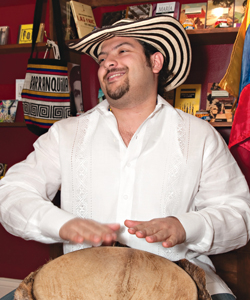
"Colombian Exposition"
By Benjamin Ortiz, for Café Latino Lifestyle Magazine
February/March 2010
Leo Suárez believes that the empanada will be the next taco.
“The empanada is the emblematic street food of Latin America,” he says of the traditional stuffed turnover. He thinks this tasty fritter has the potential to be as popular as Mexican cuisine.
In fact, he’s betting that Colombian food and music are in line to gain widespread acceptance in the United States. If that’s so and his wager pays off, then Chicago will be the epicenter of a Colombian empanada and coffee kingdom to rival Starbucks.
Owner of the two Las Tablas establishments, Suárez, 25, opened Macondo Colombian Coffee & Empanadas shop across the street from the popular Lincoln Avenue steakhouse location in October. With his new business – named in tribute to the archetypal Latin American village from Gabriel García Márquez’s 100 Years of Solitude – Suárez aims to franchise not only the empanada but also the culture of Colombia’s Afro-Latino Caribbean coast.
“Fast-forward 15 years from now, and Colombian music is going to be just as accepted in the mainstream as Cuban music and Brazilian music,” he argues.
Enter the Macondo coffee shop and you experience the flavor of Barranquilla, where Suárez was born. Tambora and alegre drums mark irresistible cumbia rhythms that mingle with coffee steam and the piquant aroma of “Chicago’s only single-origin organic Colombian espresso blend.”
Order a tangy cup of Juan Valdez CaféReale direct from the Federación Nacional de Cafeteros de Colombia. Macondo is the first spot in Chicago to serve the farmer-owned brand that supports social programs back in Colombia.
A barista wearing a sombrero vueltiao – the popular campesino hat handwoven from caña flecha cane strips – will serve your coffee and a fresh-baked Pastel Gloria, a flaky pastry shell filled with guava paste (bocadillo) and maybe arequipe (dulce de leche caramel).
While you’re waiting, you can watch wild performances of Bullerengue and Champeta music on DVD with Colombian cantadoras Totó la Momposina and Petrona Martinez, or enter a tiled alcove where handcrafted hats, purses and jewelry are on display, or read a book from the Spanish-language library among reproductions of Fernando Botero paintings. You can also buy a music CD or take home Colombian goods such as candies and chocolates.
If you’re hungry for something a bit more hearty than the pastries prepared fresh every morning by Macondo’s Colombian baker, José Chavez, then try the almuerzo corriente, a commonplace Colombian meal, with pinchos (skewers) of beef or chicken, rice and beans, and platano maduro (ripe plantains).
macondo inside 3But don’t forget the empanadas! Cooked in the style of Tolima province in central Colombia, these corn flour-shelled goodies are fried in non-trans fat vegetable oil. Macondo says it’s “the only empanada-focused business in Chicago” that offers completely gluten-free fritters.
In estilo Tolimense, Macondo empanadas are somewhat smaller than other kinds and come two per order. The Tradicional pays homage to the standard beef and potato empanada, but there are many variations. Try one with mozzarella cheese and spicy chipotle sauce, or mozzarella with guava, or chicken, all with a side of savory ají hot sauce.
Suárez is ready to roll out new empanada fillings, and he will solicit customer requests for their favorite ingredients. But don’t tell him it’s not authentic Colombian food. “The empanadas that we sell here are from the exact same recipe that my grandmother fed her family on,” he says. “She would literally wake up before dawn to make about 500 empanadas, and my father, when he was a kid, would take them to this truck stop on the highway along the path to Bogotá to sell them, and that’s how they lived.”
Suárez didn’t plan on becoming a restaurateur, but the family business of Las Tablas swallowed him up after his studies at Northwestern University. He hopes to pursue a PhD in ethno-musicology someday.
Meanwhile, he mixes music with business by co-sponsoring performances around town, bringing groups to Las Tablas, managing the traditional Afro-Colombian Grupo Rebolú based in New York City, providing musical direction for the dance company Tierra Colombiana and performing with the Afro-Latino percussion group Ngoma Alegre.
As if all of that weren’t enough, he sees Macondo becoming a franchised fair-trade coffee shop that will have its own non-profit music label to record and preserve endangered Colombian culture while contributing to community survival in South America.
“I’m trying to change the one-note overall perception of Colombia held by Americans, other Latinos and even some Colombians alike,” he says with zeal. “From a business standpoint, the culture has so much potential, and I want to be at the forefront of that now, in the early stages.”
INFOBOX
Macondo Colombian Coffee and Empanadas
Where: 2965 N. Lincoln Ave., Chicago
Hours: Sunday - Thursday, 8 a.m.-8 p.m.; Friday and Saturday, 8 a.m.-9 p.m.
Info: (773) 698-6867, http://macondochicago.com/
Angel Otero Profile (Café Magazine)
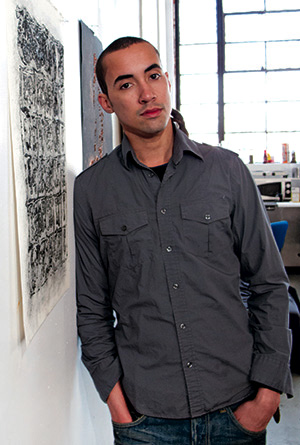
"Making It Personal"
By Benjamin Ortiz, for Café Latino Lifestyle Magazine
February/March 2010
Angel Otero’s first art assignment came from his grandmother, back in Bayamón, Puerto Rico, when her plants died. “She would make me put a stick next to the plant that was dead,” he recalls, “and make me attach the plant with some sort of cord around the stick, so the neighbors wouldn’t know that her plants were dead – so the plant could still be standing up.”
You might call this his first experiment in creating a “still life” as a figurative domestic illusion. Otero remembers such things from his upbringing with “Abita,” as he calls his grandma, the woman most responsible for influencing his rise from copying Hello Kitty designs and cartoon characters to forging a solid artistic career as an award-winning painter and sculptor.
At 28, “he has done in one year what many young artists might take a decade to do,” says Gail Levin, director of the Leonore Annenberg Scholarship and School Fund, which awarded Otero its Fellowship in the Arts for 2009.
With an impressive collegiate and post-graduate career recently accomplished at the School of the Art Institute of Chicago (SAIC), Otero has garnered raves and buzz, along with his awards, as a young artist of international significance who is in high demand.
But it all started with “Abita.” All the little details of how grandma creatively conceived of a warm home space persisted in Otero’s mind years later when he’d find himself shut up in a Chicago studio with snow falling outside. The plant-pots and vases, little porcelain figurines, the doilies and hand-woven coverings that turn wooden planks into a family table, “I started taking these memories and objects and confronting them … all these things have been pretty much my major subject matter,” says Otero.
The exhibit “Angel Otero: New Paintings” provides a sampling of works showing his artistic trajectory from school to New York, where he currently holds studio space thanks to the Annenberg award. This exhibit of 12 to 15 new works is “Otero’s largest solo show to date,” announces the Chicago Cultural Center, whose Sidney R. Yates Gallery is hosting the showing of pieces from private collections and Otero’s studio.
Lanny Silverman, Curator of Exhibitions with the Chicago Department of Cultural Affairs, points out the artist’s “unusual use of materials, the blending of collage and painting, effects of illusion of what’s real and what’s painted, and very personal content” as all notable facets of the show.
In an interview with Café Magazine, Otero speaks from his studio in the Bushwick neighborhood of Brooklyn, where he had just rushed back from the New Art Dealers Alliance (NADA) fair in Miami. His work quickly sold out on the morning of exhibition to collectors and museums. On his way over to a show at the Leyendecker Gallery of the Spanish Canary Islands, Otero is still pumped up from NADA, where two museums acquired some of his works.
With humility, he mentions thinking about his family while in Miami: “My family was never very into cultural interests or the fine arts or nothing like that… So I think about my family because they were very difficult towards what was my interest in art. [They’d say,] ‘Don’t study that because it’s not going to bring us food, you know?’”
Otero recounts this story with nothing but affection for his family in his voice, even though now, “I can say a museum bought a painting, which is the most important step of any artist’s career, and they don’t really get it at all.”
Otero describes his process now as experimenting with materials and creating abstractions based in familial commonplaces and scraps of inspiration from Puerto Rico, including the mountains and twisting cities built into the mountains. Even so, he does not create literal renderings of the island, instead opting for less obvious and more quietly personal references to growing up in Bayamón.
“There is a story he’s telling about his past, about the rich visual culture that surrounded him as a child,” says Lisa Wainwright, Interim Dean of Faculty, Dean of Graduate Studies at SAIC and one of Otero’s mentors. “He’s very much in the tradition from Picasso to Rauschenberg. He takes the still life as his armature, as his constant subject, and then he does things to it, he does remarkable things to it, and it’s pretty pleasing to see a format that you recognize in the history of art updated in a way that is radically new.”
Wainwright also describes Otero as a workaholic, someone who has “this inner necessity, this drive where they just can’t stop,” as Kandinsky put it. She says that viewers of his show at the Cultural Center will be able to engage “a sensibility of life, a kind of joy and energy that is infectious,” referring to Otero’s personality that won him fondness at SAIC from teachers and fellow students alike.
Regardless, Otero still thinks it’s a wild idea that a skinny Puerto Rican kid from Bayamón has gone so far. He’s now relocated to the Bushwick neighborhood of Brooklyn because he sees it as a promising arts district comparable to Williamsburg or the Lower East Side.
“It’s cheap, and there are a lot of new upcoming artists moving to the area – I felt I wanted to be a part of this movement.” Nonetheless, he is thinking seriously of returning to Chicago at some point, the city whose cold winters inspired him to stay in the studio longer and get more work done.
INFOBOX
Angel Otero: New Paintings and Sculpture
When: Ends March 28
Where: Sidney R. Yates Gallery, Chicago Cultural Center, 78 E. Washington St., Chicago
Info: (312) 744-6630, www.ChicagoCulturalCenter.org
"Christmas, the Acculturated Way" (Café Magazine)

"Christmas, the Acculturated Way"
By Benjamin Ortiz, for Café Latino Lifestyle Magazine
November/December 2009
Growing up along the border, I spent almost every Sunday going to Matamoros, Tamaulipas. It was a pattern that became familiar – get up early, gulp down barbacoa tacos, go to church and then trek across to Mexico. The feasting, prayer and travel seemed both a spiritual and cultural renewal for the family, like a little Tex-Mex holiday to begin every week.
But these trips weren’t always comfortable, as my sister and I preferred to stay home sometimes. Coming from a sleepy Texas town whose population peaked at 3,000, we found Matamoros to be a congested, polluted and fast-moving place of extremes in poverty and violence. Moreover, my sister and I took the brunt of our cousins’ sometimes playful but usually painful references to us as pochos – americanos of Mexican descent who lost their culture, language and true homeland.
Even so, holidays along the border were not strictly American nor Mexican for anyone on either side, but a fusion of what we would throw together – a little bit of Catholicism and a whole lot of Coca-Cola. Christmas and New Year’s Eve were especially memorable, since we often stayed in Mexico overnight.
We’d arrive at our relatives’ cold, poorly heated house with gifts for family and neighborhood kids alike – little knick-knacks and dollar-store stuff. I personally looked forward to what my sister dreaded: the cheap, easily acquired fireworks available at every corner kiosk. I remember seeing those fireworks light up the smoggy night sky, as neighbors reenacted Joseph and Mary’s search for shelter with posadas, ringing out over the firecracker blasts with carols and cries of “Tamales!”
As we grew older, the visits became more rare. We ultimately lost touch with Matamoros and assimilated into the holly-jolly culture of Santa Claus and the traditional New Year's song “Auld Lang Syne,” like many subsequent generations of Americanized Latinos who join in the holiday rush with gift lists and champagne at midnight.
Despite distance in time and space, Chicago Latinos still manage to renew cultural ties to the homelands of our ancestors through the dynamic flow of immigration. Caravans heading to Mexico typically take off for the Dec. 12 observance of La Virgen de Guadalupe day and stay through Jan. 6, the day of the Three Kings’ visit to the baby Jesus. The exodus is so dramatic that a Waukegan Public Schools source estimated in a 2007 Chicago Tribune report that 10 percent of Hispanic students in the district are absent for almost a month over the holiday season.
Many, of course, can’t leave, and so the celebrations go on with Chicago flair. As Latino writer Luis Alberto Urrea put it in a 2004 New York Times op-ed, “Every American city is now a border town,” noting the corn husks and masa mixes available at supermarkets for a “traditional Christmas meal of tamales, but Chicago style – with bratwurst instead of beef.”
HOUSE MUSIC AND HOLY DAYS IN D.F.
“We’re the ‘Everybody Loves Raymond’ house, but Mexican-style,” says Mayra Neria, a 35-year-old first-generation Mexican-American born and raised on Chicago’s North Side. She talks about how close-knit her family remains, with an aunt and grandparents living within a few blocks of her mom’s house.
“Basically, there are four generations in one house,” she says, mentioning her own daughter, Jessica, who is kicking off the Americanization process by moving out to go to college. “For her to leave the house to go to school, it took a lot [because] we don’t leave – you don’t leave until you’re married.”
Even with traditional Mexican mores dominating her upbringing, Neria gravitated toward the booming bass of Chicago house music and soaked up as many musical influences as she could tune into on the radio. But along with “the big hair and the bright, bright lipstick” of ’80s DJ parties, she remembers traveling to her parents’ homeland of Chilangolandia – Mexico City. There, she picked up dance steps from relatives so she could hang with guaracha as easily as disco.
From the age of 6 months on, Neria traveled back and forth between Chicago and Mexico City a few times each year. “This was all throughout my childhood, and same thing for the most part in my adolescence until I had my daughter, and then it kind of tapered off a bit.” She grew up with her cousins as an extended batch of siblings who were curious and in awe of the trendy Chicago that she was discovering.
“It wasn’t until I was 15 or 16 that I got an appreciation of the architecture and urban culture of Mexico City,” she remembers. “At 17, I took a trip to visit my cousin, and we went over to the Basílica de la Virgen de Guadalupe, and I never felt such an overwhelming emotion like I did that day walking into it. … It’s phenomenal.”
Neria feels a sense of Greater Mexico in her own home during the holidays, but she still travels to renew her memories and to share traditional experiences with her daughter: “Christmas has always been my favorite, because there’s the posadas. … It’s not like here. Even the piñatas – they have peanuts, they have sugar cane in them, they have oranges – I hate to use the word basic, because to us here it is basic, but there it’s super-cool to gather a big bag of peanuts from a piñata!”
She goes through a catalog of commonplaces – ponche (fruit punch cider), midnight Mass and the baby Jesus of nativity scenes that neighbors would dress up for Christmas Eve and treat to caresses and carols. She also talks about the real gift-giving day, Jan. 6, that makes for an extended Mexican holiday: “It wasn’t a very big thing when I was growing up, but now that I had Jessica, and my cousins were around, we started getting them more used to the idea of Los Tres Reyes. … Jan. 6 [is] when they have gifts for their kids, and over here, you know, let’s buy the rosca, and whoever gets El Niño Dios has to throw the party [on Feb. 2] – I mean there’s always a party for one reason or another.”
EPIPHANY ON EL PASEO BORICUA
Poet Eduardo Arocho remembers a particularly disturbing cultural mish-mash at a Chicago parade observing the Jan. 6 Día de los Tres Reyes Magos: “We had the Three Kings, and Ronald McDonald was on the horse wagon too. And I said, ‘Uh, uh, no, he isn’t supposed to be there!’”
At 39, Arocho has played a significant part in not only learning his own cultural roots but also sharing them with all of Chicago. As executive director of the Division Street Business Development Association, he’s helping build the neighborhood around a core of Puerto Rican commerce and culture.
He describes his journey as self-discovery and re-learning of lost traditions, including his switch from the Baptist religion of his father to Catholicism: “I just felt that it was a religion that I had to know more of because I wanted to feel closer to the culture.”
Growing up with mostly mainstream Christmases, Arocho slowly absorbed Puerto Rican influences at a distance, from his brother’s stories of Jan. 6 celebrations on the island to the first time he went with a church group on a suburban parranda, the tradition of singing aguinaldos [carols] from door to door and being welcomed in for food.
In college at Northeastern Illinois University, he started to work for various cultural institutions, where he was introduced to woodcarvings of saints and the Three Kings. Arocho went to Old San Juan in January 2005 to experience Tres Reyes Magos celebrations on the island firsthand for the first time. It was a historic time to Arocho because Puerto Rican representatives in the garb of the Three Kings had been welcomed by the Pope at the Vatican, and the holiday's special moment of international recognition was everywhere in the newspapers and in songs ringing out from the streets.
He remembers also the unveiling of the flag sculptures on Division Street on Jan. 6, 1995, and how a haphazardly organized parade, with toys and chocolate for the crowds, has grown into a big winter festival. “Now it’s the first parade of the year in Chicago – and it’s the fastest parade,” he says with a laugh, referring to the rush to get out of the typically frosty weather.
When asked about the significance of the Three Kings for Puerto Rican culture, he centers on Melchor, the African king: “It’s a [matter of] self-identification, and the Three Kings are as popular a representation of Puerto Rico as the coquí – among poor people early on in Puerto Rican history, they were worshipped.”
This year, he talks about introducing a big spin on the Three Kings celebration. “This year, I’m thinking that we should have three women kings, to do a little something different,” he says.
"Live rock, warts and all" (Chicago Tribune)

Feature and sidebar:
"Live rock, warts and all:
Catch local bands as they get their shot onstage and on camera with 'E > N > E Chicago Rocks'"
By Benjamin Ortiz, Special to the Chicago Tribune
Section: On the Town
Date: November 6, 2009
Quiet on the set!
The Cobra Lounge slowly picks up life on a generally slow Sunday night, but for local band GreenSugar this is a chance to lay its sound down for posterity and expand its reach. The Southern-rockish combo does a microphone check that not only has the sound tech toggling switches -- two video cameras are setting up, boom-mics are being tested and another audio-tech guy is patching into the sound board.
Because taping is about to start for "E>N>E Chicago Rocks," a TV show and music series featuring local bands -- with you in the audience making devil horns as you head bang, right there on the screen. But it's also a show with your favorite venue as the backdrop to a rock 'n' roll experience that you can enjoy in person and at home on the Wednesday after the gig. Just tune in to Chicago cable channel 25 at 9 p.m.
Maybe you haven't had the chance to see a good concert in a while, so why not let the show come to you, with its flavor of being right at center stage and an all-access pass to the whole scene, including band interviews and a taste of Chicago's rock lifestyle.
GreenSugar boasts two drummers, which the "E>N>E" production crew hasn't anticipated. "How are we going to mic that?" asks cameraman Jose Calvo, one of the cable-access show's crew. Director Hector Ivan Garcia works with him to jury-rig a solution, while producer Sandra Trevino checks in with volunteers who will help coordinate, host, produce segments and interview bands throughout the night.
At tapings, "E>N>E" has eight to 12 volunteers, and Garcia says, "The show's put together with a lot of great people that are dedicated -- it's a volunteer army, and they're there every week because they believe in it just as much as we do, and this show really gets done by the people of Chicago."
"E>N>E" started in 2002 with Garcia and Trevino wanting to document the alternative Latino music scene. The duo's sometimes guerrilla-style footage and band interviews were broadcast on public access TV. It was sort of a Latino "Wayne's World" that was trying to capture Chicago's Spanish rock, even though most local attention has gone to typical regional Mexican music and salsa, or the big names of Latino pop appearing at the biggest venues.
Although Garcia studied film production at Columbia College Chicago, he admits their first attempts to shoot video were amateurish, : "We tried to do it with one camera and the onboard mic, attempting to capture a band performing live, and it was ridiculously bad audio, but the bands were happy to be on the show."
Trevino remembers how some footage came out shaky when she became exhausted holding up the camera and running around for hours to shoot.
They produced some shows for CAN-TV, and then the City of Chicago's Cable 25 for 2 1/2 years, but "since channel 25 started charging, we eventually couldn't pay because it was all out of pocket," Garcia says.
They restarted "E>N>E" in April with renewed vigor and a plan to sell ads that would pay for airtime and production, along with the current format of visiting venues around town to capture three bands on video in front of a live audience, to sample the atmosphere of a living, breathing rock show. "I can go on record saying we were the first Latin alternative rock show in Chicago, not as a one-off little 'look at these rockeros' segment or Sabado Gigante thing," Garcia says.
"E>N>E" is now produced by Enchufate, the Latin alternative media and entertainment company that Garcia and Trevino created in 2005 out of a music blog. Now Enchufate (Spanish slang for "hook yourself up with the scene") is a multimedia Web site and organization that promotes just about every Latino touring act, and many local shows that fall into the alt-Latin category, connecting with a broad network of radio programs and rock venues and producing a weekly Spanish karaoke series, with information and giveaways for coming shows.
Since April they've shot and featured bands at Cobra Lounge, Reggie's Music Joint, Betty's Blue Star Lounge and Tiger O'Stylies in Berwyn, with coming shows at Subterranean. The format now has bands prep for a nine-minute live segment with an on-site audience, followed by a three-to-five minute interview.
"E>N>E" also showcases bands from outside the Latino-rock world. Sunday's show with GreenSugar was all English-language music, with a bill that included a heavy-metal combo and a glam-rock sounding group.
The taped product cuts quickly from band to band, with bilingual hosts introducing and interviewing while showcasing venue environs, from street-level signage to bar-side babble. Lasting an hour, the program also throws in older and more recent snippets of interviews that Garcia and Trevino get from touring acts.
They keep a dry set while taping, making sure their volunteers and bands don't bring drinks into the mix, and though their approach is much more professional these days, the show still has the flavor of their on-the-fly days. "E>N>E stands for Errores No Eliminados, Errors Not Eliminated," says Garcia, "and it came out of the idea that we were sick of all the polished (stuff) and wanted to show everything real on camera, warts and all -- I think that if we ever do playback on the show, I'm out of here, you know, if we ever put on a CD for bands to lip-sync to, because they're performing live, whether they mess up or not."
Trevino talks about how bands sometimes freeze from nerves when the lights go on and the video starts rolling: "It's fun to participate in a live program and to cheer on local talent, and whatever comes out of those nine minutes is what's going on TV -- you'll see bands and how their mood changes a little bit when they realize they're on camera."
"Every show, it's like what the hell's gonna happen next," Garcia says. "But being there cheering and knowing the cameras are rolling gets the crowd excited, and bands will bring out their whole family like it's The Ed Sullivan Show,' like TV matters again."
SIDEBAR: “A look ahead at ‘E>N>E’”
The "E>N>E Chicago Rocks" series features free live music at 9 p.m. every Sunday this month at Subterranean (2011 W. North Ave.). Most nights see three local bands, each playing a nine-minute set for a chance to be on TV when the videotaped show airs at 9 p.m. Wednesday on Chicago's Cable25 channel.
Bands range from Latino alternative music to electronica and straight-up rock 'n' roll, but November is unplugged and acoustic, offering a folksy take on "E>N>E>'s" typically raucous lineup.
Sunday: Singer-songwriter Edwin Days performs bilingual, electronica-influenced tracks from a coming release.
Nov. 15: The series matches rumba-flamenco fusion with rock en Espanol when Vivian Garcia and Sobre appear.
Singer and guitarist Garcia says she doesn't really do "flamenco puro" but instead mixes "Spanish traditions with Cuban rhythms." Usually appearing in a trio with a flamenco dancer, Garcia will perform at Subterranean with her lead guitarist in a pairing reminiscent of Mexican duo Rodrigo y Gabriela.
"2012: The End or a New Dawn?" (Café Magazine)
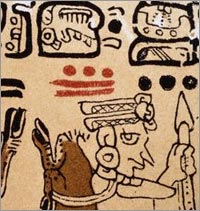
"2012: The End or a New Dawn?"
By Benjamin Ortiz, for Café Latino Lifestyle Magazine
September/October 2009
“Give yourselves up, my younger brothers, my older brothers, submit to the unhappy destiny of the katun [time cycle] which is to come. If you do not submit, you shall be moved from where your feet are rooted. … Sand and spray shall be raised aloft. The face of the sun shall be darkened by the great tempest.”
— “The Book of the Chilam Balam of Chuyamel”
Ancient Mayans imagined the Dark Rift at the center of the Milky Way Galaxy as a sacred portal and womb of cosmic birthing, through which Jaguar Priests voyaged in mystic fugues to receive messages from the gods and the divine essence of the supreme creator, Hunab Ku.
Contemporary science caught up in September 2002, discovering a massive black hole in the galactic hub, a place where stars are born. In 2005, astronomers and scientific institutes also noticed an unusual structure shaped like a loop, spanning across 20 light years, in the middle of the Dark Rift black hole, from which gravity and radio waves have strangely been emanating.
What’s more, the earth’s electromagnetic field has been weakening and becoming porous, with holes that leave us open to cosmic forces, portending a complete pole reversal. Meanwhile, the National Center for Atmospheric Research foresees extreme solar activity accelerating over the next few years, potentially threatening satellites, power grids, communication and data systems – and weakening the ozone layer while increasing global warming, mega-storms and cancer mortality from radiation, possibly even setting off geo-thermal catastrophe in a synergistic cauldron of earthquakes, tsunamis, volcanoes and deadly radiation.
By the way, the Yellowstone National Park volcano sits atop uranium deposits and is long overdue for a massive eruption that would rain immediate and long-term death onto the earth.
But that’s not all. Per Associated Press reports, a 2005 earthquake in Ethiopia opened a 37-mile-long crack in the continent that some believe might yet split Africa into pieces. And according to Russian geophysicists, the Solar System might be colliding with a pocket of interstellar energy that could exacerbate everything else going on. Some scientists are looking into the little-known effects of gravity and electromagnetic energy between planets and the sun, wondering what will happen when the Earth crosses the center of the galaxy in 2012 and enters the galactic equator, a zone of violent celestial activity.
The Mayans saw that coming, too. In fact, long before the blessings of European civilization arrived, the Mayans knew that the winter solstice on December 21, 2012 would bring a galactic solar eclipse, as the sun and earth line up with the Dark Rift. They also knew this would be a time of great upheaval and change, and you don’t have to be a mystic shaman to recognize the truth of that vision. But they also predicted that our way of life would end with a screeching, crashing halt in 2012, ushering in a golden age of the Sixth Sun, for those around to enjoy it.
Interest in 12-21-12 has become a full-force pop phenomenon (see “Mayan Doomsday Pop” sidebar). What makes this doomsday different is a wealth of concordance with astronomy, quantum physics and cross-cultural synchronicity (see “Mondo Apocalypto” sidebar), as well as the power of Mayan Cosmovision, a way of life based in stunningly accurate astronomical and mathematical calculations that put the Mayans in tune with galactic movements. It’s a bit of poetic justice for a people whose civilization collapsed just before the Spanish conquest, as their worldview and indigenous spirituality have returned with a vengeance.
MAYAN GROUND ZERO
Carlos Mejía opens his cavernous garden apartment on the northwest side of Chicago and sets aside the dinner his comadre just handed him so he can talk about Mayan Cosmovision. He’s a marimba teacher affiliated with the Mayan Folkloric Organization and Casa Guatemala, and his humble abode is dominated by a few marimba boards, with spare books, Mayan trajes (suits) and a dreamcatcher providing the only décor.
He’s also a Quiché Maya guia espiritual (spirit guide) named Phal, for his ancestors, with roots in Chichicastenango, Guatemala. He uses a calendar produced by the Fundación Centro Cultural y Asistencia Maya (CCAM) to explain the significance of Mayan timekeeping: “Every day has meaning that connects you with the Cosmovision, with Mayan thought, so that you do not disconnect the human being from natural and stellar processes … This is the essence of life for the Mayans, and this is what humans lost when they socialized. They became materialists and divided the spirit from the mind from the physical realm, everything broken up.”
Despite the disasters that befell indigenous peoples under colonialism and then neo-liberalism in Guatemala, Mejía speaks of an open and welcoming tradition. “Mayan thought is about mutually thriving and sharing, and that’s the tradition I impart through music to the whole world, Guatemalan or not.”
Spaniards destroyed much of Mayan material culture, but possibly as many as 20 hieroglyphic calendars survived, some held and protected by Mayan elders. With roots going back to 2000 BCE, Mayan civilization covered Guatemala, southern Mexico, Belize, Honduras, El Salvador and the Yucatán. Their sacred texts included the “Popol Vuh,” the Quiché Mayan book of Creation, chronicling the “The Dawn of Life” in a mytho-cosmology based in their knowledge of the heavens. Using their texts and calendars, Mayans consistently applied their cosmological insights to urban planning (temples, observatories, pyramids) and understanding the body itself as a microcosm of the entire universe.
Calendrical information was coded into their entire way of life, and as science consultant and journalist Lawrence E. Joseph puts it in “Apocalypse 2012,” “Overall, the 2000-year-old Mayan calendar is believed by many to be more accurate than the 500-year-old Gregorian calendar we use today.” Their calendar is actually one timekeeping system with many interlocking pieces, all tapped into cosmic cycles spanning billions of years.
Mejía explains, “If you are un-mindful [person] and [are] out of sync with natural processes, you will suffer, you will be lost. If you are mindful, it’s because you are living wisely and consistently with the universe.”
His CCAM calendar adds, “The Mayans do not talk about the end of the world. The only really important and relevant thing is the spirit on its voyage of evolution to superior levels. All of the prophecies seek a change in the mentality of man. So that humanity would expand across the galaxy, understanding its fundamental integrity and affinity with all that exists.”
But here’s the problem, according to Mejía: “Instead of understanding Mayan Cosmovision, we are confused and fearful of 2012, so we are not prepared. Humans are self-destructing, and to try to remedy the situation at this late hour will be hard. There will be consequences.”
SELF-SHAMANIZING FOR A NEW WORLD
Over e-mail, neo-shaman and mystic Jose Argüelles says that Latinos “should take pride in the fact that the Mayan people had sages among them and prophets as well who could calculate such matters and know the future so well. This should remind us of our spiritual and mental heritage, and in anticipation [of 2012], we should turn to a more spiritual inclination of life.”
Of course, it’s easier (and often more entertaining) to focus on disaster and destruction than spiritual evolution, but Mayan thought would have you do the hard work of self-transformation first before you deal with global change or even try to change the world yourself. Mejía adds that you don’t necessarily have to give up Christianity or any other religion in order to appreciate Mayan thought and benefit from indigenous ideas.
Chicago labor activist and first-generation Guatemalan-American, Jose Oliva sees “Mayan cosmology present in everything I do, but especially in my work.” As policy director for a national workers’ rights organization, Oliva thinks Mayan Cosmovision emphasizes human agency, and thus “our paths are completely malleable and even breakable … I think of it as not simply a metaphor for our work in the [labor] movement, but an actual roadmap.”
At 36 years old, Oliva has soaked up Mayan thought from past teachers at Casa Guatemala, including Carlos Mejía, and he calls 2012 “The New Beginning.” But Mejía breaks down the path to wisdom into simple steps toward mindfulness, including meditation techniques and attuning oneself to insights that come from learning and following the Mayan calendar. This, he says, would be the basis for any hope of social justice.
Argüelles likewise advocates a calendar switch: “The Gregorian calendar is the calendar of history, colonialism and European conquest.” But he also enumerates some basic practices toward mindfulness that seem wise in any walk of life:
1. Submit to the will of God.
2. Eat healthy.
3. Be happy.
4. Change your frequency [of time from the old calendar].
5. Love everybody!
The CCAM warns of what will happen without fundamental changes: “If we continue on this negative course of hating each other, of environmental destruction, of fear and egoism, we will be diving headlong into destruction, into chaos and the disappearance of ourselves as a sentient species on this planet.”
With a smile and unquenchable warmth, Mejía concludes: “What does 2012 matter? What happens, happens! What’s most important is that human beings live in mutual coexistence, that we wake up and come out of the darkness of our shadow. Then humanity would finally re-encounter its true self, its proper place in the universe. That would be beautiful, no?”
SHORT LIST OF 2012-RELATED WEB SITES
● Apocalypse 2012: www.apocalypse2012.com
● Galactic Research Institute: www.lawoftime.org
● Mayans: tribes.tribe.net/mayawisdom
● 2012 Predictions: www.2012predictions.net
SIDEBAR
MONDO APOCALYPTO
We’re born and bred on apocalypse in the United States – all those evangelical “Left Behind” novels are just the tip of the iceberg for a culture obsessed with The End.
But almost all cultures have an apocalyptic streak, some that eerily coincide with Mayan visions: Lord Krishna spoke of a golden age following world-wide destruction in the Kali Yuga time cycle; the Roman Empire’s Sybil oracle predicted that the last of all generations would begin in 2000 A.D.; anthropologist Terence McKenna found a “time wave” pattern in the I Ching oracle with an end-date of 12-21-12; the medieval Celtic shaman Merlin foresaw 21st century disaster, possibly including a polar shift; an Israeli mathematician cracked a “Bible Code” from the Hebrew Torah, suggesting a coming comet disaster; and the Hopi of the American southwest have long prophesied an imminent transition to the fifth world, initiated by rising oceans and the sun heating up.
Like the Mayans, ancient Inca shamans also predicted a time of reckoning consistent with the 2012 deadline – contemporary Peruvian Q’ero Indians, New Zealander Maoris and some Cherokee elders agree on the date, too. (And let’s not even get started with Nostradamus!) Our contemporary seer appears to be the Web Bot Project, a global cyber-oracle using Internet-spiders to tap into the collective unconscious – it supposedly predicted 9/11 and now sees a bad moon rising for humanity.
SIDEBAR
MAYAN APOCALYPSE GOES POP
Believe it or not, Mayan Cosmovision now dominates our thoughts and senses in a cottage industry of apocalyptic artifacts. Dismiss it as nonsense, but 12-21-12 is gathering cultural force in blockbuster pictures, documentaries, Web sites and its own subject-section at bookstores.
For starters, there’s “The Complete Idiot’s Guide to 2012.” Novelist Whitley Strieber, who wrote about his own alien-abduction experience, gets in on the action with “2012: The War for Souls,” slated for Michael Bay treatment in a Warner Bros. film coming next year. John Cusack and Roland Emmerich also use 2012 as fodder for big-screen catastrophe-porno in a November Sony release whose trailer already has popcorn falling out of mouths agape. And of course, the straight-to-video market is starting to crank out cosmic DVD B-fare.
A recent History Channel program on “The End of Days” provides more sober visual entrée, but a quick YouTube “2012” search yields a universe of disastrous delights and prognostications seeding the Web with Mayan-inspired images and ideas.
"Humboldt Park Nouveau-Rican" (Café Magazine)
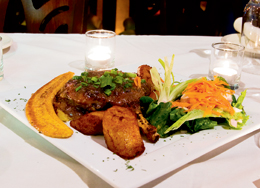
"Humboldt Park Nouveau-Rican"
By Benjamin Ortiz, for Café Latino Lifestyle Magazine
May/June 2009
Step into Coco Modern Puerto Rican Restaurant and Lounge, and “Los Mejores del Mundo” greet you at the door. It’s a panorama of Caribbean greats, from Tito Puente to Felix “Tito” Trinidad to Celia Cruz and Don Pedro Albizu Campos, captured across paintings by artist Adalberto “Cuco” Rivera.
Festive photos, sketches of bomba y plena sessions with plantation panache and a 25-foot-long sculpture-mural titled “La Boricua” enhance the rich, exposed brick and dark-wood interiors that compose a long room with private vantage points rounded by gauze-thin earth-tone curtains. Against the back wall, a faux-balcón opens the kitchen to a full view, while toasting Old San Juan’s snaking streets and vistas.
The art works and dining display celebrate the diversity of talents from La Isla del Encanto, and it feels like they’re all here to join you for dinner, drinks and maybe some salsa, if you meet the right dance partner.
You head for your table, past the middle-aged white couple that will stay on the dance floor all night, from happy hour till the band warms up for a medley of merengue, bachata, boleros – whatever the crowd feels. But before all that gets started, how about a drink first? Try the Bochinche Martini, described by the menu as “The gossip drink…Sure to make you talk.” Lime juice, coconut, fresh mint and vodka give it that urban-lounge savor, but with a tropical twist.
Dark and curly-coiffed ladies at a table across the way lift their oblong martini glasses with long, sparkly, neon-blue fingernails contrasting mango and coconut-colored highlights. As the place gets moving with people packing the 65-capacity dining area and cozying up at the bar, you’re distracted by the tables filling with a variety of cultures, styles and versions of Spanish.
For starters, try some plantain tostones stuffed with crab, a mini-jibarito sandwich and bolitas de yautia, breaded and mashed root vegetables with a side of sofrito-tinged sauce. In one Bandeja de Coco appetizer tray, your palate enjoys the collision of indigenous Taino, Spanish and African foodstuffs, reinterpreted a la Nuevo Latino cuisine straight from the heart of Humboldt Park.
But before you can think about the main course, the Bochinche Martini starts working its magic, loosens the lips and gets you talking. At the next table, two younger, mixed-race couples are double dating, so you ask why they chose Coco for the night. “It’s Chicago,” says Christine, a 20-something Latina. “It’s so diverse, and you gotta try everything.”
This is the kind of place where you can easily meet new friends and end up closing the joint down when food service yields to live music – samba on Thursdays, DJs on Fridays and a full salsa combo on Saturdays, all going from 10 p.m. till closing.
Like his clientele, owner José Allende fills the room with warmth and spirit, one minute welcoming you at the door, the next suggesting an entrée and then tweaking the house speakers for just the right atmosphere and balance of lively dining. He joins you for a bit and talks about the inspiration to open this place – basically, to offer Chicago’s first upscale Puerto Rican dining experience.
From the art collection to the music to the traditional eats jazzed up with five-star estilo, Allende intends Coco to be the spot where you want to take mom on Mother’s Day, a place where you can also learn and be proud of the Puerto Rican culture. “I think the bottom line is that people never viewed Puerto Rican food like this,” he says, referring also to the odyssey of research, travel and hard work that has kept the place open for more than five years now.
“A lot of people still don’t know about Puerto Rican food – they come in sometimes and say, ‘Where’s the chips?’ No, really!” He cuts loose with a typically full, gusty laugh that hits high notes with joy, coming back down to a serious but light-hearted tone. “I have to admit, I was told when we first opened that it was not gonna work.” Allende remains the sole owner, head chef and host extraordinaire.
But back to dinner, right? Allende recommends the mahi mahi with lobster bisque sauce and mofongo de yuca. Or the pork chop stuffed with plátano maduro and raisins. Maybe with an after-dinner rum and flan.
The tables nearby are getting really flirty, and lights are dimming for the band, so eat up and get ready to move. ¡A gozar!
INFOBOX
Coco
2723 W. Division St.
(773) 384-4811
Wheelchair accesible, all major credit cards accepted, Live music
Alt-Cinco (Café Magazine)
"What If...The French Had Won Cinco de Mayo"
By Benjamin Ortiz, for Café Latino Lifestyle Magazine
May/June 2009
IN AN ALTERNATE UNIVERSE…
The United League of Latin American Nations welcomes you to the 47th celebration of Le Cinq Mai, our hemispheric observance of the coming of the French to the Americas and the rise of Imperial Mexico!
From the Arctic Circle to French loyalist strongholds in Chiapas, from cafes lining le centre historique where old Indian women drink café au lait a la Charlotte, to the expatriate bars where the children of the warriors of May 5 reminisce, cries of “VIVE LE CINQ MAI!” ring out with toasts of cheap Chardonnay and warmed-over escargots served like elotes.
Descendants of Austrian and Hungarian Hussars, Belgian troops, French Foreign Legionnaires, and Egyptian and Sudanese conscripts gather at the bistros to regale each other with toasts to their long-passed forbears, the heroes of that long-ago battle that helped turn Mexico into a Euro-Indian nation, a force to be reckoned with in the Western hemisphere.
Along the avenues leading to le Zócalo d’Mexique and le Palais Impériale, little children set fire and explode Judases in the likeness of Benito Juárez to celebrate the triumph of Emperor Maximilian, while upper-class art patrons enjoy the traveling exhibit of “Manet and the Execution by Guillotine of Juárez” at le Palais des Beaux-Arts.
Indeed, the entire North American Union – Canada, Mexico, the United States and the Caribbean – celebrates the victory of French Imperial Mexico that led to a lasting international coalition. Even the United States, its dreams of Manifest Destiny long forgotten, now celebrates Le Cinq Mai as the event that put the Americas on the path to multinational unity, trading now in euros bearing the faces of Maximilian, Napoleon III and Charles de Gaulle.
Across the Parisian-style boulevards of the capital city, the French tricolor flag comes up for one day, as The Marseillaise rings out of every window and drunken murmurs of “TODOS SOMOS FRANCESES” (We are all French) echo well past midnight........
What if the French had won at Puebla on May 5, 1862? What if they had succeeded in creating a French client state for longer than a few years in Mexico? What if they had stayed and effectively challenged the expansion of the United States?
And what would have happened to Cinco de Mayo celebrations, both in Mexico and north of the border? Would the popular and historically incorrect celebration of Mexican military prowess now get toasted with fine wine?
A PROUD SYMBOL
According to the media, popular lore and academic opinion, Cinco de Mayo is bigger in some Chicago suburbs than most of Mexico. Even local grocery stores have been marketing it since the 1980s. It’s a big, mainstream event brought to you by every tortilla chip and cerveza company you can name – driven largely by the influx of Mexican immigrants to the United States.
Of course, Mexico remembers it too, as it became a symbol of the defeat of the well-armed foreign colonizer with only a handful of Zapotec Indians and mestizos. “The triumph was used to galvanize Mexican national identity at a time when the nation was fractured and divided regionally and ideologically,” says Dina Berger, assistant professor of modern Latin American history at Loyola University Chicago. “In the United States, however, you could poll those enjoying Corona specials on Cinco de Mayo, and most would claim the holiday stood for Mexican independence.”
Mexico gained independence from Spain by 1821, but endemic political and economic instability had it in perpetual chaos. In order to recover, the republican government of Benito Juárez suspended payments to foreign debtors, and so in October 1862, France, Spain and England agreed to compel Mexico by military force to repay debts.
The subsequent Battle of Puebla that year was a rare Mexican victory. The French proceeded to expel Juárez from the capital and secure almost a third of Mexico under a Second Empire, with the archduke of Austria, Ferdinand Maximilian, installed as emperor with his wife, Carlota of Belgium.
The Encyclopaedia Britannica notes that Max faced the same central challenge that every previous government had: how to forge political and cultural hegemony in Mexico? Spain and England withdrew from Mexico almost immediately, and Max ended up alienating both conservative and republican factions. Napoleon III eventually withdrew costly French troops as the United States came out of its Civil War and started to pressure France to withdraw completely.
Max had a last stand against Juárez with his remaining Austrian hussars and untrained Mexican conscripts, but he was defeated and later executed by firing squad on June 19, 1867.
A REVISIONIST VIEW
In her book “Mexico and the Foreign Policy of Napoleon III” (Palgrave Macmillan, 2001), Michele Cunningham, visiting research fellow at the University of Adelaide, Australia, argues for a revisionist view of Napoleon III’s interests in Mexico.
Typical interpretations suggest that Napoleon III was really interested in Mexican silver, cotton and other markets, and in establishing a Latin bloc of Catholic nations to check the United States.
Cunningham argues in her book that Napoleon had “a broader vision” than just grabbing more power for France: “Mexico provided an opportunity for Napoleon III to extend his vision for maintaining peace beyond Europe, to embrace the world.” In this account, he wanted to secure free trade as the basis for global prosperity. Cunningham argues that “this would have resulted in a European code and court of appeals, uniform coins, weights and measures, and eventually national interests would have given way to European interests.”
Cunningham confirms these ideas in an e-mail interview. “Maximilian was meant to develop his own army and eventually reduce reliance on France, but he proved to be totally inept … Whether or not a good monarchy would have brought stability to Mexico is one of the great imponderables,” she says.
“Certainly, Maximilian’s execution and the new republican government didn’t bring political stability, and even today the country still has massive problems. One thing that is certain is that the United States would not countenance a monarchy in the Americas.”
What if Napoleon’s intentions had been realized and Max had succeeded in consolidating the factions in Mexico, creating his own army and eventually bringing a Pax Maximiliano to the country?
“Had [Napoleon’s] contemporaries been less conservative and shared his vision,” Cunningham argues, “it is possible that some of the problems in international relations arising in the 20th century might have been avoided.”
In reality, says Paul Edison, history department chairman at the University of Texas-El Paso, “[The intervention] galvanized Mexican nationalism and made it easier for Mexico to overcome longstanding internal political divisions.”
And of course, in the United States, the real significance of Cinco de Mayo is that it has helped spread a sense of North American Mexicanidad, from Chicano Movement protests to pro-immigrant rallies.
SIDEBAR
THE FRENCH INFLUENCE
In the book “Food Culture in Mexico” (Greenwood Press, 2005), authors Janet Long-Solis and Luis Alberto Vargas suggest that French cuisine showed up on Mexican tables in the 18th century: “… the habits of the aristocracy in New Spain took on a French veneer, and French-style garden parties and picnics became popular.”
Though haute cuisine never really trickled down to the masses, you can stroll the Paseo de La Reforma in Mexico City, or walk through the National Palace of Fine Arts and along the Alameda, and you’re taking in the splendor of Maximilian’s imperial Mexico. Dina Berger, assistant professor of history at Loyola University Chicago, says Max modeled the Paseo after the Champs-Élysées.
“By the time of the Porfiriato [the 35-year regime of President Porfirio Diaz],” Berger says, “French cuisine, fashion and architecture were aplenty in the capital.” Diaz’s modernist vision drove the construction of a Parisian capital city and the proliferation of French affectations.
Paul Edison, chairman of the University of Texas-El Paso history department, argues that the French influence was deep and lasting: “The sustained presence of French officers, engineers, doctors and administrators [during the Intervention] had a profound impact on the practice of science, higher education and government in Mexico. For example, French and Mexican doctors together founded Mexico’s National Academy of Medicine in 1864, an institution that continues today.”
In an issue titled “México-Francia, Fascinaciones Mutuas,” the Mexico City journal Artes de México explored parallel aesthetics that link the two countries. The editorial in that issue sums up the broad connections: “Indeed, the very concept of Latin America is a French innovation which we have appropriated. Our Latin roots at once unite Mexico to France, and demonstrate the attractive differences between us.”
Latino Arts Ecology (Café Magazine)

"Redefine, Re-imagine, Recycle"
By Benjamin Ortiz, for Café Latino Lifestyle Magazine
April 2009
Latino visual artists in Chicago are turning their aesthetic concerns over to the environment we all inhabit.
These three artists, in particular, envision and expand notions of environmental themes that connect with both typical and unusual ideas about urban Latino ecology. Whether their themes concern balancing natural with human-made space, seeing art in a wider context of biological and planetary processes, or digging into a spiritual heritage to pay respect to Mother Earth, these Chicago Latino artists are making us look deeper into the environment that we might take for granted from within our skyscraper valleys and vistas.
CHASING THE SUN
Paola Cabal remembers returning to Bogotá in the late 1990s, after growing up in the United States from age 3. Newly elected President Andres Pastrana was attempting to end the decades-long civil war there among the various insurgencies. But, she recalls, “nobody had a sense of nation, a sense of country.” She came away from the experience feeling more “torn apart” than any sense of unity, and that has informed her artistic practices ever since.
Creating site-specific installations, Cabal calls her works “interventions” because she does not believe in pure invention, especially since what’s already there is much more interesting to her, from the spatial context to the audience.
“What I try to do is point up the strangeness of painting,” Cabal, 33, says, referring to the classical idea of creating monuments to perpetuate things. “I like to juxtapose the still, static thing with the real context of ‘always change.’” In the end, she says, “somebody moving through space is ultimately the thing that activates the piece.”
“Shadowtracing,” a piece she did for her bachelor’s degree, was the skeletal winter painting of a denuded tree against the wall of a not-for-profit organization she noticed while going to and from school. She thought first about doing a mural, but then decided to fill out the streetlight shadow. Once the leaves grew back, the shadow effect seemed to fulfill the natural promise of rebirth across the wall.
“Here Tomorrow,” the piece for her master’s thesis, traced patterns of sunlight throughout the day across a gallery space. With no methodology worked out, she ran around with an assistant every 15 minutes all day, tracing patterns. Later, she went back and filled in the traces with white spray paint to look like sunlight. Without trying to, she fooled some audiences into thinking they saw real, natural light.
She has created variations on this theme and tried to imagine natural light in cavernous spaces, also painting sun patterns across others’ works and charting nighttime lighting and reflections. She always accommodates her work and approach to the environment at hand, whether it’s a gallery or a public space.
“One thing that I haven’t done yet that I would like to do is analemma — the pattern that’s made by the declension and ascension of the sun over the course of the year,” she says, relishing the eventual product that will be not only natural but also gorgeous. “It’s beautiful, because the shape that it makes — if you do it right the same day every month, every two weeks if you’re really religious about it — it makes a figure-eight.”
SPIRITUALITY MEETS RECYCLING
Ricardo Santos Hernández calls himself “Consumer Man,” admitting that he’s just as caught up in wasteful materialism as anybody else.
In an essay of the same title, he bemoans the Cermak Road smokestacks spewing “a continuous vaporous smoke” that he sees from his third-floor studio in Pilsen’s A.P.O. building on 18th Street, as well as “the smoldering steel mills and refineries in Gary and Hammond.” To him, these are symbols of environmental racism and a shorter lifespan for the working class.
“I seek to paint these troubling landscapes to negotiate with my tormented heart,” says the artist, who turns 52 on April 3, describing his artistic practice almost in Catholic terms of sin and expiation. Even so, he’s not optimistic about salvation: “I see a strong disconnection between Latinos and the environment … It is really sad, because if you have a disconnect, your soul is also not grounded.”
Hernández sees himself grounded by the desert of his upbringing in Nogales, Arizona. “My dad is indio. He’s from Sonora, a Yaqui Indian, and we’ve always had this idea to walk in the desert,” he says. “I don’t consider myself an individual who practices or follows my traditions, but there was always this blessing and fulfillment from being in the desert.”
Those expansive deserts seem a far cry from Pilsen’s landscape of cramped signage, neon and tenements. Among oxygenating plants and plastic water bottles in his studio space, a decommissioned artillery shell from Army surplus sits atop a dais like a lethal quinceañera cake. Various paintings on display or in the works depict a massive fish kill that Hernández witnessed when he came to Chicago in 1993 to attend the School of the Art Institute.
“Even though Chicago’s very dynamic, it’s also very contaminated, very industrial,” he says.
Playing with found objects and collage materials from magazines, Hernández works through the Latino pop-culture notion of rascuachismo — a funky aesthetic of “making do” with minimal resources. [Rascuache has several meanings, ranging from poor and penniless to kitsch bordering on vulgar.]
Influenced by the work of Chicago muralist Marcos Raya, he also references the typical cultural iconography, such as La Virgen de Guadalupe and Mexican wrestlers, that one finds across mural walls. Thus, his paintings seem at first glance to reflect a recognizable U.S. Latino popular aesthetic, but with a sense of rascuache-as-recycling.
“Rascuache has been elevated to a scholarly and fashionable thing, but it’s really about making ends meet and not being wasteful,” he says. “It’s always been the realm of the disadvantaged, the one who will not make it or is always at the end of the totem pole.”
RE-IMAGINED URBAN SPACE
From atop a skateboard, Juan Angel Chávez might look at the city a bit differently than somebody just waiting for the bus. “What is a bench to somebody is not a bench,” he explains. “It was never a bench to me.”
Kinetically re-using sidewalks, steps and objects for his own jollies rather than what they were meant for, has clued him into new ways of seeing what’s right in front of him, affording the same meditative experience he gets from hanging out in abandoned buildings and scavenging for castoffs in hardy post-industrial ecosystems. “Walk in the old factories, and they’re completely decayed,” he says, “and plants are growing on the roof, and moss is growing on the walls, and you see that nature is beginning to take over again.”
An elemental part of his artistic practice involves working with found objects and creatively tapping into their “personality,” as he calls it. “They’re a part of us — they have a history,” Chávez, 37, says of materials that bear the aura of human use and interaction.
Through these pieces, he aims for an effect that is immediate, humble and unpretentious. Influenced by public art, Chávez worked on murals around town while interning at the National Museum of Mexican Art. But he grew more interested in the act of creating a mural in a community than in the product itself. “I started losing interest when I [realized I] wasn’t really interested in the outcome of the pieces as much as what was happening at the moment,” he says.
Taking cues from public interaction on mural projects, the McKinley Park resident began creating guerrilla-style street installations with found objects. His work from the past five years combines “large community spaces, structures and architecture.” For example, his “Speaker Project” (an “interactive sound structure”) from 2007 was as big as a two-car garage.
Local bands performed inside it at the Hyde Park Art Center, while audiences enjoyed both music and art space. “It’s not only [just about] playing inside an object or a sculpture — it’s actually creating this experience,” he says of his goal.
Originally from Chihuahua, Mexico, Chávez considers himself from neither here nor there, and despite strong familial influences, he doesn’t consider his work “cultural.” “I can’t even call it Latino, because that’s too much of a loaded word,” he says. “But I think resourcefulness, in terms of materials and objects, is something that I learned from people who have to live that way. I think that is an international thing and cross-cultural. I can’t say it’s Latino at all.”
Likewise, “I don’t consider my work eco-friendly,” he says. “I’m not doing this because I’m trying to save the Earth necessarily — I’m doing it because it connects me to nature, the processes of decaying nature, rebirthing, re-growth and the wild side of existence.”
Spanish Karaoke (Café Magazine)

"Karaoke Castellano"
By Benjamin Ortiz, for Café Latino Lifestyle Magazine
April 2009
Twenty-seven-year-old Salvador likes to sing Soda Stereo songs, and it’s good practice for his Spanish pop-rock band Caoba. But tonight he might even croon to norteño accordion star Ramón Ayala’s music.
“It depends on how many I’ve had,” he says with beer-bottle punctuation, like he’s ready to pitch another one back and then cut loose with a tear-jerking ranchera cry that will send the whole house to Ayala’s “Un Rinconcito en el Cielo,” like a home on the range and a little piece of heaven left long ago, back in the homeland. (“A” is for Alejandra Guzmán. “B” is for Belanova. “C” is for Caifanes.)
Find out if you can sing your way through the Spanish-language alphabet on karaoke Thursdays, at the bar La Botana on Chicago’s Southwest Side near Midway Airport. Mix a few thousand song titles with a couple of shots of liquid courage, and see how long it takes you to get from Juan Gabriel to Selena, maybe with a detour past Molotov. (“Ch” is for Manu Chao.)
Host El Gran Iván flips tunes and butters up the crowd with Mexican radio-style vocab, like a high-strung frontera-airwaves announcer caught on a roller coaster of his own bilingual verbiage: “¡Qué no tengan miedo ni temor!”
Up next, two women grab the microphone and try to follow racing lines and stanzas from Café Tacuba’s “Ingrata,” but the duet comes to a crashing halt with a sluggish echo of indio-punk feedback. El Gran Iván declares, “¡Y que sigan pisteando!” [“Just keep on drinking!”]
Héctor Iván García, 34, hosts Karaoke en Español as a part of Enchufate, the Latin alternative music promotions company he runs with thirty-something partners Sandra Treviño and José Calvo. “El Grán Iván” is the character he created when he was a 5-year-old mariachi singer, and that persona now serves to agitate, provoke and encourage the karaoke crowd with Spanglish double entendre.
“You’re at a place that’s energetic and live,” García says of a typical Thursday night. “Your name is mentioned, and you make instant friends with your peers, with people that speak Spanish and like the same genres you like.”
"You see the metalhead singing a norteña and the dude in the cowboy hat singing El Tri,” he adds. “We come from all kinds of music and cultural influences covering the gamut of what’s Latino — and every week it’s truly different.”
Born and raised a South Sider, García also fronts Spanish rock band Descarga. “My whole upbringing has been a mix of Mexican and American, plus multicultural Chicago,” he says.
The Botana crowd, likewise, is a diverse gathering, with Mexicans from across the region and generation, Central Americans and homegrown Latino South Siders.
Bar co-owner Ivan Fandino was born in Bogotá, Colombia, and came to Chicago’s Little Village neighborhood when he was 3. He sees La Botana as a more upscale and Latino-friendly South Side spot for showcasing Latino arts and music.
Fandino has welcomed local and touring acts from a variety of genres, including Spanish rock and flamenco, and the venue currently offers salsa and merengue on Fridays. “We’ve had some tremendous singers come through here,” he says of karaoke night, mentioning that he occasionally sings one or two Freddy Fender songs.
El Gran Iván also jazzes up the event with DJ sets blended in between the singing. Local DJ Nando recently threw together a lively mix of Latin alternative and rock, with some funky shoe-gaze downtempo cumbia for good measure. Enchufate plans on scheduling more DJs, listening parties for new releases, ticket giveaways and free downloads to promote local Spanish-language and Latino music happenings.
García started Karaoke en Español six years ago and moved it around town, landing at La Botana last fall. Enchufate partner Treviño notices a mostly Spanish-speaking audience at their current venue, but she also sees “the fresa [pop dandy] crowd that likes the pop and rock.”
To Treviño, Spanish karaoke is a way for people to connect with their roots, hear about new music and have fun. “People love their ’90s rock and they like their Luis Miguel, too,” she says.
Born in Chicago and raised in Durango, Mexico, José Calvo shoots photos for Enchufate and helps document the music scene. He admits to singing the occasional Ramón Ayala ditty, too — “Tragos Amargos,” to be specific. “That’s when the tequila kicks in,” he says. “People love going up there in front of everyone and letting it all out, whether they know how to sing or not.”
After all, how many of us ever thought that we’d end up drinking and singing in a cantina, just like dear old dad or grandpa?
INFOBOX
Karaoke en Español
4818 S. Pulaski Rd., Chicago
Thursdays, 10 p.m.-2 a.m.
No cover
www.myspace.com/spanishkaraoke
www.enchufate.com
Chicago Writer Achy Obejas (Café Magazine)
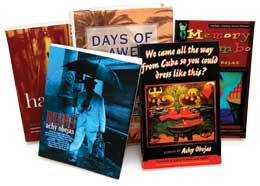
"The Marvelous Reality of Achy Obejas"
By Benjamin Ortiz, for Café Latino Lifestyle Magazine
March 2009
“The world breaks us all, / throws us up against the wall, / splits our hearts with a vengeance… / Pain is the risk and the measure / not just of how far we’re willing to go, / but of how much we’re willing to feel / later, alone in the dark.” Achy Obejas, “The Habits of the Blind”
In poems conjuring afternoons lost in a lover’s embrace, Achy Obejas takes us away from self-deluding flights of fancy and back down to an earth that has its own pungent delights.
Amid lost loves and lives that could have been, Obejas spins verse that has “embraced chaos,” as she puts it in her best-selling poetry chapbook, “This Is What Happened in Our Other Life” (A Midsummer Night’s Press, 2007).
In an interview with Café, back from Cuba and fresh from a holiday trip to Iowa, Achy Obejas warmly opens the door to her Kenwood home and offers deep mugs of bold-roasted coffee over a chat about “Ruins,” her upcoming novel release, on the 50th anniversary of the Cuban revolution.
In a kitchen nook crested with homey placards blazoned in cartoonish bodega advertising — “HOT BOLLOS / CUBAN SANDWICHES / CAFÉ CON LECHE” — Obejas tells a sardonic joke from the Cuban exile community: “Everybody in that first wave of immigrants was like, ‘Oh, I lost my farm, my business.’ My mom loved to tell this joke about how if you put together all the land that everybody lost you would realize that Cuba is really the size of the Soviet Union, because their sense of everything was way hyperbolic.”
“Cubans always have a holy grail,” Obejas continues, “whether it’s the Spanish grandfather who left you millions and you just need to find that birth certificate to get it ... or the person who’s got all this pre-revolutionary money stuffed in their fake ceiling waiting for capitalism to come back. God, they really are the Jews of the Caribbean — there’s always a Messiah they’re waiting for that never arrives.”
In the introduction to the anthology “Havana Noir” that she edited for Akashic Books in 2007, Obejas describes the city of her interrupted Cuban childhood as “a city of ironic and often antagonizing contradiction.” Though she takes on subjects so very close to her own skin with brio and sharp wit, Obejas dignifies the sources of her inspiration.
Johnny Temple, Akashic publisher and editor of her forthcoming novel, describes her writing as “gorgeous... stylized without being self-conscious.”
Her new book, in particular, “explores the crisis that Cuba is facing with unusual sensitivity and honesty,” he says. “Too much writing about Cuba is polarized, reflecting either an anti-Communist perspective or an anti-America/imperialist sentiment. Achy deftly avoids these traps in ‘Ruins’ and tells the story with language that is both rich and lucid.”
LAUNCHING PAD
Her journey started when mom and dad left Cuba in 1963, when she was six, taking her to Miami and then ending up in northern Indiana. “It wasn’t a decision that I felt even a little bit comfortable second-guessing,” she says. “I don’t know what I would have done in their position.”
But she started imagining other worlds and selves at the same time she pondered another life that could have been in Cuba. “I started writing very early on, making up my own Greek myths and comic strips when I was about six or so. I’ve always wanted to write — I’ve never wanted to do anything else.”
She moved to Chicago on her own in 1979, having attended various schools, including Indiana University, eventually earning a Masters of Fine Arts from Warren Wilson College. With brief sojourns in Southern California and Hawaii, Obejas made Chicago her home base and launching pad for a career in journalism.
Covering the city for the Sun-Times, then the Windy City Times and later for the Chicago Tribune as a longtime staffer, she admits to having become politicized by communities that were considerably to the left of her Cuban-American upbringing.
When asked about being an activist herself, she responds with knit eyebrows and a slightly annoyed smile. “You know, I’m always amused by this notion of activism. I don’t really think of myself very much that way,” she says. “But when I got here, in the late 70s and early 80s, the activist community was the Puerto Rican community. [It] was in absolute revolt over a lot of things that had been going on, and [they] were working for inclusion in a way that paved the way for a lot of what happened later with Harold Washington and the election of other people of color.”
Her journalism led to Peter Lisagor and Studs Terkel awards, plus a team Pulitzer at the Tribune. Obejas reflects specifically on the short-lived Sun-Times Spanish-language column “Los Vecinos,” which she shared with Jorge Casuso and Bill Zayas, as an important corrective to Chicago journalism. “We wrote a lot of stories about political engagement that the American reporters couldn’t get into,” she says. “Part of it was language, part of it was culture, part of it was fear. They were scared of going south of Madison, but they were terrified of going west of Western for black and Latino issues.”
Former colleague and current Tribune reporter Monica Eng confirms in an e-mail how Obejas pushed coverage toward a more inclusive Chicago: “Achy was a real anomaly at this largely white and largely male paper. And she went a looooong way to reel in stories that the typical Tribune staffer would never know about and from worlds they simply did not inhabit, but that Achy did.”
The gay community was one of the worlds she inhabited and helped promote beyond the bounds of objective journalism. “[T]hat’s about the only time that I actually have ever really been engaged in activist things,” she points out.
“I worked for Windy City Times, which was an activist newspaper,” she says. “I was with the Mayor’s commission on lesbian and gay issues for a little while, and I also participated in the passage of the Human Rights Ordinance. I actually wrote the speech that [Mayor] Eugene Sawyer gave on the passage of the ordinance [in 1988].”
RETURN FROM EXILE
Events and characters in Chicago fed her literary imagination as she wrote, submitted and published short works that were compiled in 1994 by San Francisco’s Cleis Press in her first book, “We Came All the Way From Cuba So You Could Dress Like This?” Cleis followed the short story collection with Obejas’ first novel, “Memory Mambo” (1996), focused on one Cuban family’s urban exile in Chicago.
Between her first two published works, Obejas embarked on a return from exile that continues to this day. “I wanted very much to reconnect, and the first time I got an invitation was in the early 80s,” she remembers. “But I needed my Cuban passport, which my parents had, and my mom and dad refused. All my Cuban friends were going, but I was sort of living vicariously through them.”
Eventually, mom and dad got used to the idea, so Obejas was able to reconnect and establish her current network of friends, relatives and neighbors back in Cuba.
From these trips in the late 90s, Obejas would gather material for her 2001 novel, “Days of Awe,” winner of the Lambda Award for Lesbian Fiction.
The novel shifts phantasmagorically between memory, dream, history and narrative, as the main character, like Obejas, discovers a hidden Jewish heritage.
For Obejas, this was nothing shocking: “[My family had] always lived in Jewish communities and had frequently celebrated Jewish holidays. But I’m neither a normative nor a crypto-Jew. I love the social justice aspects of Judaism, the sense of justice, the emphasis on literacy and the idea of connectiveness, but I pray my own way.”
“Days of Awe” seemed also a work of translation and anthologizing — of cultures, languages, faiths, revolutionary rhetoric and reclaimed Caribbean authors. Obejas continues this strategy in “Ruins,” a recasting of Ernest Hemingway’s “Old Man and the Sea” in the midst of the Special Period in Cuba.
The main character, “Usnavy” — a reference to American military power branding Cubans — struggles to keep his family together while remaining true to the revolution. But post-Soviet scarcity ultimately prods him to engage in “bisnes,” the underground economy.
Obejas dedicates the book to the neighborhood she’s cultivated since 1997 in Old Havana. “I think [Usnavy] is a dreamer,” she says. “Like most people who believed in the revolution — they were dreamers. They really wanted to find that rainbow at the end, after the storm.”
Obejas points out that this book is not about exile: It’s about those currently in Cuba “who really believed in the revolutionary experiment, and who really gave it their all … because of the greater good, and then the greater good never came.”
Contrasting Usnavy’s quixotic fantasies, Obejas is nothing but realistic about the coming, eventual re-alignment of Cuba: “I live in Chicago, with an ever-diminishing Cuban-American community and far from the Miami epicenter. I am much more interested in being a part of a post-revolutionary Cuba than the diasporic community, which will most likely follow historical pattern and be absorbed into the U.S. mainstream as another immigrant (no longer exile) community.”
Obejas is in a good place to study these changes as DePaul University’s Sor Juana Inés de la Cruz chair in Latin American and Latino Studies.
Currently, she’s busy translating into English the poetry of classic Cuban poet Nicolás Guillén. She also delivered a translation in fall 2008 of Junot Díaz’s Pulitzer-winning “The Brief Wondrous Life of Oscar Wao.”
In an effusive outburst of e-mail, Díaz describes Obejas as an “aching, scathing artist of the first order, and her vision of an America haunted forever by Cuba and a Cuba forever haunted by itself is fundamental to remembering that there is no American century without a voyage to Cuba, none that is worth a damn.”

Record-Store Performances (Chicago Tribune)
"In-store sounds
What's in store at record shops: Band performances, readings, more going on"
By Benjamin Ortiz, Special to the Chicago Tribune
Section: On the Town
Date: July 4, 2008
Record shops give you something that even the most interactive music Web site can't—someone who knows what you like and gives you a pile of great dusty grooves to sort through.
Shops have taste or a certain style, and that's why you're there. Reckless, Jazz Record Mart, the Apple Store all have a feel.
You can think of an in-store performance as a shopping soundtrack or an event. Either way, it's like closing the link between past and future. You're at Reckless, hearing some little post-punk band on your music player, and the band members are in the flesh.
Yet in an age when the biggest music retailer (iTunes) is virtual, Chicagoans are still looking to real time for a place littered with LPs, dusty acoustics and real sound. Area music shops subsist on a hunger for the good-old days and the hope for brand-new sounds. With turntables popping up again bearing USB ports and iPod jacks, vinyl recordings are set for a comeback, as bands put tracks onto 180-gram vinyl and play to select crowds at tune boutiques.
Let's face it: Some pieces of vinyl have seen more parties than you have. So take the time trip with other fans picking over the past for a sense of musical soul to see what you unearth from the crates.
Music shop performances aren't just for record promotions any longer. Now they're but one sign that a local shop is truly committed to its neighborhood. The store gets buzz, and you get to see a cool band for free. This is true even as leaner stores find themselves with less space and fewer acts willing to play for free.
"In-store events are not a guaranteed turnout," says David Hofer, a Chicago-area native and buyer at Reckless Records. And yet "that's what you do when you like bands—you champion them."
With an army of clerks familiar with the local scene, Reckless picks up on tips about bands that might draw a crowd, especially underage fans who can't get into some venues. At a recent Reckless event, Jesael Espinoza brought his two young sons, to hear California-based flamenco/R&B jammers Cryptacize at the chain's Wicker Park store. The kids were able to play with the instruments, and adults who might have caught the band the night before at Schubas could talk to the band after its brief set.
Far from the Wicker Park indie scene, The Old School Records of Forest Park sees itself as an oasis for its West suburban community of customers, musicians and fans. "We are custodians of culture," says co-owner Jodi Gianakopoulos of the shop that specializes in R&B, soul, jazz and reggae.
With a hyper-local focus, Old School also frequently arranges on-site events, with an outdoor sidewalk set-up when possible. At June's annual Forest Park Summerfest, Old School had writer and regular customer Stephanie Kuehnert read from her rock-inspired novel "I Wanna Be Your Joey Ramone" and perform covers of songs by Sleater-Kinney and Social Distortion. In addition, over the event's two days, a dozen up-and-coming area DJs spun everything from Afrobeat to disco and stepping sets.
Gianakopoulos sees her commercial and neighborhood efforts as a unified endeavor. "We work ridiculously hard to survive and we can't without [community] help."
At the other end of the spectrum, the Michigan Avenue Apple Store, with its sleek counters, reflective surfaces and pristine white workstations, is the incarnation of the new music landscape.
Yet like the grungy Reckless and friendly Old School, Apple hosts in-stores as well.
These might be for iTunes cross-promotion, or local DJ nights that showcase performers as well as the Apple music gizmos. Set up at a mobile turntable cart, the first-floor DJ expo draws window shoppers and store browsers to a buzz that is like white noise humming beneath the sound of commerce.
In the halls of Apple, it's a stretch to imagine a shop such as Untitled, where DJs of yesteryear spun vinyl all night long for hyped-up crowds. Sylia Yi, senior buyer at Untitled, has been around since the store opened in 1990 as a hub for DJ culture.
"Our turntables have been a starting point for world-renowned DJs and producers," Yi says.
From its early days, Untitled has been the one-stop place to go for gear, fliers, show tickets and free DJ sets. The rave scene is long gone, but Untitled still hosts DJ sets at three of its four locations every Saturday. Local hip-hopper Anacron Allen spins regularly at the shops because "I have free rein to stretch out and play how I really like."
In Ukrainian Village, Permanent Records' back wall is a tight fit for the Warlocks' brief set before the band heads off to a Logan Square gig. About 50 people file between the music bins, some just looking for a deal, most focused on the Warlocks. The atmospheric reverb echoes against walls plastered with funky posters, and grateful applause heartily lifts to the ceiling and out the door.
With an eclectic selection of new and used stuff plus friendly clerks ready to chew the fat like the guys in "High Fidelity," Permanent feels like a rock happening and bills itself as a community space, having hosted movie screenings and listening parties. Owner Lance Barresi also says the store produces recordings on 180-gram vinyl, because "we personally find vinyl more appealing than CDs."
A short ride from Permanent takes you to 18th Street, where Revolver Records rocks the bells for South Side hip-hoppers, DJs and fans. Marlon Hernandez hails from Wrigleyville but fell in love with the Pilsen community, where his Mexican parents met and where he opened his shop a few years ago. He's just another Chicagoland kid who imagined owning a record store. But he actually did it, and his 650-square-foot shop—decorated with local Latino art and heaps of dusty 45s—regularly hosts music and art shows and parties.
"One of the bigger events I had was when Kafele and JoJo, drummer for Fela Kuti and Africa '70, played live for one hour nonstop," he remembers. Like other shop owners, he's involved in his adopted neighborhood and sees himself as a teacher of forgotten sounds. His store can transfer your records to digital format, but he'd much rather talk about the defunct, portable turntable in his display window.
"Analog is a really good sound," he says. "It's beautiful. It's warmth."
Back at Reckless, Hofer says crowds don't show up sometimes, even for popular groups, such as when The Brian Jonestown Massacre played in front of five people. But he's enthusiastic about the authentic music experience.
"There's not a lot of record stores left in general, so we try and make ours as special as possible."
LINKS:
Apple Store (North Michigan Avenue)
The Old School Records (Forest Park)
Permanent Records (Ukrainian Village)
Reckless Records (multiple locations)
Chicago Performance Poetry (Chicago Tribune)
"Fighting words: Checking in on the sass and spirit of the city's open-mic battlegrounds
Hiss, grunt, snap—become well-versed"
By Benjamin Ortiz, Special to the Tribune
Section: On the Town
Date: April 4, 2008
Eternal poet laureate of Illinois Carl Sandburg said it from the jump of the 20th Century: My city can kick your city's butt. Just listen to the rusting, hulking lilt of Sandburg's "Chicago Poems" and you can hear a city set to brawl, a pugilist ready to hit the mark and make his name.
Our city still is ready for a tussle. A mix of ancient Greek ritual, Shakespearean bawdy groundling humor and Wild West saloon burlesque, Chicago's open-mic poetry spots appeal to a rowdy audience. Sandburg's boast bears fruit in this poetry scene that has its ups and downs yet keeps its fists up.
April is National Poetry Month, so it's a good time to check out the spirited events. If you go, be prepared for the "feminist hiss" from women in the crowd in reaction to anything sexist or wielded ironically, and the "masculine grunt" from guys getting Frankenstein-esque about lines that are instantly deemed good or bad. And if you hear stomping while delivering your verse, it's time to get better or get gone.
Poets like Carl Sandburg, Nelson Algren and Gwendolyn Brooks long ago articulated the essential myths of Chicago as a big-shoulders modernist, a city whose literary ballads to the working class define our profile every bit as skyscrapers set against Lake Michigan do. Through the first decade of the 21st Century, Chicago still stands tall as a square-jawed bard, with poetry like fighting words.
THE OLD DOGS
Hailed as the great grand-pappy of performance poetry, the Uptown Poetry Slam has been kicking at the Green Mill since 1987, the work of venerable SlamPapi Marc Smith, a construction worker who started the show in reaction to arrogant academic poetry. Bristling at the idea of having to have a degree or published work to be taken seriously as a poet, Smith brayed Sandburg-like with a big, fat "SO WHAT."
And that's how he continues to do the show—every time he says "I'm Marc Smith," the crowd joyously responds, "SO WHAT!" This and other such rituals surround the slam, like the snapping fingers and pounding feet that let a poet know the end is near, or the "feminist hiss" and "masculine grunt" from the audience that evaluate poetry on the spot.
"I always manage to make it new for myself," Smith says of hosting every single week. "I consider myself a servant to my audience." At a recent slam, Smith climbed the bar and scaled tables with signature crowd-busting vocal fanfare, backed by his Rootabaga jazz combo.
" 'Til I die," he says about slamming. "[I'll be] up there in a wheelchair doing the same old shtick." Smith invokes prairies and penthouses, smokestacks and neon skylines, littered in a long, quixotic free-verse line that feels like it could go on forever.
Competing for stage geriatrics and attitude, Weeds Tavern hosts a slam-style poetry harangue that will probably die about as hard as Smith. Weeds' arch-ritualized, bluest of Mondays includes zombielike repetition of the bar address plus the frequent, profanity-ridden refrain of just how much they "don't give a good ***damn."
Smith admits the zany stuff doesn't happen much anymore in Uptown, but Weeds Tavern is just the sort of poetry "Twilight Zone" to keep social disorder set to verse—it's a neighborhood bar without a neighborhood, a pub in search of a people. Like one of its handmade poster-broadsides reads, "Tricky, Turbulent, Tribal."
Bartender Sergio Mayora holds forth at the reading, where he's known to do the same two poems (penned in junior high) every week. Mixing aggressively juvenile anti-white protest with the equally adolescent observation that "we all came out of a hole" when we were born, Mayora declaims rapidly and robotically, usually because the crowd is busy rapping out lines from his greatest hits.
Host and Chicago poetry veteran Gregorio Gomez is a literary chameleon who regularly gets around town for Latino-themed readings at more sedate spots, but at Weeds he's all animal, with off-color jokes, remixed clichés, political punditry and off-the-wall, on-the-fly nonsense rattled out like a repo-lot bulldog howling at his own shadow.
Despite the irreverent performance style, Gomez says: "I stand for hundreds and hundreds of poets who will never be famous. I like to consider this still an underground poetry spot." Open-mic poets also get their few minutes to shine from out of Weeds' funky murk, answering the call of its carny-barking muse.
THE YOUNG TURKS
Gomez and Mayora claim poetry has been going on at Weeds since 1984, which would make it the main contender for longest-running series against the Uptown Slam. Back in the day they were buddies with Smith, even doing a few shows together before their huge personalities went in separate directions.
Like their elders, younger poets have cross-pollinated a few shows that carry the torch, especially with their openness to pure entertainment mixed in with the poetry. The '90s Chicago poetry scene hit a high point with various popular venues, and one of them yielded a slam team to compete against the vibe and verse of the Green Mill: Mental Graffiti.
Ebbing and flowing over the years, Mental Graffiti moved around venues mainly centered in Wicker Park, with a dedicated weekly hipster crowd and more of a hip-hop/urban-DJ atmosphere to match Uptown's jazz. Now in River West, the series has gone monthly, with a trio of organizers who got their chops in the spoken-word trenches around town.
Joel Chmara regularly pushes the envelope with über-ironic meta-commentary on poetry and the scene, and his self-deprecating Midwestern sort of Bob Newhart-style draws in the crowd. Chmara and co-organizer Tim Stafford work the Chicago social scene in general to draw "both cool people and poets" to Mental Graffiti. "New people we don't know show up," says Chmara, "a younger crowd and more of a party atmosphere, including an Arsenio Hall-style Dog Pound cheering section."
The multimedia PolyRhythmic arts collective has been doing an eclectic weekly open-mic in Wrigleyville for almost seven years, with roots in the old Mental Graffiti. The show—Safe Smiles—feels nicely tucked away from sports-bar-land, and yet the DJ sets, hosting and performances have a raucous, crowd-pleasing edge.
Collective member Drew Perfilio says they like to mix up the show with poets, musicians, clowns, comics and avant-garde madness.
MULTICULTURAL MISSION
Itself a monument to Chicago's greatest writers and literary achievements, The Guild Complex fosters the next generation of local poets through various programs, and its multicultural mission reaches out specifically to the Latino community with the monthly Palabra Pura series. Executive director Ellen Placey Wadey notes the need for a venue where Chicagoans who mix Spanish and English can enjoy bilingual poetry, the reason the Guild started the series in February 2006.
With definite community warmth, last month's Palabra Pura in the back-room lounge at the California Clipper featured local and touring poets, in addition to open-mic readings in English and Spanish, sometimes mixing the two. The roving series moves next to the Center on Halsted, with celebrated poets Lorna Dee Cervantes and Rigoberto Gonzalez.
In Rogers Park, poetry gets paced to the elevated train that hugs the Heartland Cafe and shoots sparks in symbolic praise of restless night. With slightly younger, 18-and-up energy, the wide-eyed literati darken the main dining room and share something between a drum circle and speech-and-drama squad experience.
Here at In One Ear may be our next great Chicago voice, struggling to the head of the sign-up list to get heard.
INFO
“In One Ear” open mic
Wednesdays, 9:30 p.m., $3, 18+
Heartland Café, 7000 N. Glenwood, 773-465-8005
Mental Graffiti
Third Mondays, 8 p.m., $5, 21+
Funky Buddha Lounge, 728 W. Grand, 312-666-1695
Palabra Pura reading series
Third Wednesdays, 8 p.m., free
Next event: April 16, Center on Halsted, 3656 N. Halsted, all ages
PolyRhythmic Presents “Safe Smiles”
Tuesdays, 10:30 p.m., $3, 21+
Trace Lounge (upstairs), 3714 N. Clark, 773-477-3400
Uptown Poetry Slam
Sundays, 7 p.m., $6, 21+
Green Mill, 4802 N. Broadway, 773-878-5552
Weeds Poetry
Mondays, 10 p.m., free, 21+
Weeds, 1555 N. Dayton, 312-943-7815
Alt-Latin Entertainment (Chicago Tribune)

"Latin entertainment offers plenty of options nowadays: Spanish karaoke, indie-rock dance parties, drag shows"
By Benjamin Ortiz, Special to the Tribune
Section: On the Town front cover
Date: February 29, 2008
Beyond salsa and regional music, Latino Chicago offers much more than typical sounds and styles associated with the community. Younger Latinos from diverse backgrounds are combining disparate pieces of local culture into sometimes wildly eclectic hybrids and unusual entertainments. Off the map and charting its own path, alternative Latino Chi-Town remixes tradition to fit new beats and fashions.
There's so much out there, if you dig a bit. Explore karaoke in Spanish, dancing to cumbia mixes and sassy drag shows. Here's a taste of Spanglish Second City:
THE DANCE MOVES
At 4, Hector Ivan Garcia led his first mariachi band on vocals. His truck-driving Tex-Mex dad met mom, who is from Monterrey, in Chicago, bringing echoes of rancheras and norteñas along the way.
Though he now fronts Latin rockers Descarga, Garcia is a self-described karaoke freak. Over years of gigging around town and seeing venues come and go on the Latino rock scene, he knows music fans are fiending to take the mic themselves and get their fix for three minutes of celebrity, like a mariachi or a pop dandy or a good old boy, Mexicano-style.
Every Thursday, Garcia hosts Karaoke en Español at Spot 6 in Lakeview. His promotions company, Enchufate, provides more than 1,500 song selections across the spectrum of Latino sounds, from Selena to Celia, salsa to Soda Stereo.
"We don't do English," he warns. No matter. The event draws regulars from around town, including Lakeview's off-the-clock Latino workforce, for a melange of rockers, rancheros, fresas (dandies) and retro New Wavers.
Spot 6 itself is a funky, artsy lounge, with a basement area featuring DJs during karaoke. From punk to bumpkin, Garcia says you'll see Mohawks dueling with cowboy hats.
"I can recommend this show to lots of different people -- my uncle, my friends, even college kids trying to learn Spanish."
For anyone trying to learn Spanish, "Enchufate" means "hook yourself up," as in "get connected with the scene." On First Saturdays at Spot 6, Enchufate presents Indiecent, a Latin alternative electro-indie-rock dance party, featuring DJ sets in English and Spanish, meant to plug people in to a progressive Latino party atmosphere.
At the February party, a packed Spot 6 split between R&B/urban club-goers in the basement and alt-Latino hipsters in the lounge, with a multiracial mix. Hosted by DJ Nando, the show also featured Eduardo Calvillo, from WLUW's popular Rock Sin Anestesia show.
Enchufate partner Sandra Treviño says the parties started in November as an offshoot of CD release events, because "there's so much more music out there than what gets typical airplay." Jumping from Ladytron to Kinky to Babasonicos to The Pinker Tones, February's set had about 300 people grooving, with friends moshing arm-in-arm and salsa-inspired hips hugging bass lines to create new blends of Latin dance.
Fusion and innovative flavors likewise inform the drink and DJ selections at Ñ, an Argentine-style restaurant-lounge on Elston Avenue from the owner of Tango Sur. Well off the beaten path of Latino Chicagoloand, Ñ presents DJ David Chavez on Thursdays with Latintronica, a blend of tango, Afro-Cuban, house, cumbia and alt-Latin remixes.
Born in Logan Square to Salvadoran parents and raised on Chicago house music, Chavez started spinning at parties in the '80s. After a trip to Cuba in the mid-'90s blew his mind with the discovery of son Cubano, Chavez became program director at HotHouse and got a chance to DJ for world-music audiences.
A recent set at Ñ switched from Puerto Rican bugalu to feverishly hot cumbia Colombiana to reggaeton, from classic Fania cuts to new Nacional Records tracks.
Chavez plans to include guest DJs and live musicians soon, to try out new approaches to Latin music. "This is a night for the discerning ear," he says, "for the person who wants to hear fresh, new alternatives to commercial salsa and merengue."
THE ROCK SHOW
On Friday nights near Midway Airport, rocker chicas with spiked hair in leg warmers and studded belts couples-dance to crazy merengue, bachata and cumbia mixes, because at Club Watra the dancing is just one menu item for a mainly Mexican crowd that comes to hear local bands play everything from ska to hip-hop to punk, in Spanish, at a once strictly Polish venue.
In Polish, "Watra" refers to a kind of campfire, though this club offers all the comforts: a sports-bar area, lounge and banquet-style concert hall. Promoter Leonardo Ibarra made inroads here a few years ago with his audio-visual company that rents out equipment. Working with promoters, bands and bars, Ibarra got the idea to put it all together. "Everybody goes to the North Side for entertainment and now we're doing this for the South Side."
Focused on local talent, Ibarra's shows also hook up touring bands from Latin America. A recent Watra show featured hip-hoppers Masakre Skuad, punkers Herencia de Zapata and Spanish ska by Malafacha, on the main stage, while DJ Alex Perez had booties moving to more typical Latin fare, free of charge, in the lounge. The event brought out roughly 300 people across subcultures -- Polish, American and Mexican.
Back on the beaten path, downtown's Excalibur is known for more conventional tastes, but Second Thursdays bring the local Latin rock scene to the Dome Room. Promoter Andres Meneses organizes the shows through his company, Latin Street Dancing.
He says, "It's very difficult to get people out to listen to Latino rock bands, at least local ones, and there's not a lot of opportunities for them."
His February show brought out nearly 100 people for bands 2012, Martires and headliner Damian Rivero -- a funk-flavored, pop singer-songwriter -- hosted by DJ Eduardo Calvillo. Meneses says the menu ranges "from Mexican metal bands to ska, rock and pop, everything but the tropical music."
THE DRAG SHOW

Alternative Latino entertainment seems to sprout wherever it can survive, and El Gato Negro Bar is that kind of survivor. Despite changing neighborhood demographics in west Lakeview and over-the-top urban legendry -- from word-of-mouth gossip to the Internet -- Gato Negro has been around for more than 20 years as Chicago's Latin transgender cantina.
Bar president Geraldine "Lua" Lambert came here from Sao Paolo, Brazil, to study at Loyola, and she has owned various properties around town. In 1986, she named this one The Black Cat in Spanish, because she's an animal lover. "Black cats look like panthers," she says. "They are very sexy and powerful."
So follows the ambience, from a jukebox that spins apropos tunes ("A Walk on the Wild Side," "Hey Big Spender," "Private Dancer" etc.), to the Latin "girls" who try to outdo each other at lip-syncing and vamping, to the raucous house band that bops between burlesque and straight-up jazz.
Despite its rough-around-the-edges look, Gato Negro really gets going near midnight, when all the glitz and glam revert to the regular girls who sign up to show off.
Lua describes the clientele as two distinct groups: young men who dress up as women and older white guys on the down-low who come to see them.
"A lot of the girls have very sad stories," Lua says, "because they're not accepted in their countries and they're discriminated against, but here they feel free and I never judge them."
The bar also throws birthday parties for regulars, with cake and arroz con pollo.
Lua has a no-cover-charge policy, even though an eclectic multicultural band plays Thursdays through Sundays. Events usually start late, but once it gets going, the vibe is like Russ Meyers movies and Spanish telenovelas, with costumes and choreography, to the tune of wild sax trills, Mexican polkas, bossa nova and blues.
Just about every night is a show of sorts, with a sleek black cat as spirit guide and feline green eyes that beckon you to stop by for a drink.
- - -
WHERE TO GO
Indiecent Latin Alternative Dance Party
Spot 6, 3343 N. Clark St.
First Saturdays, doors open 9 p.m.
No cover
http://www.enchufate.com
Karaoke en Español
Spot 6
Thursdays, open sign-up list at 10 p.m.
No cover
http://www.enchufate.com
Latintronica DJ Show
Ñ, 2977 N. Elston Ave.
Thursdays at 10 p.m.
No cover
773-866-9898
Latin Drag Shows and Live Music
El Gato Negro Bar, 1461 W. Irving Park Rd.
Drag queen lip-sync performances on Sundays at midnight, live jazz on Thursdays at 10 p.m., Latin combo Friday-Sunday at 10 p.m.
No cover
773-472-9353
http://www.elgatonegrobar.com
Latin Rock Fridays
Watra Night Club, 4758 S. Pulaski Rd.
Doors open at 9 p.m.
Cover charge varies
773-927-0710
http://www.myspace.com/sonidoninja
Latin Rock Saturdays
La Española Tapas Bar, 6543 W. Cermak Rd., Berwyn
Doors open 10 p.m.
Cover charge varies
708-788-7400
http://www.myspace.com/sonidoninja
Live Latin Rock presented by Latin Street Dancing
The Dome Room @ Excalibur, 632 N. Dearborn St.
Second Thursdays at 10 p.m.
$10 advance, $15 at the door
312-427-2572
http://www.latinstreetdancing.com
"BOMB THE WALLS"
Raza Aztlán turns taggers into muralists
“From one art form to another: bombing with spraycans to painting with brushes”
San Antonio Current, 28 May – 3 June 1998
Smoke from crops burning in Mexico brings the faint taste of pesticides on this steamy and overcast day. Mixing with the stench of a nearby fried chicken stand and the cigarettes five teens are smoking spray-paint laces the chemical fuzz in the air like icing.
Aerosol ball bearings smack together and paint hisses out onto the walls of a factory skeleton — the remains of a building off Military Drive, a husk of labor right down to a rusted time clock card file. The teens are admiring their work. Ranging from 15 to 17 years old, they have names like Kaze, Nome, Shek, and Kaes — tags that sound good to them and look striking on a wall.
“It’s better than the names gangsters come up with, like Snoopy, Payaso, or Sir Loc Dog,” says Nome, who’s touching up a piece and experimenting with his new tag, “Jents.” He specializes in wildstyle — indecipherably wicked, explosive, wraparound typeface that could confound graphic designers. “You make it for other [graffiti] writers to understand, not for the norms,” explains Shek.
Another crew member, Case, arrives to check on his throw-up (a wildstyle tag with bubble letters), but his almost-finished piece has been crossed out with a single scrawling blue line. He’s not happy at all and thinks he knows who did it, while Shek looks at one of his pieces he has dismissed by painting a bulging revolver to the side with action lines that make it look as if it’s shooting out his name.
“It’s blasting my tag,” Shek says, “’cause I thought it was wack after I did it.” Shek’s an artist of principle — he’ll only battle on walls, not with fists. Except for the random drama that happens every now and then in unknown territory. He points at a warning tag: “No wall beef. Physical beef. Toy fucken ediot [sic].” Laughing, Shek says his boy wrote that as a threat of physical revenge against those who crossed him out.
Believe it or not, Shek and these other teens are on their way to doing something less dangerous and more legal, and the beat-up white van that pulls in across a prickly field is here to transport them from one art form to another, from bombing with spraycans to painting with brushes.
ARTS ACTIVISM
Cruz Antonio Ortiz drives the ’69 Chevy, and he looks a lot like a 25-year-old version of the teens in back — paint flecks on his clothes and all. The growling engine and bumpy alignment knock objects around on the dash, including a worn copy of the Universal Declaration of Human Rights.
This is a major part of what he does for his group, Raza Aztlán: driving around, scouting for taggers he can recruit to work on legal, commissioned, graffiti-incorporating murals. The organization is non-profit, though it has no official 501c3 status yet. It began as a spin-off from the Esperanza Peace and Justice Center (Ortiz is a board member), under which Raza Aztlán applies for grants.
Raza Aztlán is trying to get on its feet as a separate organization focused on mural projects, as well as ’zine-writing, experimental art workshops, and the Coatl program, which helps teens get into college. While Ortiz, his wife Rina Moreno, and their friend Laura Hernandez founded the group, he stresses that they include the youth in all decisions, right down to financial reports, so that they’ll feel like the organization is theirs.
“The thing with graffiti artists,” Ortiz admits when we arrive, “is it’s hard to have a set schedule with them, so it’s like when they come, we’ll have five or six, and the next day we could have 20, 25, all from different gangs who hate each other. But we get them to sit down and tell them, look, we all have something in common: we’re all Mexican-American or Latino, and we all live in a working-class or low-income environment. Let’s start working on these things and express ourselves on walls with murals.”
While the teens go across the street to practice on canvas, Laura Hernandez recounts how the group came together through the three founders. At 29, Hernandez was raised on the northwest side. “I grew up very sheltered,” she recounts, describing her clean, family-oriented neighborhood. “The culture I grew up in was more Americanized.”
After graduating from Incarnate Word High School in 1987, she noticed the neighborhood start to change, with more tags, noise, and police patrolling. “It seemed like our neighborhood was becoming more and more isolated,” Hernandez remembers. She started spending more time on the South Side and worked as a case manager for three years at the Center for Health Care Services. In 1994 she started graduate school in social work at Our Lady of the Lake, where she met Moreno and helped start Raza Aztlán.
“Looking back on my childhood, I think I grew up with a certain perspective that these kids are bad, that these kids are wasting their time and they obviously don’t care about what’s happening to them and they’re destroying their neighborhood. It took me a long time to realize…There’s a lot of good kids trying to change their situation who can’t — they need to find ways to express themselves. It’s just going to take time to reach these kids and build trust.”
Her first try at community work with Moreno came in the fall of 1995. Moreno heard about a truce between West Side gangs, and so they decided to take advantage of the peace to keep gangs from fighting again. Independent of their studies, they got together with Ortiz and met with youth at a basketball court on Trinity Street.
“We had a rough time starting, because we didn’t have any foundation to go from,” says Moreno, “and we even had a little event at that basketball court, and hardly any youth showed up.” They kept trying, which is typical of the group’s determination and specifically Moreno’s driven vision.
Moreno, 25, claims the far West Side and their current home on the East Side as her neighborhoods. Moreno’s single mother worked as a program coordinator at the San Antonio State Hospital, as she has for the past 20 years, and she used to come home frustrated when she thought people acted wrongly at work.
“I felt like it wasn’t fair, what my mom would tell me, and I thought somebody should be accountable,” Moreno says. “I always said I was gonna grow up and basically, I guess in my own little mind, save the world from all these unjust things.”
As an angry young teen at John Jay High School, Moreno dressed differently and drew jokes from teachers. “Youth always feels misunderstood, because nobody’s really willing to listen to you.” She graduated at 16 and went directly to St. Mary’s University, finishing college in 1993 and meeting Ortiz that year when she joined Inner City Development. He was working on a mural project, and Moreno wanted grassroots experience with low-income neighborhoods. “We both had a lot of similar ideas about the community and our people, and I guess that attracted us to each other.”
In August of 1996 they named their work “Raza Aztlán,” and they have worked with teens ever since. The organization has moved wherever they found themselves, including the inner city northwest side. They are on the East Side now, drawn by the inner-city setting and the lack of community centers or mural projects for teens on this side of town. And her grandparents’ house is right across the street, where it has been for 50 years.
“Cruz was doing murals,” Moreno recounts, “and a lot of the youth involved were doing graffiti, and we thought maybe there would be an interest in the art. We figured, let’s do murals with the youth and exercise their interest in art by making it more productive, so they get into less trouble, and then there’s a pride that comes along with the images they’re presenting. It’s also about improving the face of the community, the image that we have. You know, we got boarded up houses, graffiti everywhere, you got streets that look really bad…I think that Raza Aztlán can help make the rest of the community look better.”
Since Raza Aztlán has no budget except for mural commissions and fundraiser money, Moreno works with the San Antonio Police Department Victims Advocacy Section, responding to domestic violence calls with a community-policing officer. “I’m not an artist,” she admits, “I’m a social worker, and that’s my interest in this — taking graffiti artists, and instead of being so hard on them, being punitive, and putting them in juvenile detention centers and taking them down a negative road, let’s take them down a positive road. And at the same time, it brings pride to the community.”
A loud cracking sound from outside interrupts, and Moreno gasps: “We just heard a gunshot…did you hear that? I’m going to call 911.” She gets on the phone as Ortiz walks over to their new studio space.
TAG TALK
Kaze, Nome, Shek, and Kaes are sketching with markers on paper, as they do before they hit up a wall. They claim membership along with 20 or so other taggers in the CDS crew, which stands for as many things as they can conceive: Criminals Down South, Calling Da Shots, Creating Dope Shit. “Caca, Doodoo, Shit,” jokes Shek.
Traveling to Raza Aztlán headquarters from the Palo Alto neighborhood on the South Side, they have been working with the group for only a few months, and so they’re a rowdy bunch compared to the more seasoned teens who worked with Ortiz on the group’s first two murals.
Kaes tells the story of sitting at a Taco Bell after bombing some trains when Ortiz walked up to him because he had paint smears all over. “He asked me if I was a tagger, and I thought he was a cop, but he said he wasn’t and he could hear the cans in my bag. He said he wanted me to work on murals with him and mix spray paint into it.”
While they haven’t used brushes yet, these guys know the difference in paints by eyesight, just like they can immediately distinguish gang tags from graffiti art, which is done for art’s sake as opposed to marking territory. And scratch bombers — they call them scribers — who mark windows with razors are distinct altogether.
When asked if CDS mainly tags or bombs — if they focus on quick name tags as opposed to more elaborate wildstyle bombs that sometimes carry pictures and figures — Shek answers, “a little bit from column A, and a little bit from column B.”
Shek puts together a slap tag, a small piece of graffiti art with his and the crew’s names plus a lanky, stylized figure in baggy clothes and the label “One Cool Dork” that’s been marker-painted onto a sticker, which can be quickly slapped onto a surface. Shek appraises his own work and concludes, “I don’t know, it’s kinda wack.”
They get their spraypaint through legal-aged buyers. A full piece can cost $20-$30 worth of paint and take up to six hours to complete. Nome says he’s working with Raza Aztlán because of the constant threat of getting busted.
“Here, we get to practice, there’s free paint, and we don’t have to worry about the cops harassing us.” But they still plan on tagging, especially downtown. “When you go downtown and meet other writers,” says Nome, “they’re like, ‘oh yeah, I’ve seen your stuff, you get up a lot.’ It makes me feel good.”
As their fame with other writers increases, their infamy in the community and with the police brings them back to the reality that they are wanted as criminals. “It’s a thrill when you know you’re getting chased,” Nome admits. “You get an adrenaline rush. At first it’s scary when you’re running, you’re like, ‘oh shit, what do I do?’ But then afterwards, when you got away, you’re pumped up. It’s a high. That’s if you don’t get busted,” Shek adds.
Finished with the sketches, they practice can control against a wooden canvas, and the air fills with thick Krylon coating. “Sometimes, like especially when it’s really hot outside bombing,” Kaes says between spray bursts, “the sun gets to you an you got the spray paint into you already, you start walking and feel all weak.”
Shek pulls out a plastic baggie with fat and think spraycan tips. “Factory tips are weak — they mess up too much.” They compare tags and talk about different styles that have come and gone, like in 1993 when the fad was to go gangster. “That really messed up tagging,” comments Nome, “and now even gangsters try to use our style and tag like us.” Kaes points out that “gangsters can’t be taggers. Gangsters have guns — our guns are Krylon cans.”
THE FIRE OF HOPE
Ortiz pulls up with the van to take the group on a survey of Raza Aztlán murals, and he talks about the advantages of pushing graffiti into legal formats. “We tell them, look, these are skills, you’re learning painting skills, so you can get a painting job or whatever you want. We also teach them silk-screening, to make T-shirts they can sell. That’s empowerment. Not just cultural or self-esteem building — it’s also about economics. We need to develop something where our artists are gonna get paid.”
After a quick drive, he parks at Zarzamora and Cincinnati so we can see “La Lumbre de Esperanza,” started in 1996 and completed in 1997. Painted on a taxidermy shop, the mural depicts an indigenous woman reaching out to Mexican men and women enclosed by a concrete wall and boxed in by buildings.
The second mural, completed late last year, sits behind a gas station at West Avenue and Olmos. In Aztec motif, it’s titled “Quinto Sol,” with the four elements represented and spraypaint accenting the blues of the water spirit, cloud shading, and the orange-red of Quetzalcoatl.
Ortiz worked with the surrounding businesses and neighbors to approve this mural. Sometimes he has to reign in the taggers: “I tell them, look at that! It’s not a corporate office, it’s a simple business, a mom and pop shop. They’re just barely surviving, and you doing that, you’re disrespecting them. Do you like it when people scratch out your stuff? No. Well, then, let’s have some respect.”
Ortiz walks around to a house behind the gas station and emerges with Roy Carrillo, who started tagging when he was 12 and worked on the “Quinto Sol” mural. At 17, he claims he’s done with tagging, though the gas station management let him put some pieces up on their back wall with the UTM (“Up to Mischief”) crew tag. Carrillo quit tagging a year ago because it’s boring to him now and he got busted too many times.
Given his talent, it’s good he won’t face imprisonment. One of his pieces bears the title “Deceived Since Conceived,” and a squirming, mangled figure with a ripped umbilical cord dramatically carries his tag. “Tagging is getting too old, and everybody’s doing it, like a fad,” he mentions impassively.
“You can lecture kids all you want,” Ortiz adds, “you can make laws, you can make codes, but they’re going to come out and do it again. I’ve seen it. Some of them straight off tagged again after getting out of jail, and of course they got busted and went back. But then we have some who did stop, and now they’re going to San Antonio College, like Roy. That’s our reward.”
As he’s walking away, Ortiz reflects on the hope Raza Aztlán bears: “I know some of them say that ‘I’m always gonna tag,’ and the structure of graffiti art is based on risk. But the thing is, that’s endangering our communities. Raza Aztlán is at the borderline — we’re trying to get the community to understand them, and them to understand the community. We tell them they shouldn’t do it, but you can tell them a million times, and they’ll still do it. We have to keep working with the youth instead of rejecting them like everybody else does.”
Bible Thumping the Gangbangers
"The new blood-soaked theatrics of that old-time religion splatter Benjamin Ortiz."
A young Latin loco, sagging x-large, steps with attitude up to the local rock dealer. Recognizing his customer, the dopeman pulls a sack from his pocket and shakes it like a dinner bell. "My man, Joker," he croons, "look what I saved for you special." Joker strikes a defiant pose as his homeboy creeps up behind with a drawn shotgun. "Your crew blasted my boy the other night," Joker snarls. "It's payback time, punk!" BOO-YA!
The shotgun explodes, dusting the dopeman. The audience breaks out in screams, cheers, killer thrills. Joker runs off, right when Satan and his black-robed minions arrive to haul the fresh soul away. "Help me, Jesus, forgive my sins! Aiiiieeeee!" dopeman howls. "TOO LATE!" someone in the audience roars, and the crowd busts up laughing.
Just another day in the 'hood? More like a taste of "Inner City Madness," a performance staged last Friday night by Victory Outreach ministries, a Humboldt Park Pentecostal group. Passing through a metal detector at the Kelvyn Park High auditorium, I notice that the boyz working security are all ex-bangers and knuckle-heads turned Christian. Homeboy waves me through, and I spot the placazo (tattoo) between thumb and index finger. The crowd of mostly Latino and African-American teens fills the 1,300-seat venue beyond capacity. An R&B combo on stage wails holy hype, and many respond with singing and clapping. After a call for prayer, ministers take the mic and shout out tales of prostitution, drug addiction, gang-banging, broken families, and hopelessness: "I tried everything – PCP, marijuana, heroin, LSD – but I was lost until I found the Lord." Cheers, hands lift to the heavens in praise. A Christian hip-hop set bombs the bass. "God's the original 'G'! Jesus Christ in tha houuuuuuse!" Two youngsters belt out a flow of street knowledge about the saving powers of Christ, and the divine fly-girls rip it up.
Then the play starts: BOOM! opens a cycle of violence and addiction, spiced with real weapons discharging blanks, building to a Tarantino-esque standoff between enemy thugs. When a minister breaks the tension with a Bible thrown between gun barrels, the gangs finally submit to the Gospel. Laura P. Sánchez of Victory Outreach says the play's goal is "to revive hope through Jesus as Savior." But doesn't the spectacle appeal to violent emotions with its depiction of gunplay? "You have to relate to the crowd by going to their level," she answers. The audience whoops as Satan carts away more freshly buckshot ghosts.
I leave with permanent hearing damage. But the voice of one character echoes in my mind: "What do you want, preacher? I can't read or write! All I know is the gun!" And I wonder if anyone else noticed that Jesus never appeared to answer that question.
—by Benjamin Ortiz
NewCity 9 November 1995
The Bicycle Thieves
"Cutting crew: Benjamin Ortiz tracks down a ring of professional bike heisters."
An apt and true reply was given to Alexander the Great by a pirate who had been seized. For when that king had asked the man what he meant by keeping hostile possession of the sea, he answered with bold pride. "What thou meanest by seizing the whole earth; but because I do it with a petty ship, I am called a robber, whilst thou who dost it with a great fleet art style emperor."
--St. Augustine, "The City of God"
A repetitive techno beat pulses synthetic energy as three little hoodlums cruise a desolate North Side residential stretch at 4am. After a few hours of party-hopping and hitting forty-ouncers, it's time to settle some accounts. Chavo passes a joint to Kief in the backseat when he spots the target he has been looking for all night, and with a quick hand signal he motions to the driver. "What's up?" Smoke asks, pulling the ride into slow motion. And then at once they detect what Chavo's eagle eye picked out from beneath the shadows: a state-of-the-art Gary Fisher 24-speed with suspension shocks and top-line gearshift, locked to a yard fence. As they creep by, Chavo eyeballs the prize and reaches his hand out for the boys to lay five on him. "Hell yeah!" Kief nods his head with smoked-out enthusiasm. "You got infra-red eyes, bro! That shit is just asking for us to take it to the bank!"
I ride my bicycle through a labyrinthine wasteland of Chicago's industrial husk to an address I secured only after calling three voice-mail boxes, finally getting the mumbled directions from Pee-Wee, an "associate" of the boys. At the end of a deserted cul-de-sac, I find the action: a crumbling, stuccoed two-story house pumps with bass, booming through my bike frame from a block away. I roll up, and older teens check me out from a lopsided porch. Some form a smoking ring on the ledge, and a few couples go back to making out. Walking my bike through the rusty, crooked gate and up the sidewalk, I greet a few mad-do stares with "What's up?" Smoke snaps out of his tobacco meditations and stands up from a slouched low-rider lawn chair. "What's up?" he echoes as he plods past the people on the steps. "Where should I put my ride?" I ask. He sizes my bike up with roaming eyes. "Just set it by the fence, dog, ain't nobody here gonna take it." I don't know if I should feel assured or insulted at his bottom-line evaluation, but I secure the bike and he escorts me into he house party.
Smoke and two friends he grew up with, Kief and Chavo, form the core of a veteran bike-thief posse. Many of their pals at the party have gone on runs with them or manage their own theft crews. Smoke and his buddies see nothing wrong with a little friendly competition; through their network of "associates," they are able to farm out merchandise and keep sales flowing. Soon after I approached Smoke with the idea of writing a story on his crew, he called me back and said, "The boys figure you can help us out with PR." And so they invited me to check out their warehouse during peak party time for a conversation about the biz.
Smoke and I walk up to the front door and a solid mountain of a man named Smiley waves us through with an impassive, slight nod. "At $3 a head, we're gonna clear $600 tonight after expenses," Smoke explains with a hint of pride. We walk into a front room decorated with chipped paint, random graffiti tags and strobes, through layers of groove throbbing from the turntables and mixer, as a sweaty crowd shakes their asses to booty-call house music. Smoke hails and slaps five on nearly everyone along the way to the kitchen, where Kief and Chavo are maxing and relaxing. With a lazy grin, Chavo nods toward the back door, where the four of us retreat for some shop talk.
The boys circle back around the block, Smoke all the while scratching his chin and calculating balance sheets in his head: "I'd say approximately $1,200 retail, and I can push it for $600, which comes to $200 each, plus whatever commission I can pull in off the customer." Chavo smells a paycheck. "Let's do this," Kief confirms, pulling a pair of Kmart bolt cutters from under the seat. The techno vibe crescendoes into hard acid chaos as Chavo's sticky fingers flex. He bobs his head with the electric rush he feels for the job at hand.
On the back porch, Kief pins my arms behind my back while Chavo frantically pats me down. "You got a wire? YOU GOT A WIRE?" Kief says, and they bust up laughing. "Just kidding," Chavo adds. "We know you ain't no McGruff Crime Dog, G." At twenty years of age, Chavo is the informal leader of his crew and the first to have gotten into bike theft. He started a year ago when some friends with mutual interests decided they were tired of having raggedy-assed bikes and wanted "the dope rides." Kief, now 18, got into the life when he saw what Chavo was doing and wanted a piece of the action. Together, they've heisted seventy-five bikes in a year without getting caught, spotted or snitched on. "The first job I pulled was at night in the Lincoln Park area," Chavo remembers, "and I didn't even know if bolt cutters would work, but they did the trick sho' 'nuff. The procedure was standard, and I rode away with some piece of shit I thought was fresh. But it was worth only $200 retail, tops."
Chavo laughs at his amateur days of snatching chump change. "It all started out as fun, but it became less a game and more a way to solve financial problems. Snatching bikes helped bail out my family for doctor bills, rent and such when regular work didn't pay jack." Discovering the profit potential, Chavo and Kief educated themselves to increase the return on their labor and risk. "We asked questions at bike stores and read magazines to find out the most expensive frames and components -- it was like research, except not for some bullshit book report," Chavo says. "It's a job I do every now and then for money, but I still do it for fun, for the rush I get out of it." Kief confirms "the rush," a natural adrenaline kick from the dexterity and danger involved.
Smoke, 19, never got into the thrill of snatching, but found his niche as the group's business and sales manager. He still goes on runs with them every now and then to help sniff out high-profit targets. Smoke gives his job title as "middleman, expert in the distribution of new properties." Smoke sometimes posts flyers to sell a bike, telling the customer he has to trade in his favorite one for school money. His usual practice, though, is to find a buyer through word of mouth. He explains how the boys cut the retail price of their wares in half for sale, so if Smoke goes on the run he gets his equal cut plus whatever extra the customer is willing to pay. "You've been skimming off the top!" Chavo breaks in with exaggerated anger, reaching into his coat pocket like he's pulling out a piece. Smoke laughs. "Nah, the mark-up is my commission for the extra sales work I do," he says. "No matter what, though, the customer always gets a good deal."
The car pulls up with its lights off half a block from the merchandise, and Smoke keeps the engine idling. Kief and Chavo close the doors quietly and exit with a firm pace, all the while looking up and down the street for John Does and Five-O's. Nothing's going on here, officer, just two youths in hoodies and baggy gear power-walking with a large set of bolt cutters between them. Chavo plants himself next to a tree just off the sidewalk in front of the yard, blending into the darkness, and Kief moves in on the goal."
Chavo breaks it down: "We usually scope out bikes just before sundown, so we don't waste any time at a rack trying to find the right model. Then we snatch between eleven at night and 1am, or from four to six in the morning. Spotting the bike can take the most time, but the actual job takes two, three minutes tops." With a one-time expense for bolt cutters, the crew prefers the lock-crunching method to freon. "Hydraulic jacks are also good for breaking U-locks, but we never try to pull locked bikes off traffic signs, 'cause then you still have to transport the bike and break the lock anyway," Chavo says. The crew can take on most anti-theft devices except certain U-locks -- like the Kryptonite New York -- and some fiber O-locks. If a lock cannot be broken, the mission is aborted. "Which is cool," Chavo says, smiling, "because sometimes we can take valuable components anyways, mix and match them with good frames we have in stock."
The three say they never would beat down some unsuspecting cyclist and snatch a bike by force. "That's fucked-up man," Chavo says. "And unprofessional," Smoke adds. "My parents wouldn't approve of what I do, even though I do it for them lotsa times," Kief clarifies. "But if they hadn't brought me up with the right morals, I probably would be socking fools in the face and jacking bikes by crude strength -- but that shit's deep and only gets deeper." Chavo shakes his head. "Ruthlessness, what you're talking about."
Kief sets the bolt cutters aside as he glances at the two-story duplex some twenty-five feet away. No lights, no sounds. Then his eyes feast on the chalice. The front wheel is quick-release, of course, and a Kryptonite Sport secures both wheel and frame to the chain-link fence. Kief pulls out a pocket knife and takes thirty seconds to strip rubber away from the bolt-and-key part of the U-lock. Once a bare, vulnerable strip of metal is visible near the lock mechanism, Kief stashes the knife and steadies the jaws of the bolt cutters on the lock. With one of the cutter grips firmly resting against the ground, Kief starts to push with all his weight against the opposite grip, and the lock groans slightly under the pressure. But then a sharp, quick whistle pierces his ears, and he pulls the cutters away. Chavo has just noticed a car turning a corner two blocks south and moving in on the spot, so he and Kief disappear under the tree. Smoke, too, ducks down in the driver's seat. Headlights close in on the getaway ride.
When I ask Chavo if he'd ever buy a stolen bike, he looks at me sideways, unimpressed. "Depends on the price, dog." Kief and Smoke bust up laughing. But how would Chavo feel if someone stole his bike? "Actually, some parts did get taken off my bike once," he says. "Fuck it, there's enough to go around." Kief and Smoke nod in agreement. And then I drop the bomb: What would you say to people who think you're wrong for stealing, for taking what's not yours and what you didn't work for? Chavo and Kief hedge for a while, like they're looking around for an answer to pop up. "I guess I'd say they're right," Chavo finally says in a flat tone. "Basically, it's bad what we're doing," Kief agrees, "but I don't do it for drugs or high-profiling, just for the money, for shit I need." Smoke, silent all the while, shakes his head. "Nah, bro, what we're doing is redistributing wealth, 'cause the way I see it, some fool who has a $1,000 bike isn't hurting for rent and bills like us. Straight up." After Smoke speaks the virtues of converting private property into communal resource, he works another angle. "Put it to you this way, since you're a straight John Doe who pays his taxes and obeys the Constitution and all that bullshit, not like us illegal motherfuckers -- there's people taking you for your livelihood every day and lying to you about it to your face, dog! Highway robbers in suits and government gangsters using your money to kill Gs like me worldwide! And then somebody gonna act like I'm a little maggot for taking what I need to help my moms 'cause she doesn't have a fuckin' gold card? Shiiit..."
The car zooms by without incident, and Smoke sits up to see brake lights in the distance. Chavo crawls back to his post, and Kief wastes no time working at the lock. The cutter jaws crunch it open in no time, and Kief pulls the broken corpse away from his new toy as Chavo strides over, collecting both the shattered lock and the bolt cutters. At once, Kief mounts the Gary Fisher and kicks away from the scene, Chavo walks back to the car and Smoke shifts the engine into "drive." Kief disappears down a side street into an alley. Chavo and Smoke five each other as the car lights come back on, congratulating themselves on a nice, clean job well done. The easy part now is to rendezvous with Kief at the checkpoint, stash the goods and maybe hit a rave. It's OE 800 time.
"Bicyclists' Golden Rule:
Never buy a stolen bike."
--"Bike Cult," David Perry
Bike Thieves' Golden Rule:
Greed will fuck you up.
The party still bumps with diabolical mixing, and it looks like the boys are anxious to get stupid on the dance floor, so I ask to see their warehouse of goods before we break off the interview. "Right this way," Smoke announces, more than happy to showcase the fruits of their labor. He leads me into the kitchen and through a bolted, padlocked door down into a musty, post-apocalyptic basement. Carefully stepping down a splintered wooden stairway, I ask Chavo if he sees a future for himself in bike burglary. "I'll definitely never look at a bike the same way," he answers, as we walk through a boiler room up to another bolted door. Do you think you'll ever graduate to grand theft, like jacking expensive cars?" I ask. "There he goes with that corrupt shit again," Kief breaks in, laughing. Chavo smiles, but then responds seriously. "We're strictly bikes -- nothing more, nothing less. We leave other markets to the experts."
We finally reach a cramped, low-ceilinged crevice which serves as the graveyard of broken locks: Gorillas, Pyramids, ATBs, the Club for Bikes. (Kief evaluates the Club: "What a fuckin' joke!") In the opposite corner rest fifteen bicycles. Specialized Rock Hoppers, Gary Fishers, a Mongoose, GTs, Treks. My guides give me a rundown of the prices and stories attached to each model. "Here's one I got with some serious rookies," Kief snaps. "I pretty much go out with Chavo and others I can trust to do the job right, but I've been out with some wannabes who fuck up a lot." Kief blazes a few tales about "busters who punk out on a job right when it's happening." Some super-rookies specialize in taking bikes from people caught "slipping," like when someone leaves only the quick-release wheel locked but not the frame.
"This one time," Kief recounts, "some shorties I went with spent fifteen minutes playing around on one rack until they got this bike right here, and then they wanted another one from the same rack!" Chavo adds his contempt, "Yeh, that was bullshit right there. Rookies are rookies, meaning they fuck up, but greediness is one thing I do not tolerate when I go out on a run. Aside from leaving evidence behind, getting greedy is the worst mistake you can make." I'm confused. What's the difference between "bringing in bank" and being greedy? "Somebody who gets greedy can pick up two nice bikes in one night want to go for more just 'cause they can make mad money for a new CD player or whatever," Chavo answers. "I mean, there's a lot of bikes out there and a lot of people snatching them, but greed is not called for." Kief agrees: "We do it so we don't have to struggle so much, not for fresh gear and jewelry. The guy who gets greedy keeps thinking, 'Yeah, just one more bike, and I can get cable!' But that one more bike can make you sloppy and get you in trouble." Chavo sums it up: "After you score some valuable merchandise, you just have to relax or it will go to your head. Greed will fuck you up."
Smoke brings the conversation back to biz. "So what you think?" Sounds like a proposition. "I saw the Acapulco Giant you rolled up on, and it looks like you could afford to upgrade, my brother." More laughs, but then Smoke turns to me and flashes a grin. "Nothing wrong with a test ride, eh?"
—by Benjamin Ortiz
NewCity 23 November 1995
Chicago Latin Rock
The boys of Kardoid play music from their ranchera-loving parents' nightmares. Mostly Mexican-American teenagers native to Chicago, these four up-and-coming rockers prefer Slipknot and Molotov -- bands that can sound like planes taking off in their Midway Airport neighborhood -- instead of the rural ballads and bandas of México lindo y querido. But when I telephoned guitarist Ivan Duarte at home, his mom answered excitedly in Spanish that he was busy practicing, as she passed the phone through a wash of feedback and amp distortion. "They really don't like the music we play," Duarte says of his family's more traditional tastes. "But now that we're getting attention, they have a little more respect for what we're trying to do."
In a city bred on blues, where immigrant-descent musicians might make more money playing regional music from the motherland at cotillions and weddings, a rock invasion has been cooking (literally) in Latin kitchens around town since the late-'90s. Balancing underground cred and word-of-mouth publicity with a strong web presence, Chicago Latinos have put together their own tight-knit network of indie radio shows, Mexican-restaurant rock venues, e-'zines (www.tepoch.com), and rockero tiendas vending paraphernalia and spreading news about shows. With a cable-access program in the works, the scene continues to reach beyond neighborhood, musical category, and linguistic frontiers that once kept choices limited to a few touring shows at the same venue every year. Now, Latin rock is in the Loop.
In a desolate area near a "chicken shack" bar at Lake and Halsted, Rooster Blues & Bar-B-Q (www.roosterblues.net) used to bill itself as "the only blues club in the West Loop area." Now, the Rooster can claim fame as the most centrally located professional venue for Latin rock in town. Owner Rufus McCullum built the club in 1999, from a cold-cut factory and print shop where he set up two stages, wooden benches and bar stools, exposed-brick decor, and a kitchen serving barbecue and shrimp. Turns out that the blues did not draw enough throughout the week, so McCullum diversified the calendar, which he is still tweaking with underground hip-hop, house music, Chicago Samba, and blues-rock. When Rooster cook and booking manager Francisco Villa suggested rock-en-español, McCullum was skeptical. "We still want something more like cumbias and salsa, for people to dance to," says McCullum, "but we finally tried the Spanish rock [starting in November], because that's what Francisco likes, and it's working out."
McCullum doesn't like everything he hears on Saturday nights, but the weekly shows have so far drawn a growing crowd for four bands per night that typically mix it up, from industrial-goth to speed metal to garage rock. Promoter Antonio Cordova -- a 21-year-old Ace Hardware worker called "Vampiro" because of his strangely sharp canine teeth -- has been working shows at La Justicia Restaurant and Rooster from the get-go, building on his experience throwing high-school house-parties in his basement at home near Midway. He appreciates McCullum's gamble on Latin rock and loves the venue for its pro sound system and capacity.
Band managers and musicians alike tend to consider Rooster a coup for its setup and location ñ a near-downtown club that takes bands outside of well-worn grooves at such places as La Justicia Restaurant (www.justiciarestaurante.com), a beachhead for local Latin rock at 3901 W. 26th. Though the place is not set up for rock shows, Cordova has managed to squeeze usually four bands and a standing-room-only crowd every Friday night into the first floor area of the eatery, which has a full-service dining area on the second-floor that also caters to Latinos by screening boxing and soccer matches. Meanwhile, downstairs, such local favorites as Zamandoque Tarahum have been known to incite crowd surfing that pushes the capacity of La Justicia beyond your average taqueria. La Justicia has been central to the local scene, for its recognition and location in the community and for allowing all-ages shows.
Similarly, Los Cazos Restaurant started to showcase bands on Saturdays in late 2001, at 5945 W. Fullerton, usually starting at 9:30 p.m. for a $7 cover. More typical club-shows popped up subsequently on Saturdays at Rooster and Club PM (in "The Dirty Worm Room" rock corner) on 2047 N. Milwaukee. Restaurant-style venues continue to be popular, though, with new weekly shows spilling out into the south suburbs: Pepe's in Calumet City (943 River Oaks Dr.) and El Cortez in Blue Island (13414 Western Av.). Instead of mariachis strumming margarita-sipping traditional music, places like La Justicia are forging new connections between casa, cocina, and cultura. "Even white people are showing up at La Justicia these days," says Cordova.
For example, Evergreen Park guitarist/songwriter Larry Kahn couldn't stand the heat, so he went to the kitchen. With a history of collaborating on Christian Spanish rock projects, Kahn says he used to play mostly in English-language venues, but he prefers the respectful reception from such spots as La Justicia. With nods to classic and grunge rock, his band Loner is not particularly Latino (with white, Asian, and black musicians) but enjoys the benefits of assimilation as a spin-off from locals Biblia Negra. On Saturday, February 2nd, Kahn and musicos from as far away as Aurora converged on Rooster for the first major "Expo" of local Latino bands that have been involved in the recently developing scene.
With an egalitarian spirit based on a sense of community, the Expo lineup was the result of a lottery drawing that randomly assigned a 30-minute spot to each band participating. Using Rooster's twin stages advantageously for quick set-up and transitions, the Expo proved to be a shotgun-sampler of the various tastes, languages (Spanish or English, and in some cases both), and styles that mingle within the local scene -- bands that are just as likely to cover The Who as JuanGa. Starting at 4:30 in the afternoon and going on until the wee hours of the morning, the "Expo" drew more than 800 in attendance for $10 entry to see 20 bands and to shop at tables set up with CDs and t-shirts from rock shops located on the South and West Sides and in Rogers Park.
30-year-old manager Sandra Treviño -- who grew up listening to norteño, classical Mexican trios, and Tejano -- summed up her band Descarga and the scene when she said, "There are so many styles that it doesn't even make sense to categorize it all as just Spanish rock." As the show lurched forward with only minor technical problems and set-up tangles, Treviño conducted interviews on video in the Rooster chill-out lounge for a cable-access show she's putting together called "E.N.E. (Errores No Eliminados)," while jewelry-makers hawked wares in the crowd and low-profile bootleggers handed out flyers with CDs available for pirate recording and sale ("La pirateria es buena"). The bands, more than can be recaptured here, included:
Alebrije: Classic '80s-metal instrumental licks dueled with Ronnie James Dio-esque vocal delivery when this band took stage, and though their music made it seem like the last 22 years of hard-rock evolution had disappeared, it was a juicer for the crowd. Typical of young Latin tastes, that '80s sound never went out of style.
Descarga: With a clean, focused effort, this quartet of Chicago-born Mexican-Americans contrasts elements of international pop-flavored vocals against harder-edged rhythms. With a gig at NYC's 2001 Latin Alternative Music Conference under their belt, Descarga capture bits of the Chicago alter-Latino psyche with the savor of Caifanes and Foo Fighters. (www.descargazone.com)
El Guapo: The live backing band for local hip-hoppers Los Marijuanos, El Guapo boast a diverse list of venues and lineups, including a spot with Survivor, .38 Special, and Night Ranger in South Barrington a few years ago. With a straightforward pop/rock-in-Spanish sound, they've found their way onto Mancow and Q101. Guitarist/vocalist Mike Lopez was instrumental in organizing the first Spanish rock showcase at last year's MOBfest -- this year they plan to expand to three.
Kardoid: This rookie band's sound is raw, sometimes sloppy, but spirited, turning Molotov's "Puto" into an even more frenetic experience than the original and pelting out speed-metallish growler-rock with songs titled "Maldito" and "Desmadre." (www.kardoid.com)
Monospit: "Blah blah blah," reads the bio scrawled on construction paper that the band handed to me. Their point: "This is not about us -- it's about the music." Hailing from Aurora, Monospit mixes punk attitude with hard-rock execution for an aggressive, energetic performance. (www.monospit.com)
Norge Glass Company: The drummer's parents showed up to see this trio whip out bass-driven metal licks and high-nasal punk vocals in one of the more aggressively inspired sets on the Expo bill. The older white folks and chicas-in-black alike were treated to Norge's rough channeling of the Jesus Lizard and Big Black.
Planeta De Crystal: Their cover of the classic Who cut, translated as "Mi Generación," comes off as a mini-manifesto for local Latin rock and update of ur-rockeros Los Locos Del Ritmo: "Todo el mundo me quiere pisotear/Porque me gusta desmadrar." With traces of trad-Mexican son, PDC are evocative of '80s power-pop. (www.planetadecrystal.com)
Vendima: Citing influences from Rush to Siouxsie to Sheep On Drugs, Vendima grinds out tunes with melodramatically dark names like "Hasta Morir" and "Oración" that amble along with heavy bass, synth programming, and Exene-like, pedal-distorted vocals from lead "Vixen" Brenda, who wears bilingual goth-influences on her sleeve, whether Mephisto Walz or Santa Sabina.
Zamandoque Tarahum: Having experimented with Afro-Cuban and folkloric Mexican music, los Bros. Amaro put together a rock combo whose name is inspired by the Mexican states of Chihuaha and San Luìs Potosì. Out of the Expo lineup, ZT had the crowd slamming and surfing to some of the more unique sounds and more overtly political lyrics on showcase, mixing New Wave-ish rock and African percussion a la Santana. (www.zamandoquetarahum.com)
Juan "Fito" Salinas, rhythm guitarist for Uno De Mas, speaks for many of his fellow musicians when he says: "All of us, at some point or other, have been outcast -- all of my friends growing up were into rap music, but now the Spanish rock scene is a place for me to get away." From Little Village to the Loop to the far North Side, local Latin rock is becoming less a retreat and more a visible part of the Latino community.
With growing demand and independent ingenuity, local Latino rock continues to transgress boundaries just as its sources come from all over the world to make it here in Chicago.
March 2002, Illinois Entertainer
Ozomatli: Canto y Cambio
"En la vida, dos cosas ciertas/Son la muerte y el cambio," say Ozomatli on "Dos Cosas Ciertas," a mix of Cuban son with drum 'n' bass rap, from their second album Embrace The Chaos (Interscope). The Los Angeles combo of seven musicians (including MC and DJ) seem older than their actual ages (ranging from 25 to 34 years old) and certainly more mature than the band's lifespan (going back to 1995) to be commenting with such sonic eloquence on the certainties of death and change as life's only guarantees. Typical for the group, this observation goes beyond existential weariness; personal change intersects with social upheaval, while physical death can be the culmination of spiritual and moral fatality, unless one takes action to create meaning and seize dignity in life.
Aware that change is both a certainty and opportunity, Ozomatli came together on March 12, 1995, when Wil-Dog Abers helped orchestrate a sit-down strike at the L.A. Conservation Corps' Emergency Response Unit Headquarters. A Jewish kid from Pico-Union in Echo Park, Abers had been employed by the program for public beautification that hired youngsters at minimum wage (without benefits) for such projects as painting over graffiti. He came to consider it a "poverty pimp" organization, especially when an attempt to unionize got him and others summarily fired. It was not the most celebratory situation, but Abers called up a network of friends and turned the strike into a party.
Lucky for L.A. (and the rest of the world), the strike band Somos Marcos became Ozomatli, named after the Aztec god of dance, and began gigging around town at activist events. Wil-Dog was able to convince Chali2na, an underground MC with Jurassic Five whom Abers had known since he was 12, and the J5's DJ Cut Chemist to come by and try a session. Soon enough, a peanut gallery of L.A. multi-culti soul brothers had formed -- including trumpeter Asdru Sierra (a high-school friend of Wil-Dog's from a family of salseros), Choctaw/Creole percussionist Justin "Niño" Porée, guitarist Raul Pacheco (whose tastes include Latin jazz and country/western), clarinetist/saxophonist Ulises Bella (Fishbone fan and student of L.A.'s free-jazz guru Bobby Bradford), and tabla-player Jiro Yamaguchi, a Japanese American homeboy trained in classical Indian music.
As worldly as the City Of Angels, Ozomatli's members grew up inspired by the movements and music of their hometown. Bella describes how every party he went to as a kid had to have Santana's "Oye Como Va" play at least once. Los Ozos knew Santana's sources and contemporaries -- the '70s Chicano/Afro-Latino groove scene made of equal amounts roots and funk that included such groups as War, Tierra, Malo, El Chicano, Azteca, and Mandrill.
By 1998, the demand for Ozomatli as one of L.A.'s most popular live bands resulted in their self-titled debut album (on Herb Alpert's Almo Sounds label). It was a dedication to their ancestors, a slice of hope to their peers growing up under the suspicious watch of police and other gangs, and a mix of joyful noise pointing the way to new social relations. It also took them out of L.A., onto the road, and into new struggles. Over the next few years, Ozomatli tested their music and mission in a variety of challenging contexts. They played the second stage on the 1998 Vans/Warped Tour that featured mostly frenetic skacore acts. Reception was cold at times, but at some shows kids would skank to an Ozo rendition of Dominican merengue under the assumption that it was ska. Bella remembers, "Some people said we were the most punk-rock thing on the tour, just because there was nothing like us." The punk-rock spirit might have gotten them a little carried away, as they ended up on The Offspring's early-1999 tour that had them dealing with boos, catcalls, and suburban kids who considered them "jungle Mexican music."
Still, Ozo bounced back in 1999 with spots on Santana's "Supernatural" tour and, strangely enough, a cameo as the prom band in the Drew Barrymore vehicle Never Been Kissed. Their music also showed up in Ron Howard's EDtv and HBO's "Sex And The City."
Over time, the road started to take its toll, and life changes were drawing some members back to family obligations. "We toured so much for two years on and off," says Porée. "We were trying to learn how to bond, and after a while, we got sick of each other musically and emotionally. We did go through a period there where it was really hard, where we did not know if the band was going to stay together. Physically, financially, and emotionally, we're still trying to help each other out, and it has its rough times." Eventually, their original drummer and alto-saxist left the band, and their Almo label dissolved, while Chali2na and Cut Chemist went back to Jurassic Five to support their first major release with that group. If Ozomatli's first record was a celebration of what brought them together, their second would have to search for a reason to keep on doing it.
"Pa'lante," the first cut on Embrace The Chaos, matches its lyrical message -- to wipe away the tears, move forward, unify, and fight the darkness -- with the musical foot-stomping flair of Mexican son huasteco, featuring the African kora harp, Los Lobos' David Hidalgo on violin, Bella on six-string requinto, and Pacheco strumming the eight-string jarana guitar from Veracruz. It's an instrumentally advanced tune that takes the listener by the hand for a dance with raised fist, without a hint of its hard-earned experiential cost.
Despite its overtones of menace (with the sounds of ghetto birds hovering and impending street scuffles), Ozomatli fearlessly cut pieces from their soul to weave into a blanket to keep the listener warm against the world's chill winds. Reassembling their lineup with a new MC, DJ, and drummer -- respectively, Kanetic Source, Spinobi, and Andrew Mendoza -- Ozo come back with typical blends of trad-Cuban/Mexican son, funk, rap, R&B, experimental jazz, electronica, salsa, banda, and vallenato, but this time with the confidence of accumulated experience. "I think all of us as a band have matured quite a bit musically," Bella notes. "For example, on this record there are certain cuts with [Los Lobos'] Steve Berlin that we did completely live, quick track, direct to tape, and we pulled it off this time around, whereas the first time I don't think we could have done it."
Their musical maturity shows as much as the deeper involvement of collaboration, with a trio of producers that includes Berlin, the Beastie Boys' Mario Caldato Jr., and Bob Power (who has worked with Erykah Badu, the Roots, and others). Wil-Dog also anchors with solid chops from having worked with core Lobos on the Latino super-group Los Super Seven's second album Canto, that brought him into the studio with legends Ruben Ramos, Caetano Veloso, and Susana Baca. As well, Cut Chemist still appears on several tracks, as does Chali2na in sample format on the album's first single, "Vocal Artillery," that features MCs Medusa and Will.I.Am. from Black Eyed Peas. Elsewhere, De La Soul, vocalists from Quetzal, and Chicago's very own Common join in.
In particular, Common's vocals on the record's title track articulate the band's millenial epiphany -- "only through chaos will we ever see change." Still, from uplifting lyrics seemingly inspired by Sly & the Family Stone's "Stand" to the comical cover art, Ozo do it with a sense of joy and humor. They took photos for the record without a permit on an L.A. street corner and acted as if they were shoplifting their instruments while under surveillance and dodging cops. They even included a pawn-shop security guard -- a real timbalero and one of Sierra's friends -- in the shoot as an extra Ozo.
Meanwhile, continuing to tour this past summer in anticipation of the new release, Ozo looked forward to the date that Embrace The Chaos would hit the streets: September 11, 2001.
The release date leads right back to those two sure things, death and change. Kanetic raps a relevant message on "Dos Cosas Ciertas": "It's you they card, it's you they charge, it's you they complain about, strolling the boulevard/You's the one claiming and screaming you're all hard/Are you in control, or is it just a facade?/ If Uncle Sam wants you, it's you that'll need/It's you that'll sacrifice and you that'll bleed." On that dark day, militant rhetoric fell under a new shadow of scrutiny never anticipated by Parental Advisory stickers, and Ozomatli found themselves sitting on their tour bus for three days watching CNN, debating how to analyze the situation. Wil-Dog soon posted a note on an Ozomatli web board:
"I used to work in the mail room in one of the high-rises downtown, and I think about all the office workers, secretaries, janitors, etc. affected by this and it saddens me . . . As much as I'm saddened by this I'm not surprised one bit. 'Cause there's millions of people all over the world that hate the U.S. for doing the exact same thing to them for centuries."
As Porée points out, not everyone in the band necessarily is as strident as Wil-Dog, and Bella says right off the bat that any loss of innocent life is a tragedy. But, he adds, "We have to educate ourselves to the history of events, and bombing the shit out of people is not going to do anything."
Like many committed artists who visited Chicago recently for the World Music Festival, Ozomatli will blend such messages into the fabric of performance, so what they communicate won't turn out a speech, lecture, or scolding. Their music itself will speak with a more powerful militancy, that of unity despite what divides. As they do at every show, they'll begin and end right in the middle of the crowd, with a Brazilian-style batucada drum blowout that takes it to the people. Whoever dreams of a new world already triumphs, they seem to say, so let's just feel together what the drum tells us to do next.
November 2001, Illinois Entertainer
Make the Word Go BANG!
Lights dim, shimmer, fade, and revive - pulsing with breath as if to match the steadily roaring grumble of a capacity crowd at the Paramount Theatre in Austin, Texas. Showers of raucous catcalls pour from all walls in rivulets of rage, furor, and nail-biting tension. This 1,324-seater is sold out, and people are looking for blood like sharks who have inhaled fear, thundering like sports fans who taste a touchdown or a piledriver with hands clapping against the backs of chairs and shoes stomping on concrete. The auditorium could almost crack open and swallow itself from stage to balcony.
The crowd spews choice phrases at the slightest show of weakness, and yet they're prone to abject sing-song hypnosis and moments of crushing pathos, especially when their heroes melt under a collective magnifying glass of audience scorn. They're oddly tame when an emcee takes the microphone.
AUDIENCE: DO YOU SOLEMNLY SWEAR TO TRY TO INFLUENCE THE JUDGES' SCORING THROUGH YOUR UNBRIDLED ENTHUSIASM?
"Hell yeah!" the house echoes. But the audience is not worked up over a football game or wrestling match; they're here for a verbose brawl, a battle of wits, metaphorical bloodsport, an endurance contest fought, won, and lost with the travel of words from mind to mouth to mic to the mob.
Believe it or not, they're here for poetry.
The ringmaster has no clothes, so to speak, except for a porkpie hat and scrubby facial growth. He's the zookeeper, word pusher, the Ayatollah of Slam-ola, guardian of the poetry-temple exchange rates. New York City poetry impresario Bob Holman speaks: "Hey hey hey! Everyone wants to know how come when you get these poems up here, these THINGS of beauty, which we have asked the whimsically selected judges to adjudicate for us, that these THINGS of beauty can become their numerological equivalents - doesn't that mean that the life gets kicked out of it? Absolutely! It's a poetry slam!"
JUDGES: DO YOU SOLEMNLY SWEAR THAT YOUR SCORES WILL BE BASED SOLELY ON YOUR OBJECTIVE EVALUATION OF THE POETRY AND PERFORMANCE, AND NOT HOW MUCH BEER YOU HAVE BEEN BRIBED WITH?
Jeering whistles clash with hands clapping, but Holman devours all responses: "This is a poem that is dedicated to all of us, all the poets who have come up here, read their poems, and gotten screwed! It's called 'Why Slam Causes Pain and Is a Good Thing':
because slam is unfair
because slam is too much fun
because poetry because rules
because poetry rules
because I could do that
because everybody's voice is heard ..."
AND LASTLY, COMPETING TEAMS: DO YOU REALIZE THAT YOU HAVE GIVEN THE POWER TO DECIDE WHAT IS GOOD POETRY TO FIVE ARBITRARILY CHOSEN PEOPLE WHO WILL GET DRUNKER AND DRUNKER AS THE EVENING PROGRESSES? DO YOU REALIZE THAT THE DECK IS STACKED AGAINST YOU IN AN OBSCENE NUMBER OF WAYS? IF YOU REALIZE ALL OF THIS, WILL YOU PLEASE SHOUT WITH CONVICTION: IT'S A FUCKING SLAM!
Holman continues with inspired froth:
"because Pepsi and Nike have conflicting ideas about slam team uniforms ...
because Patricia Smith has more truth in her little finger than an entire
Boston Globe front page ...
because rap is poetry and hip hop is poetry ...
because local heroes finally have national community...
because best poet always loses!!!"
A tsunami of noise washes over the auditorium with echoes of echoes, as the lights go down and come up on one solitary mic when a disembodied voice commands:
LET'S GET RRRRREADY TO RRRRRRRUMMMMBLE!
"We gonna get it on, because we don't get along!"
- Muhammad Ali to George Foreman
I arrive at Austin's Ruta Maya cafe on Thursday, August 20, for a preliminary bout in the 9th annual National Poetry Slam. It's the biggest such event yet, with 45 teams (of four people each) competing for the grand prize of $2,000, plus 14 additional individual competitors going separately for $500. Poets from across the U.S. and Canada arrive here upon qualifying in local and regional competitions held throughout the year at home-based reading series. For many, the national slam is a pilgrimage that draws repeat contenders, but for others it's a brave, new world, as with the New York City team based out of the Nuyorican Poets Cafe, which generates new teammates every year.
Arguably, the slam's origins are co-terminous with poetry itself, but the slam as a distinctly U.S. phenomenon goes back to the '70s and '80s when hard-nosed midwestern poets experimented with taking poetry from salons to saloons. Former Chicago construction worker Marc Smith was one of those poets who helped breathe new life into poetry after experiencing stale literary and academic gatherings where the spoken word was treated reverentially, like the word of God. In dada-esque reaction, Smith and others organized events in which poets donned boxing gear and sparred in wrestling rings where they honed the art of verbal one-upmanship. Smith encouraged the crowd to voice consent or dissent with the poet's vision, or to just howl drunkenly if that's what they felt like doing.
By the mid-'80s, Smith had launched a regular weekly slam that eventually found a home at the Green Mill (Al Capone's former speakeasy, by the way). From there, it spread to the coasts, and the Chicago style of performance poetry was cross-pollinated at newly christened slam cafes and bars across the country. It wasn't long before the first national slam competition convened in San Francisco in 1990.
I think about the slam's humble beginnings when I elbow my way into Ruta Maya's packed environs full of young scribes-wanting-to-be-oracles chomping at the bit for a piece of the action. When all of a sudden, I'm asked to be a judge for this bout between San Francisco, Roanoke, and Seattle. Should I remain "objective" or dive in head first? As the constant refrain, mantra, and all-purpose disclaimer goes: it's a fucking slam!
Five judges are chosen randomly from the audience to give an Olympic-style score of 0-10 for each three-minute reading in four rounds, where each team member gets a reading slot. The high and low scores are dropped, and the remaining three judges' scores are added. Poems over three-minutes long are penalized, and group performances are allowed in place of an individual reading. Props, costumes, and music are against the rules. Reading from memory is the norm, but scripts are allowed. The team with the highest cumulative score wins. Sounds simple, right? Before the weekend is over, these basic rules will serve as the nexus of debate, division, and unbridled animosity. Protest is as much the rule as the rules themselves.
The heat is on. Literally. Poems spit forth like steaming asphalt, fast and furious, increasing the Texas humidity with lip friction. Four-time individual slam champion Patricia Smith serves as emcee and introduces the judges: "this might be the only time you'll want to applaud them." I get used to the booing and hissing as if this article has already been released to a room full of poets. "Thanks for attending this bout at the hottest place on earth," Smith jokes (she must not have visited SanAnto before). The bout closes with San Francisco on top (106.5 points), ahead of Roanoke (98.4) and Seattle (96.6).
The standout poem in this round is "Fallen Catholic Fix," by SF's Russell Gonzaga, a 29-year-old Filipino whose excitement at attending his third national slam matches his energy to win this year. We talk after the round and manage to sweat out the heat that will make poets faint throughout this weekend's tournament.
Gonzaga teaches in an after-school program for mostly at-risk youth, a background he himself shares. The slam seems to be both a channel for and target of the rage he has worked through since his gang-banging days. He talks specifically about poetry readings for the slam versus poetry readings in communities of color: "I have slam work, and I have work that I do for the community, people of color, and I keep the two fairly separate. With a slam poem, I don't get too spiritual. If I do, it's interweaved with something that's more mainstreamish, and that's the one thing that's strange about the slam: it's defining a mainstream poetry, which is kind of odd."
Addressing racial issues and other topics of importance to communities of color is a difficult if not self-defeating undertaking at the slam, says Gonzaga. "Subjecting oneself to the scrutiny of the dominant culture is one thing," Gonzaga points out, "and not only that, they're giving you number scores, which is even more problematic." Paul Devlin's excellent movie, Slam Nation: The Sport of the Spoken Word, documents the opinion at the 1996 national slam that poems on race from people of color score low. But then again, conventional wisdom says that the judges always suck, and the argument goes that the best teams are the ones who can win despite and because of this fact.
In fairness, Gonzaga admits that folks of color participate widely in the slam, and that only females won the individual competition up until last year, when Cleveland's Da Boogie Man, a young black male, won the title. But the question remains: why divide oneself between work devoted to home community versus this relatively new community called the national slam? "I'll describe it in terms of experience," says Gonzaga, "my first national slam at Ann Arbor, Michigan, walking into an auditorium filled with like 1,000 people, to see poetry! I had never experienced that in my life." Ultimately, he feels that he must support the slam's popularizing and democratizing effects for poetry.
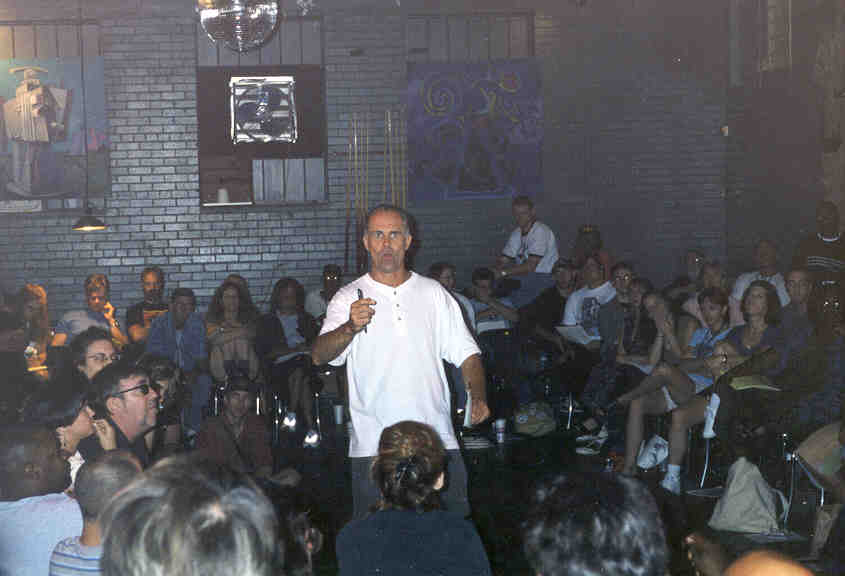
[Marc Smith, photo by Benjamin Ortiz]
Devlin's film vividly captures the glory of poetry elevated by spectator flash, as the documentary follows Team New York City on its trip to the 1996 nationals in Portland, Oregon. The film's title foregrounds the "sport" aspect of the slam, which makes sense since Devlin is an award-winning sports documentarian. But the film also does a good job of kicking different opinions around; some see the slam as a vehicle to advance literature, others see it as a poetry and performance hybrid art form unto itself, while others thrive on the slam as pure, no-holds-barred competition. Slam Nation also puts Marc Smith on camera, sagely suggesting that the slam works if it creates a community of poets.
But to get to the nationals, a year's worth of local competition is
required, with poets keeping stats on themselves and others like running
backs. Poets sometimes "riff" on each others' works, voicing criticism
often to the point of pissing each other off, and all the while provoking
each other to perform in top form like a race horse pushed to the limit,
requiring some element of strategy and even more stamina. Ultimately, the
slam is a community created by local and regional winners, who further put
the national gathering to the test of what community means and how it can
survive the contentious head butting that competition breeds.
Bob Holman, 1998 Team Manhattan slammaster (slamspeak for local
venue organizer), has been criticized and hated in some circles for
cheapening the slam and appealing to pure spectacle, as well as exploiting
gray areas (loopholes in rules). He helped found Mouth Almighty, the first
and only label devoted to spoken word artists, along with producing The
United States of Poetry for PBS and master-minding last year's Manhattan
slam team, named Team Mouth Almighty, who won the championship. His
promotion of poetry's commercial viability through corporate sponsorship
and merchandising has further been a source of controversy, with arguments
in his favor that this is merely an extension of the slam's mission: to
popularize poetry. Sometimes, his emphasis on glitz and celebrity runs up
against Marc Smith's blue collar character and emphasis on an honor system
in respecting rules.
But where does riffing cross the line between competitive edge, on
the one hand, and violation of a poet's integrity, on the other? Where does
community give way to competition, that which both brings people together
and potentially divides them? Are rules to be taken advantage of, or
respected as law? Should the slam have a singular vision of poetic
integrity, or revel in creative division? When does poetry lose its
literary value and become pure performance? And how much corporate
sponsorship is too much?
These are questions that stem from the slam and fuel its fire,
questions that will never be answered definitively. But each and every
individual's answers constitute a leap of faith in the slam that keeps them
coming back and contributing their diversity to the national community.
Community within community
Through light sprinkles of rain and ominous lightening, I travel
after the Ruta Maya bout with friends to Resistencia Bookstore, a haven of
progressive literary events proverbially situated "east of the freeway," as
in the poetry collection of the same name by raulrsalinas. At 64, Salinas
is one of few remaining elder statesmen of Chicano poetry who has traveled
extensively to create networks of solidarity between African-American,
pan-Latino, and Native-American activists.
Part of his unofficial training in political and literary struggles
comes from Puerto Rican independentistas he met while imprisoned in the
U.S. federal prison system. Given the early passing of such poets as Jose
Antonio Burciaga, Ricardo Sanchez, and San Antonio's own Jose Montalvo, the
reading for tonight will be an historic draw for Latinos from Austin and
SanAnto - Miguel Algarin, one of the founders of the Nuyorican Poets Cafe,
will headline a reading with the New York City slam team - all in "occupied
Mexico," as Algarin calls it.
Straight out of Manhattan's Lower East Side, the Nuyorican Poets
Cafe began in 1974 in Algarin's apartment, where poets of the Puerto Rican
diaspora gave voice to a new urban identity captured by the term
"Nuyorican" taken up by now-legendary poets Miguel Piñero and Lucky
Cienfuegos. The Cafe sat closed for most of the '80s but was jump-started
in 1989 after the death of Piñero, one of its co-founders. In partnership
with Algarin, Holman instituted the
cafe's weekly slam and brought new life to the venue. Ed Morales, a Village
Voice writer who has worked with Holman, charts how the cafe became popular
to the point of super trendiness under Holman's direction, and how it was
criticized for losing the Puerto Rican community base that was once the
founding principle of its existence.
"Algarin willingly allowed Holman to turn the cafe into a circus on
Friday nights when he ran the slam," says Morales. Algarin's taxing battle
with HIV and the demands of his professorship at Rutgers eventually took
his attention away from the cafe, where Holman was left to take credit for
its newfound notoriety. This was when relations between Holman and Algarin
became strained; Holman's style began to supplant recognition of Algarin,
which made for a contentious relationship. Finally, a mutual schism over
Holman's leave of absence to work on other projects got him booted in 1996
from the cafe's board of directors. Morales admits that Holman helped make
the cafe a success in the '90s, and that its original aesthetic has
subsequently evolved into the hip-hop ethos drawing the city's young black
poets.
But tonight, at Resistencia, Algarin seems charged by the energy he
shares with the next generation of Nuyorican poets on the 1998 team. With
his left arm in a cast - reportedly from a street scuffle where he
interceded on behalf of a woman being harassed - Algarin takes the stage
with a jazz combo of saxophone and coronet to interpret poems by Salinas.
"Street corner dude makes jaaazzzzz Latino sounds," Algarin intones with a
horn-trilled accent, as he simulates the cadence of congas, one-upping
Salinas's Beat-jazz sensibilities with Afro-Latino rhythms and sensual
playfulness.
"I dare Raul to come up and read these poems better," he says, in a
joking spirit of competition that forebodes the slam semi-finals coming up
tomorrow. Raul doesn't take up the challenge, but instead he shares a few
poems before urging people to buy Algarin's books and talk to him while
he's still around, before they "catch the bus" with poets who have retired
from the struggle.
An open-mic reading begins, led by New York City slammaster Keith
Roach, who introduces the Nuyorican team and a host of other slam poets who
share in the evening's festivity. A Nuyorican expatriate now on Team Los
Angeles, Gerrie B. Quickley arrives and hugs Keith Roach. Poets from
Montreal, Toronto, and Austin read until almost one in the morning despite
intermittent drizzle, sharing the calm of this community within the greater
slam community. It's the calm before the storm.
Cold comfort community
I start Friday with breakfast at El Sol y la Luna next to the
Austin Motel, where poets are dragging themselves out of bed for a feast of
events in addition to the semi-finals bouts. Team Boston's Gary Hicks, a
Christian Marxist who has a distinctive salt-and-pepper beard, joins in the
bouts today that will weed four finalists from the 18 teams who have made
the cut. "I'm in a state of existential shock," says Hicks between coffee
refills. Today's events include a head-to-head haiku slam, gay/lesbian
readings, and a "Chocolate City" showcase of African-American poets, among
many other open-mics and mini-slams. And then there's the yearly softball
game, where poets prove they're not true athletes.
But I head off to Book People bookstore to hear a reading with
Patricia Smith, emcee from the bout last night. I walk into Book People
just as the reading has started, and I notice that Smith is reciting her
"Note of Apology" that was printed in the Boston Globe following her
resignation as a metro columnist in June. Aside from being widely
recognized at the national slam as a pillar of this community and a slam
poet par excellence, she has also become known nationwide as the Pulitzer
Prize-finalist who admitted to fabricating characters and quotes in four
columns. In the note - her farewell column - the 43-year-old journalist
suggests that the ambition to achieve motivated her decision to "slam home
a salient point" from time to time with fabrication. "Finally, I'd like to
apologize to the memory of my father, Otis Douglas Smith," she reads,
continuing with slight defiance, "and that's his real name - you can check
it."
Enthusiastic cheers issue from the crowd in obvious compensation
for the sense of loss Smith expresses. She mentions the support she has
received from the poetry community: "in the end, that was really the only
community that mattered." Continuing to read poems laying bare what's been
on her mind in the wake of the Globe incident, she admits to thoughts and
fears of the worst in moments of heartbreaking vulnerability: "My penance
is that I will keep living to see myself keep dying. I can see the
headline: disgraced, ousted, sinful ex-columnist just doesn't get it. I
hide the gun on a bookshelf behind one painfully alphabetized row of poetry
volumes."
Smith takes some time to switch papers, shaken somewhat. "Perhaps
you don't understand. I am the face of American journalism slapping
journalism's American face ... I have been nationally declared a liar,
which means that this must be a lie and that me telling you that this must
be a lie must be a lie also." Light, sympathetic laughter urges Smith to
keep reading with strength, but tears form at the corners of her eyes, as
her pained voice reads on: "These are words that I can still use: fluent,
funky, anemone, android, penis, shogun, sonnet, chisel, shield .... These
are words that I can still use: petal, candle, murmur, apple, tongue,
refrain."
Now choking back tears, she forces the words to come out in a
litany, a catalogue of language she reclaims as her own: "scat, lullaby,
hands, adultery, vibrate, history." She struggles to keep the string of
words coming, and then in thick staccato: "Man did not give me this gift -
man cannot take it away," repeating this refrain to the point of
gut-wrenching emphasis, throwing her script to the ground, and finally
breaking out in tears that are met with open sobs from the audience. The
reading ends with a standing ovation and extended cheers.
Team Santa Cruz members Kelly McNally and Meliza Bañales openly
break down and cry with Smith. Afterwards, they say she's a scapegoat in a
profession where journalists misquote and make far worse mistakes all the
time. Says Bañales, "She admitted she was wrong, and it takes a very human
person to admit mistakes. It's also easy to demonize people for mistakes
because they're in a public position." From their reactions to her reading,
I wonder if they're personal friends, but McNally points out that they just
met her: "She's very open and giving, and she's given us a lot of
encouragement since we're only one of two all-female teams, and we're going
into the semis."
After the event, I head to Mojo's cafe for a caffeine refill and to
see what's happening next. I end up recounting Smith's reading to a few
poets and an east coast slammaster. The slammaster voices a different
opinion on Smith's appearance at this year's slam: "She's milking poets for
sympathy, because poets are dumb-asses. They don't read the newspapers. I
mean, what she did wasn't a mistake - it was blatant, calculated
fabrication." Pointing out that there's no need to fabricate material for a
metro column, he also clues me in to claims from the Boston Globe's editor
that 20 more columns by Smith appear to have been fabricated. What's clear
is that Smith's career turn has become something of a rallying point in the
slam community.
Jivin' with the pre-bout jitters
After the caffeine jolt, I wander over to Fringeware, a bookstore
next to Mojo's, and run into Bob Holman chewing the fat with an old friend
of mine, Reggie Gibson. The 1996 film Love Jones was based loosely on
Chicago's black poetry scene and featured poems by Gibson, whose
rhythmystical lyricism was a main source of inspiration for director
Theodore Witcher. Reggie has a bout this evening as part of Team Bellwood
(a Chicago satellite) and in the individual semi-finals, so we talk about
his strategy until a semi-finals update is posted in the windows of
Fringeware.
Very bad news: a computation error in scores has completely
rearranged the semi-finals bouts. Two teams, Santa Cruz and the Ozarks
(Arkansas), have been cut from the semis given the corrected scores, while
Manhattan and San Francisco's Mission District team have joined the semis
bouts - all only a matter of hours before the bouts begin. I notice Russell
Gonzaga looking at the update. "This is bad - this is so very bad," he
mutters exhaustedly. His San Francisco team will now go against Cleveland
and SF-Mission District, whose slammaster is one of his teammates.
Gonzaga mentions the possible conflict of interest his teammate,
Tarin Towers, has between her SF team and the Mission District slam, which
she organized to produce their team. He also claims that Team Mission
District formed when individuals didn't make the San Francisco team, and
suggests that their representation of the Mission District (a once
predominantly Latino neighborhood newly gentrified) has negative racial
overtones. Team Mission District member Daphne Gottlieb tells me later that
the team formed legally under slam law, which 1998 National Poetry Slam
co-director Phil West confirms. According to West, the local Mission slams
did happen after the San Francisco slams, but Towers had contacted West
prior to the San Francisco qualifiers and approved the formation of a
Mission Disrict Team.
"It was known that both teams would be appearing at the nationals
for at least a month," says Gottlieb, "[and] the Mission team thought that
any conflicts had been ironed out prior to departing for Texas." But
Gonzaga maintains: "There remains doubt as to the truth of their claims of
having an open slam. Some sources in SF have told me that there were no
qualifying open slams for these spots, and that they never intended for
there to be any ... I, and others, are convinced that there were no open,
advertised, public slams to qualify the three other spots on the team
[aside from the fourth spot slammed by Lauren Wheeler]. I voiced my dismay
with my team and the slam master [who] told us that the team was registered
and we could not protest the team unless we were directly affected by them,
in particular ... I was content with this, being fairly sure that we
wouldn't have to compete against them."
He moans, "I don't want to do this round," but his teammate Omolara
consoles him and says "we knew this bout could happen, and it's no big
deal." Gonzaga doesn't seem convinced.
Back at Mojo's, an impromptu reading has started as poets from the
Chocolate City showcase spill out of the cafe. Reggie Gibson, Cleveland's
Da Boogie Man (who is sitting out this year's competition), Kent Foreman
from Team Bellwood, and others are sharing a circle of poetry like family
reunited, and the call-and-response style of some poets creates an
evangelistic revival atmosphere. Which reminds me: poets just can't get
enough of poetry. This goes on for a few hours, through the mugginess and
threatening storm clouds, until Gibson announces, "Oh shit! It's time for
semis!"
Smash-mouth poetry comin' at ya!
The math error now pits Albuquerque against Manhattan against
Bellwood, a bout that should prove to make poetic sparks fly with the
talent lined up, and so I'm at Blondies, a skate store, where Albuquerque's
Kenn Rodriguez is flexing for the match. He doesn't seem visibly worried
about the re-match with Manhattan, who beat Albuquerque last year. "If you
want to win the national championships, you got to beat the nation," he
says matter-of-factly. He mentions the corporate taint to the Manhattan
team, since they were sponsored by Mouth Almighty Records while other teams
had to hold fundraisers to scrape up money for nationals. And then there's
the infamous incident last year when a Team Mouth Almighty member simulated
a penis by using a belt buckle suggestively, which tested the prop rules
but drew no penalty.
"We're a pretty poor team, so if anybody should hate them, it's
us," says Rodriguez, "because we're from one of the poorest states in the
nation. But you can't go at it that way. Last year, we were built up with
hate, because a lot of people wanted us to beat them, but it didn't help us
at all - in fact, it hurt us." He sums up by saying that Albuquerque will
feel good about the bout if they perform well with integrity.
Team Bellwood's Chuck Perkins, on the other hand, is in a state of
agitation. "I'm an ex-football player," he grumbles with playful, mock
menace, and he looks the part with his shaved head and Fridge-Man frame.
"There's terminology we use as ball players, like smash-mouth football. So
I'm out to let that transpire to poetry. I want, like, smash-mouth poetry -
I take no prisoners. I don't play, and that's why I dropped out of grammar
school: I didn't like recess." He busts up laughing and breaks from his
act, still talking about how a poet can step up to the mic with venom and
leave the stage sizzling. He's here for the pure sport of it - that, and
the wine, women, song, and such that the national slam entails.
But it's time for Perkins to show us the money. The teams draw for
order, and the emcee skips through the spiel repeated prior to every bout:
"A perfect score of 10 would be an earth-shattering text performed
perfectly, and a zero would be the worst poem you could possibly imagine
performed by someone who should not quit his or her day job."
Manhattan's Beau Sia takes the mic first and works himself into a
frenzy with a piece he read in 1996 finals: "When I get the money, I'm
gonna have iced monkey brain in Madagascar with Uma Thurman and Spock, and
me and Tarantino are gonna buy the bones of Bruce Lee and put them in a
movie called THE BONES OF BRUCE LEE ARE ALIVE ... and I'm gonna be the
Asian male hustler on the Real World [on] Mars, and I'm gonna do sold-out
haiku poetry jams in Vegas! ... when I get the money, I'm gonna own MTV,
and sure, money can't buy you love, but love can't buy you shit!" Manhattan
partisans whoop it up, urging him into more and more of a rabid recitation.
Different sides of the room ring with applause when the teams
rotate and poets step up, while coaches mark time with stop watches and
hold up color-coded cards to let the emcees know who's on next. Albuquerque
takes the stage with a group poem: "From where I'm sitting, I haven't seen
any poem that can make me feel safe at night ... I haven't seen any poem
that could feed, bathe, or clothe a homeless man." Syncopated voices switch
off between the four team members lined up: "I haven't seen any poem that
could stop police dogs from ripping chunks of flesh off a ten-year-old
boy." Neck veins and pressured eyes bulge, as they comment on their
situation as poets, with dangerously close judgment of their own craft:
"when are we going to stop talking assertively and start acting
assertively? ... when are we going to stop posturing behind staticky
microphones and finally start getting our pristine hands dirty? ... I've
never seen any poem that could stop oppression ... but I am ready and
waiting with an open heart and open mind."
Manhattan comes back with a team piece pairing Amanda Nazario and
Beau Sia. In the performance, Nazario tries to convince Sia that he's gay,
while Sia adamantly professes his heterosexual love for her - until she
asks, with the microphone demonstratively used for emphasis, "would you
love me if I had a dick? ... If I was a man, and I had a dick, you'd touch
my dick?" Sia follows through the logic and breaks down, with Amanda
congratulating him on his admission.
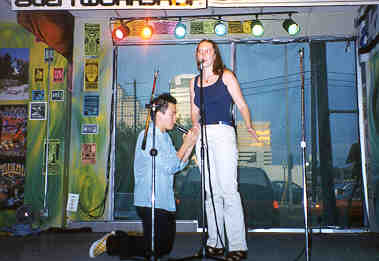
[Amanda Nazario and Beau Sia from Team Manhattan, in Austin 1998, photo by Benjamin Ortiz]
The round stops, as the emcee announces a protest lodged by someone
in the audience: possible violation of the prop rule. Someone from the
audience utters, "sometimes a microphone is just a microphone." The emcee
adds that Nazario's performance slot was mostly taken up by Sia, and that
the authorship of the poem is in question which makes for another protest
by Albuquerque; Manhattan might have violated the authorship rule.
While the protests are being discussed, Bellwood's Dan Ferri takes
the mic with a touching, meditative piece inspired by his work as a
sixth-grade teacher, speaking to the precariousness of young minds and
energy: "a room full of boys is a box full of mouse traps with a ping-pong
ball set on each spring aching for release ... girls circle, gathering,
dancing new molecules, negotiating solar systems - they are a tag team of
young Venuses, I am a weakening sun." After his reading, a friend of Team
Bellwood whispers to me that he should have read "The Bald Guy," a
crowd-pleasing take on Ferri's hairlessness. The judges score the piece,
which hovers around 8.7. Ferri walks out of Blondies with heavy emotion on
his face, recognizing that Bellwood won't come back from this blow.
The emcee gives a protest update, mentioning that Sia's
participation in the duet is legal if Nazario is the primary author of the
poem. On the prop protest, he reads from rulebook: "Generally, poets are
allowed to use their given environment and the accouterments it offers -
microphones, mic stands, the stage itself." Interestingly, he doesn't read
the part stating that the rule's "intent is to keep the focus on the words
rather than objects."
The bout continues with round four and another group poem from
Manhattan. "This is the great first line which sets the tone of the poem,
grabs your attention," they announce while tag-teaming on lines in
self-referential commentary, "And this next funny line doesn't let you down
- no, no, it's funnier than that first line! ... You see, the gist of the
poem is we're writing a generalized poem because, because who can be
specific about a topic like 'blah blah blah'?" They seem to respond to
Albuquerque's impassioned plea for politics: "when suddenly the poem got
political," they exclaim, while droning "POLITICS POLITICS POLITICS"
repeatedly, adding "Knock-knock, who's there? Emotional manipulation,
snappy one-liners ... leaving no button un-pushed - family: I hate my
father, I love my mother, I miss my sister!" With playful mocking of other
poems, they close: "This is the end line that makes you cream your pants
... throw your panties on stage, and: fuck me after the show!" Howls,
jeers, and semaphore of hand-gesturing incredulity burst from the crowd,
but the scores are in: Manhattan with 110.3, Albuquerque with 109.3, and
Bellwood with 106.8.
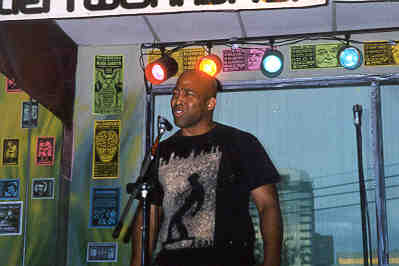
[Chuck Perkins from Team Bellwood, photo by Benjamin Ortiz]
An exodus of poets meets a crowd waiting for the next semis bout,
and as I make my way outside I notice Marc Smith surrounded by a gaggle of
poets evaluating the prior match. "It's not about the writing anymore,"
says Smith, "it's about how many different ways can you say 'suck my
dick.'" I walk away with Dan Ferri and Reggie Gibson, who console each
other. Ferri is visibly upset, but enthusiastic: "We did what we did with
integrity." Gibson answers, "I was so glad you dropped that piece! You
nailed that motherfucker!" Ferri agrees, "I wouldn't have been able to
forgive myself if I had read 'The Bald Guy.'" Ferri is talking about
nailing points versus staying true to the word. This is the double-edged
sword of combining poetry with performance, iambs with slams, writing with
shucking & jiving. A fan comes up and says, "your writing blew away
anything around you - you guys should have won," and the Bellwood boys seem
consoled.
It ain't over 'til it's over
I'm at the Electric Lounge, the home of Austin's local slam, for
the individual competition semi-finals. The place is packed, and few chairs
are available to the mostly standing audience. Organizers have brought up
an interlude of mariachis for "local flavor," and I have to excuse their
ignorance to the truly Tejano sounds of conjunto because the mariachis are
doing a cookin' version of "Jailhouse Rock." Chuck Perkins grabs my tape
recorder so he can mock-interview some ladies, and so I head out to the
parking lot where poets are mulling over the semi-finals wreckage.
I marvel at the variety of backgrounds, persuasions, identities,
political viewpoints, and professions from around these states represented,
as folks sit on concrete abutments and talk shop. Congratulating Keith
Roach on New York's triumph in their last bout, Albuquerque's Danny Solis
also seems to comment on Team Manhattan when he says, "I'm so tired of this
soulless pop culture bullshit Real World MTV crap." A few minutes later,
Bob Holman walks by Keith Roach, and they shake hands like old buddies. As
I walk back into the lounge, Tarin Towers rushes the door, citing a
"security problem."
I squeeze my way back just in time to see scorekeepers tabulating
maniacally as people from the crowd jump to correct math errors. Reggie
Gibson takes the stage next, as he dedicates the following poem to James
Marshal Hendrix: "Burn it down, burn it down, burn it all the way down,
Jimi, make us burn in the flame that became your sound, Jimi, grabbing ol'
Legba by his neck forcing him to show you respect, hoochie man coochie man,
strangle him coochie hoodoo man, wrangle him voodoo child ... and the
purple haaaaze ran through your brain and drained into the veins of
trippers, daytrippers turned acid angels by the gift of little wings from
you ... and the musing brews of your sadomasochistic blues would ooze
through pores and LSD doors ... one more time before it's your last time,
brother ... TO DIE YOUNG, TO DIE HIGH, TO DIE STONED, TO DIE FREEEEEEEE."
He repeats this last refrain and wails into an air-jammed guitar
simulation, as the crowd jumps from their seats to affirm Gibson's ultimate
number-one standing going into finals.
Back in the parking lot, poets sit in circles with backpacks like
cashed-out ravers, while New York and Albuquerque team members discuss the
protests against Manhattan. New York City's Stephen Colman mentions to
Danny Solis that he once saw Beau Sia perform the duet from the semis bout
as a solo piece, which would bolster Albuquerque's protest that Sia broke
the rules by being primary author of two poems performed. The discussion
gets heated when Colman says he doesn't want to get involved in the
protest. Solis yells "fuck you," as teammates restrain him and try to cool
down the argument. Kenn Rodriguez later tells me that "it's not about us
getting into the finals. I think the Albuquerque team would gladly sit it
out if that's what the slam community wants, because for us it's about the
integrity of the slam and its rules."
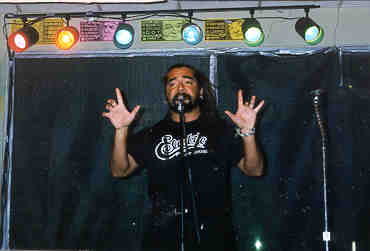
[Danny Solis from Team Albuquerque in Austin 1998, photo by Benjamin Ortiz]
On another front, Russell Gonzaga shows up with worry written all
over his face. It turns out that his match with the Mission District and
Cleveland turned into a score-settling blowout, after an attempt at a
formal protest against the Mission District failed. Deciding to read a poem
titled "Goodbye Kiss to the So-Called Western Civilization" especially for
that round, Gonzaga started off by saying "fuck the points - this is
personal: so-called 'Mission District team,' your deceit has broken my
heart," and ended the poem with "I will make you wish you were never born."
The poem went way over time, which destroyed San Francisco's chances to win
- though Gonzaga had learned that numerically the two teams had little
chance of making it into finals anyway - and some of his own teammates
cried as he read the poem, which was perceived by Mission District female
teammates as a real threat of rape and physical harm.
The Mission District's Eitan Kadosh argues that the poem itself was
a violation, commenting that "During the course of his meandering piece,
describing how much he 'hated the Mission Team,' he explained, in explicit
detail, how he would come into our homes and tie us to our beds, while
carrying out assorted acts of violence."
Others, including Kelly McNally of Santa Cruz, suggest that Gonzaga didn't
mean his poem as a real threat. "What I witnessed that night was not a
'threat to rape and cause physical harm,'" says McNally. "What I saw was
the performance of a horrifyingly well-written poem that was designed to
elicit a response of emotional pain, which it did entirely too well, using
graphic images of metaphoric violence."
Regardless, Gonzaga has gotten himself barred from walking into the
Electric Lounge tonight, and he says that Mission District teammates have
called the police. While we talk, Tarin Towers walks out, and Gonzaga tries
to call her over to explain himself, but she turns around and walks back
into the lounge with a hurried pace. Mission District teammates will later
stay up all night worried for their safety at the slightest sounds down the
hallway of their hotel.
Slammin' Super-8 style
I, on the other hand, will stay up all night in a search for even
more poetry. Chuck Perkins insists on checking out the Super-8 Motel, where
Team New York City is reportedly chilling poolside. We head out with Da
Boogie Man and Cleveland slammaster David Snodgrass, a 29-year-old
industrial machinery worker with stringy hair sprouting from underneath an
oily baseball cap. It's about 1:30 a.m., and Boogie repeatedly gets calls
and answers pages from Ohio on his cellular phone. "What's up?" he answers.
"I'm at the national poetry slam, dog, like I told you!"
When we arrive at the Super-8, some folks have already dipped into
the pool, but they gather to start a round-robin reading. Poets riff off of
each other reciting treatises from memory, and Team Montreal's Debbie Young
says, "Damn! We're some poetry fiends here!" Just when I'm about to nod off
in a parking lot oil puddle, another poem starts up. The reading goes on
until about 5:30 a.m. when Kenn Rodriguez arrives with Albuquerque
teammates. He's back from the protest meeting, where Manhattan was found
free from penalty. Kenn looks like death warmed over, and neither team has
made it into the finals.
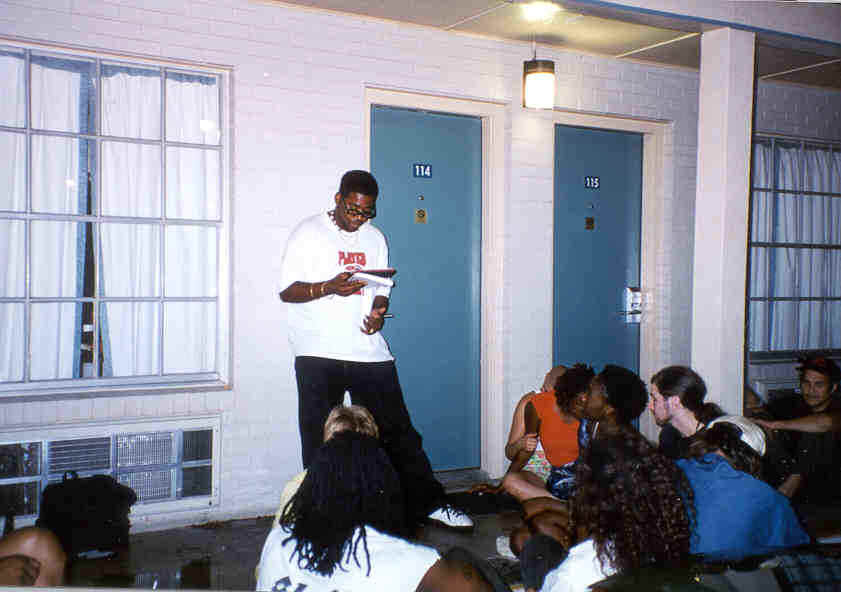
[Da Boogie Man from Cleveland, slammin' at the Super 8, photo by Benjamin Ortiz]
The republic rolls out of bed
Despite last night's revelries, everyone convenes at the Electric
Lounge at 10:30 a.m., dodging the light spritz that becomes a lawn watering
and later a downpour. Every participant is welcome to the slammasters
meeting, one of two yearly gatherings to decide rules and take care of
business. The other meeting happens in the spring in Chicago, where the
National Slam Executive Council presides. But this meeting is where
democracy in the fullest sense takes precedence, where every participant
can voice concerns and vote on immediate business. Less a formal convention
than a measuring of the communal vibe, this meeting is meant to take care
of the bad blood and conflicts that have come up before the slam heads into
finals tonight, where Los Angeles, New York City, Cleveland, and Dallas
will be competing for the championship.
Over bagels and coffee, participants take turns going around the
room to pose questions about what qualifies as an ongoing venue and what
qualifies as a team. Marc Smith, president-for-life of the national slam,
explains regulations in his down-to-earth nasally rusty Chicago accent. He
expresses discomfort with the idea of creating more rules on top of rules,
which is against the spirit of the slam.
Suggestions are made to hire independent auditors to eliminate math
errors. As comments go around the room, someone voices a hopeful "Peace for
all poets." Everyone responds enthusiastically, but reports follow of slam
poets serving as judges in some of the bouts, a possible violation of the
slam's honor system. More suggestions: David Snodgrass calls for opening
the national budget to scrutiny.
The issue of stripping during a performance is brought up, since
the option is not available equally to women as to men. That's when Team
Austin's Genevieve Van Cleve lodges a complaint against Clebo Rainey, a
Team Dallas member who ripped his shirt off during a semi-finals reading of
his poem "Rarefied in Arkansas." Taking her own shirt off and standing
topless, she reads from a statement in an emotionally charged voice: "in
all his rarefied glory, no one would accuse Clebo of using his breasts to
get a better score or a better job. I know, the slam is not responsible for
righting the inequities of our culture ... however ... we must assure that
our words are not enhanced or underscored by a nakedness not available to
the entire community ... I swear, if that shirt equaled two-tenths of a
point, if that shirt had stayed on my very very good friend's body, I might
be on the stage at the Paramount tonight performing poems ... The prop law
needs to be changed at slammaster's in the spring."
In her comments, she suggests that Team Dallas benefited unfairly
from Clebo's stripping, though Team Austin member Ernie Cline comments, "We
lost to Dallas fair and square. The opinions Genevieve expressed about the
competition being unfair are her own." Regardless, Van Cleve's statement
opens a floodgate of issues to debate, including the prop and costume rules
and whether a new rule needs to be made. Marc Smith breaks in: "This is a
scenario where part of our community has to be sensitive to other parts; we
have to listen to what the women are telling us." Attention then turns to
Rainey, a black-clad potbellied musician-turned-poet who drawls in
response: "last year at slammaster's meeting this came up, and I stood up
and said to everyone, 'Just tell me what the fucking rule is, and I'll do
it.'" He mentions also that he had the poem and his stripping approved by
slam officials before he performed it. But for tonight, since the issue has
forced his hand, he'll perform "Rarefied" without stripping, as a gesture
of concession to Van Cleve and Team Austin.
Cheers follow and die down when Russell Gonzaga raises his hand to
speak, apologizing to Team Mission District: "I'm so sorry for what I did
last night ... I turned it into one of the worst experiences that I ever
had with poetry." He apologizes to his own team as well, and admits that
his actions were inappropriate. Applause meets his apology, and afterward
people congratulate Gonzaga for his admission. One poet says that she had
been similarly insulted at a prior slam, but that no one had apologized to
her. Gonzaga accepts comments with a weary, defeated look.
Before the meeting moves on to deciding sites for subsequent
nationals, Danny Solis makes a statement: "This is a feast, and when you
have a feast, wolves will come. Some people want to make a living off being
in the gray area. So be it. But I think we need to ... eliminate those
areas as a family, so we won't be dishonored and exploited ... I invite
everybody to put everything aside - if you had bad experiences, enjoy
tonight."
Someone follows up with the comment, "watch what you say to the
press, because nothing is off the record." He cites past coverage that
painted the nationals as an orgy of sex and drugs. "Don't let them paint us
as degenerates!" From the back of the room, a chant goes up: "We are
degenerates!" As I walk out to catch some fresh air, I notice that Dan
Ferri has a T-shirt on that reads: "The points are not the point; THE POINT
IS POETRY." Plato wanted to cast all poets from his republic, but what
about a republic made entirely of poets? This republic has met its on-going
crisis of legitimation, and has survived. Just in time for the finals
Meeting the master
Amid waves of chaotic aural overload, a jelly-roll-shaped white guy
in tights and a lucha libre Mexican wrestling mask with thick-framed
glasses holds up an individual slam championship belt heavy with fake gold
plating as the Paramount crowd roars to see El Poeta (as this year's mascot
is known) get down and dirty with the rest of the poets. Skimming camp
humor from Mexicans rankles me a bit - especially since El Poeta's Boston
accent mangles the pronunciation of his Spanish name - so I head out to the
lobby, where rent-a-cops are watching the doors like attack dogs. I manage
to convince them to let a few recognizable poets in without hassle.
Outside, faces are pressed with distortion against the glass doors,
as rain falls over an impromptu poetry reading with poets holding up a
banner that reads: "YOU HAVE THE RIGHT TO BE LOUD." The banner mixes with
cardboard signs announcing the need for an extra ticket. And there's
scalpers - people scalping tickets to see poetry!
Back in the auditorium, a pre-competition poetry showcase includes
Amanda Nazario and Beau Sia doing the protest-drawing piece from
semi-finals. Before they can start, someone yells "NO PROPS!" This audience
hasn't necessarily been following the whole event, so this comment is lost
on most, though it doesn't pass without scattered snickering.
Phil West emcees the first few rounds of the team competition,
looking dead tired with the demands of keeping the slam running. After the
first round, New York City leads with 28.3, while Dallas follows (28.1),
with LA in third (27.9) and Cleveland trailing with 27.1. The second round
begins without missing a beat.
Dallas steps up with a group piece on phone sex, verbally and
physically simulating spankings and masturbation: "I'll jerk you off with
my words." In an interesting juxtaposition, New York's Lynne Procope
follows with commanding presence and gravity in her words: "We be
pretenders, pretenders to the position of prophet, we don the mask of poets
late at night, and between the smokes of the lyrical jokes we slam up on
this mike." Her serious tone plays off the hoots and hollers from the prior
piece: "we forget that this shit goes beyond Gil Scott, it goes beyond that
grand slam finals pot, this goes beyond all these half-ass rhymes you've
long forgot ... everything we say must be the truth, because the innocents
are listening, and it will all be held against us, which we do not hold for
ourselves ... do you know the definition of your revolution, or are you
just pretending when you step up to this mike? One-two, one-two: this thing
is on."
At the end of the second round, positions have shifted slightly:
New York at 57.3, LA with 56.8, Dallas with 56.6, and Cleveland still
trailing with 56. Tension is high, but an intermission follows with poets
pouring into the lobby for drinks or outside for smokes. Vancouver's swank
Ms. Spelt, a pale skinny boy, shows much love in the lobby with his taffeta
skirt, boa, and silky dinner gloves. Delirious embraces are exchanged, and
hallucinatory sleep deprivation makes for an edgy vibe when poets file back
in for the individual finals.
Marc Smith takes the stage to emcee, saying "My name is Marc
Smith," greeted by a resounding "SO WHAT!" Patricia Smith joins him to
handle the six indie finalists who will go two rounds each for the
championship. Derrick Brown, from Laguna Beach, goes into an abstract
absurdist piece that thrills the crowd with its suggestive rhythm: "I am
the punk in your trunk and the if in your riff and the or in your gasm ...
I am the tears extracted by Johnson & Johnson, I am the cuts on the fists
of Mr. Charlie Bronson ... I am the last thing JFK tasted." Brian Comiskey,
a roofer from Boston, reads a softly compelling poem on stealing car
stereos and how he became a poet - "the poet who once stole songs." Reggie
Gibson repeats his Hendrix poem to a standing ovation and shouts of "10!
10! 10! 10!!!"
In an under-rated performance, Vancouver's Cass King takes the
stage and endures catcalls at her appearance: "Nice dress baby!" She opens
with a rendition of "The Girl From Ipanema": "and when she passes, each one
she passes goes: 'HEY MOMMA, YO MOMMA, COME ON, WHAT'S UP BAAABEEEE!"
Strutting and dancing around, she explodes into a cabaret-style scat like
she was expecting to get heckled and had her words ready to counter, with
the crowd clapping along to her rhythm and rhyme.
In the second round, Roanoke's Patricia Johnson expresses the most
volatile engagement of racial issues yet, bringing up the incident in
Jasper, Texas, and her own cousin's violent death, challenging the audience
to right wrongs and be accountable. Her poem goes crushingly over time and
dooms her to last place, but Patricia Smith notes: "Sometimes you got poems
you just gotta do." She also mentions that journalists Molly Ivins and Dan
Rather are in the house. Cheers and cross-cheers fill the house, with the
audience taking sides on who should win, but the championship ultimately
goes to Reggie Gibson, with Derrick Brown in second, and Brian Comiskey in
third.
"This is sadistic," says Marc Smith, "we got these other teams
backstage waiting to come out!" They've been waiting for over an hour,
strategizing and deciding which pieces to throw at the crowd, anticipating
the other teams' moves. Guy LeCharles Gonzalez brings another engaged poem
from New York: "Mumia's plight is a hollow slogan to hook a poem on / as
the revolution is compromised by wannabe rap stars disguised as slam poets
/ pandering to the crowd / telling them what they want to hear / instead of
what they need to hear." It's an incredibly gutsy poem to read in a house
full of slam poets, especially with randomly picked judges, since Gonzalez
seems to take the whole slam to task for the art it produces: "You're not a
poet, you just slam a lot / cram a lot of senseless rhyming / soulless
pantomiming / saying shit like Tommy Kills-niggers / 'cause it's always
fashionable to lay blame elsewhere / especially if it'll get a laugh and a
couple of extra points." At the end of the third round, New York is still
on top with 86.5. Dallas follows with 85.7, then LA with 85.6, and
Cleveland with 85.3.
In the final round, Dallas comes back with a group poem: "Look, up
in the sky! It's a bird, it's a plane, it's a bad motherf - SHUSH yo mouth!
I'm just talking about my black superhero, baby!" As the piece progresses,
they go through archetypes for a black, redneck, and gay superhero, as with
the redneck: "I'll clothe myself in black, expose my butt crack, and walk
with the swagger of Johnny Cash!" Rising euphoria of the crowd makes the
house feel like everyone should jump on stage and join in the fun, and
rumbles of "10! 10! 10!!!" delay scoring. Team Dallas's GNO rushes across
backstage like he's flying during the cheering, which draws cries of "Team
Dallas is trying to influence the score!" No matter: Dallas scores a
perfect ten.
But it's not over yet: for New York City's final entry, Alix Olson
rushes the microphone, not letting the chaos die down from the Dallas
reading. Slightly hunched over and jabbing with her free hand, Olson
snatches the mic as if she wants to catapult her poem off the vibe from the
former piece, reading with furious energy: "it's a remote control America
that's on sale 'cause standing up for justice can't compare to 'I can't do
it from a lazy chair' ... we're closing out this country the way we began,
so step up for the hottest selling commodity - that's right, no waiting
lines for HIV - condoms and needle exchange, they're a hard-to-sell thing
for the right wing, so if you're a junkie or a fag, rent to own your own
body bag - now, while America's on sale ... with buy one shmuck get one
shmuck free in the capitalist party, and there's nothing left to get in the
way, of a full blue-light blowout of the U-S-of-A, there's a know-nothing
back guarantee, a zero-year warranty when you buy this land of the freetos,
ruffles, lays - this home of the braves, the chiefs, the reds, the slaves,
so call 1-800-IDON'TCAREABOUTSHIT or www.fuckallofit to receive your credit
for the fate of our nation ... where the almighty dollars sparkle and shine
in the Starbucks land, I'm proud to call it mine, but America's selling
fast, shoppers - buy it all while you can, 'cause America's been downsized,
citizens, and YOU'RE ALL FIRED."
The scores pile in, and poets mob the stage when New York takes
first place with 116.2, with Dallas in second (115.7), Los Angeles in third
(115.1), and Cleveland in fourth (114.9). Debates will continue to rage
through the coming year about rules and definitions of poetry, and the
conflicts will never entirely be resolved. But the question, as Cass King
put it, remains: "I know it's entertainment, but is it A-R-T - is it
AAAAAART?" That's the leap of faith. But in this auditorium, through the
agony of defeat and the grandeur of victory, all of that has been put to
the side. These slam poets - the new griots, storytellers, shit talkers,
neighborhood sages, and village idiots all - replay and relive the communal
underpinnings of the spoken word. On this stage, they meet their maker, and
this moment is pure.
September 1998, San Antonio Current, Word: The Monthly Guide to the Arts in Dallas, and LiP Magazine