Chicago Tribune Perspective on the White Sox
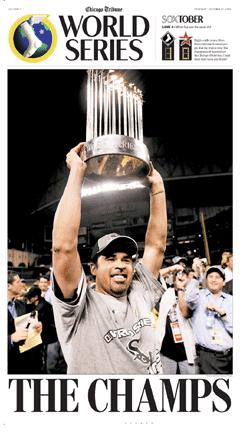
Download my first Tribune article (30 Oct. 2005) as a PDF file.
Raising Discourse From the Dead...
Raising Discourse From the Dead at an American City College
The Warsaw kid has just turned in a paper this morning comparing himself to George Orwell in 1930s Europe, making a leap from Down and Out in Paris and London to selling bootleg American DVDs for beer money in 21st century Poland. When I pass out today’s reading, I can’t wait to see what he thinks about the chat between guest writers Antara Dev Sen and Dinesh D’Souza, since he usually has the most sardonic comments during class discussion, deflating high American seriousness with Eastern European deadpan.
As an India-descent student finishes breathlessly berating United States foreign policy in her best South-Side white-ethnic accent (a sure mark of someone raised in Chicago), I see that our friend from Poland simply smiles a mischievous grin that only gets bigger when other native students join in a veritable Two-Minutes’ Hate session on the (re)election of George W. Bush. But the student who has periodically updated us on everything from Ukrainian elections to Euro-soccer riots sits back with a contented smirk that says it all. “I love listening to Americans talk about the world,” he says, “because it’s so touching when you remember the rest of us.”
Democracy’s Dead-Letter Office
In my office at Harry S Truman College – one of Chicago’s seven City Colleges – I collect student papers handed in but never reclaimed when the authors drop the class or otherwise disappear. As I survey this ever-growing stack, I cannot help but think of “the rest of us” that my students sometimes mention with bittersweet humor. To me, these papers represent so many hopes and not a few American dreams.
In my mind, they consist of letters to at least one American: “Teacher, please pass me so I can go on to become a nurse…” or “Teacher, I worked really hard on this paper, so please do not grade so hard so I can graduate…” or “Please teacher, English is not my language, and this is the third time I take this class, so…” These essays and their epistolary content signify hard work cast adrift. I collect them now and wonder when I’ll see these missing students again, if their hopes of self-advancement in American higher education are coming to fruition even without my critical marks.
Truman College challenges students to develop critical thinking, reading, and writing skills in English 102, much like any other such Composition II course offered around the country. But I didn’t expect that this basic college requirement would become my greatest challenge and reward while teaching at a two-year school. The issue, simply put, is that of engaging students at a school with the highest number of ethnic minorities and lowest income in City Colleges, further, students from more than 110 countries and 55 different language backgrounds – this, also, in Chicago’s Uptown neighborhood, whose 32% foreign-born population feeds the streets around campus with global flavor even in a starkly urban setting. A walk through the school’s bare yet bustling hallways fills my mind with fancies of William S. Burroughs’ “InterZone University”, as international students rub elbows with urban counterparts from Chicago’s public and alternative secondary schools.
In this setting, my challenge is to encourage education as a great American enterprise – one not necessarily synonymous with “free” enterprise – even while pushing students to develop critical ammunition against such grandiose-sounding commonplaces. The class often thus proceeds as America-on-trial with teacher-as-judge in a globalized Law and Order episode. My reward comes when class starts to run at its own rhythm of dialectical thinking, when I get to sit back and listen like a student myself.
But how to engage students with American aspirations, when their dreams lead from and to so many different destinations? How to pinpoint America’s great promises when such language smacks of empire? I’m reminded of a student from Lagos-by-way-of-London who responded to my synopsis of Samuel Huntington’s “Hispanic Challenge” in class: “What you’re saying sounds so racist that, if you were white, students would be protesting your class.” Where is the happy discursive medium, between apathy and protest, necessary for learning?
In the Land of Dirty Dreamer Discourse
With these concerns in mind, I came about using openDemocracy’s “Letters to Americans” series as a source of provocation. When forwarded a link for the exchange between Ramin Jahanbegloo and Richard Rorty, I was impressed by such great ideas about a great country espoused by great thinkers.
And I sincerely mean that.
You see, in my Chicago milieu, it’s common to hear pub conversation turn quickly to Bush bashing, and people in my neighborhood seem to have anticipated and dreaded the November 2004 election in language identical to that of the “Letters” writers. Among much of the local left, to speak of America in anything but shameful tones is to invite ridicule.
And so I was inspired to read Jahanbegloo and Rorty talk with such sophistication and ease about American ideals that have motivated me as both a U.S. native and product of its diasporas. With more than a bit of my own liberal guilt at work, I felt nothing less than vindicated in my nascent patriotism to see Iranian and American intellectuals agree on the greatness and global ownership of the American dream.
This is why I originally posted a link to that exchange on my blog, under the heading “Discourse & Debate,” because I believed, like Jahanbegloo, in “a dialogue which will establish a plural globalization as a paradigm for understanding and reshaping the world order.” In fact, this is exactly what I aim for in class. As I expected and hoped, a student posted an online reaction to the authors’ mutual suggestions. With a laundry list of recent U.S. incursions on civil liberties, this student ripped America’s rhetoric with youthful cynicism: “…we never had freedom of speech. America has our own style of freedom in which we like to force on other countries … ‘American dream’ isn’t for everyone…”
As I read more exchanges, I realized that the “Letters” series mirrored what was already happening in class. Moreover, the “Letters” allowed students to eavesdrop on a conversation touching on both America’s dirty pragmatism and dreamy idealism. Since the “Letters” authors repeat the exhortation for America to “join the rest of the world,” I was glad that the rest of the world seemed to have joined our English 102 discussions (meaning, of course, the rest of the world that isn’t already America).
Utopia = Good Place + No Place
I memorized this definition of “utopia” like an equation in high school when I studied public speaking and debate, two forms of nerdy gladiator sports that I’ve hoped to pass on to Truman students. Though I was sorely ignorant and naïve then, I found that interscholastic debate forced thoroughgoing consideration of opposing viewpoints and articulation of practical solutions. Now, in my 102 course, I urge students likewise to consider great questions of the day: Is there a just response to terrorism?...How do we safeguard national security and civil liberty at the same time?...etc. The “Letters” exchange helped fuel such in-class debates, also introducing students to the manners and mores of intellectual discourse. (Or as one student put it, “Dear Dinesh D’Souza: We have never met, but you sound like a jerk.”)
My only criticism of the series would be that, for all its talk about America, the country never seems to come across as a real place located in physical reality. As Huntington once said, the price of lofty principles in the ideal might well be double-standards in reality. So, too, the cost of talking about America in such broad idealistic strokes might well mean a diminished sense of America in real time, say, at a place like Truman College. In this respect, the series came off to this American reader more like “Letters to Santa Claus” than to Americans. But then again, we all have sometimes imagined America in much the same way a youngster idealizes the North Pole. (“Dear Santa: Please don’t blow up my country this year, and please let me pass English 102…”)
In my own place and time, at least, openDemocracy’s “Letters to the Editor” exchange helped bring America and its plenitude of dreams to life.
—by Benjamin Ortiz
An abridged version of this essay appears online at openDemocracy.com.
Mariachi + Rush = World Music
"Said one American: 'I can hear those goddamn radios blaring Mariachi music and Rush all day and night.'" -- The Onion, reporting on Mexico and Canada building a bridge over the U.S.
The only reason to write about race is to undo it. Completely. Forever. I take as my partner in this wrestling match Richard Rodriguez, whose new book, Brown: The Last Discovery Of America, describes the willful confusion of literature with sociology as "trading in skins." Remembering that my reading lists at Stanford instructed me to choose at least one woman and African American, I think about the balancing act I'll have to perform by fitting the world and its music into 800 words.
Rather than confuse music with sociology and trade skins labeled "Latin" or "indigenous" or "Afro-whatever," the only point to writing about music and its terms from the standpoint of a "world music" column is to undermine. Does it make any sense to say that "rock en español" can lay claim equally to African and gringo sources? Whatever happened to just plain ol' good music? Did it die on an airplane with Ritchie Valens?
Rodriguez reminds me that I didn't listen to music as a kid with sociolinguistic filters. Growing up with Tex-Mex accordions and heavy-metal riffs, I tried on punk rock for size and found it a good antidote to all things "shitkicker," though all of it taken together informs a latter-day appreciation of, for example, Alejandro Escovedo. Now is that Latin music? Texas music? Cowpunk? He told me once before a show that all the terms are bullshit; record labels and musical labels, they're all just trying to sell something.
In the recently released Living In Spanglish, Village Voice writer Ed Morales observes, "Until the end of the '60s, rock music was a multiracial enterprise, with crucial participation by musicians of color. The fact that three of Woodstock's most memorable performances that of Jimi Hendrix, Sly & The Family Stone, and Santana were carried out by Latinos and blacks is a little-developed notion . . . " Ironic, then, that we try now to separate terms and peoples, mainly because the notion of "rock" doesn't much allow for imagining faces like Escovedo's attached to its definition in a dictionary or encyclopedia entry. Think of "rock 'n' roll," and one does not imagine a mestizo with Indian features.
What, then, do we make of a rock singer-songwriter like Mexico City's Ely Guerra? Some critics have said that language is the only thing keeping Guerra from crossover popularity as if it's a hurdle easily transgressed, like a bridge from Mexico to Canada. How about a tidy Q101 intro that announces her first big U.S. single as Nuevo Mex-Brazilian Trip-Hop? Having absorbed her mother's samba and bossa nova records as a child, Guerra hears Milton Nascimiento and Astrud Gilberto in her head when composing tunes equally inspired by British techno-rock and U.S. folk music but with a taste of Afro-Brazilian percussion (the pandeiro and surdo) thrown into the mix, with guest musicians like guitar wizard Marc Ribot plus Steve Barber on farfisa/Wurlitzer keys, all on her 1999 release (available in the U.S. as of 2002), Lotofire (Higher Octave).
"I'm making my own style," Guerra explains, "sometimes I feel empathy with Radiohead, PJ Harvey . . . but not all the time . . . sometimes Portishead is telling me something." With a powerful gift for emotive vocalization that alternates from urgent to playful and back, Guerra also revels in the title of her release as a term that's simply true to the journey she undertakes. "It was kinda' funny for me," she says, "to choose a title in English." And a neologism, a novel compound-word, at that: lotus + fire = lotofire. "In Mexico, I go to the supermarket, and you find products there [advertised] in English and Spanish. As well, something is happening with the language, so that Mexicans speak more and more Spanglish. For me, it was the best name to explain where I was at the time."
Undoing the terms of discussion might be quixotic, especially since the marketplace would rather just have received terms, like "Latin" and "rock," mixed together like they were always meant to couple. But insofar as this column is about the world and its music, its subjects will confuse and confound (and then later, strangely, recognize) themselves, will termify and neologize so as to squeeze some sense of real life out of the terms and ultimately leave them behind, to stroll on a street like mine where French-Haitian dancehall music bleeds through my floor into the salsa blaring from the Puerto Ricans next door. To connect these sounds to the Mariachi music and Rush I heard as a teenager in Texas. Like Rodriguez says, literature takes as its only subject what it feels like to be alive.
Forget about the terms. What does it sound like to be alive?
July 2002, Illinois Entertainer