"Spirit Guide" (Chicago Reader)
"Spirit Guide:
Carlos Cumpian on Poetry, Chicano Culture, and the Emergency Taco"
By Benjamin Ortiz, for "Our Town" in the Chicago Reader
September 05, 1996
We're refugees, vato," Carlos Cumpian says in his trademark Spanglish. Editor of Chicago's MARCH/Abrazo Press and author of three books, the poet continues to wear his Tejano heritage on his sleeve despite having moved to Chicago in his teens. "We're economic refugees," he says, explaining his family history. "We left south Texas to follow the feria [money] waiting for us en el norte, like all our gente [people] who wind up here in Chicano, Illinois."
Cumpian's early life followed a picaresque trail from Texas, where speaking Spanish was punished in elementary school, to a south-side high school where an Anglo Spanish-language teacher once reprimanded him for not speaking good Castilian. Spanish-speaking immigrants in Chicago's barrios mocked his Chicano slang. On his visits to Mexico, locals called him a pocho, a Mexican-American who doesn't speak proper Spanish.
Cumpian was born in San Antonio, the cradle of Mexican south Texas culture, where he claims his roots reach back to 1790. With so much history tied up a thousand miles away, Cumpian's migration to Chicago is a puzzle. "We came up here for the climate," he jokes. In 1968 his father, who worked in retail, ventured to Chicago before the rest of the family and found a job at Goodwill. "A month later the job was no longer there because Martin Luther King Jr. had been assassinated, and the following night dad's place of employment was torched." The family eventually settled in the Roseland/Pullman area.
For Cumpian, Chicago offered a radically different pace. "It's clearly a town of immigrants." The dynamics of Anglo-Mexican conflict that Cumpian grew up with in Texas were mirrored in an African-American community pushing for equal opportunity. "It made me hunger to know more about my own culture as I discovered more and more about African-Americans. After high school I went back down to Texas, lived there along the frontera, and started learning about raza all the way back to the Azteca and Maya." In Texas, Cumpian now found a burgeoning home-grown civil rights movement charged by the energy of the United Farm Workers, with the Raza Unida party taking over the government of Crystal City (his dad's hometown) and running Ramsey Muniz, a Mexican-American candidate, for governor.
Cumpian came back to Chicago in the mid-70s and entered Truman College while continuing to search after his cultural heritage. "It really wasn't until I went into Truman and got a trip down to Mexico with a crew of students that I really saw with my own eyes the complexity of Mexican society, as opposed to seeing Mexico through a few border towns where Mexican culture merges with the U.S. southwest." In Chicago Cumpian recognized an embryonic Latino arts scene of writers and painters inspired by the Chicano movement. He began experimenting with watercolors and putting his thoughts down on paper, teaming up with other artists and writers such as muralist Jose G. Gonzalez and poet and printmaker Carlos Cortez. Their group gained force and numbers and established itself as the Movimiento Artistico Chicano, or MARCH. "We're barely coming into our own as a people now, but back then nobody knew about us--we were invisible in the arts scene," Cumpian remembers. "MARCH managed to get some art shows going and the press started writing about us, even if it was mainly negative or ignorant at first."
In 1975 the group gained notoriety when members organized Mexposicion, a major exhibit from Mexico City's Mexican Fine Arts Museum that included works by Siqueiros and Orozco. MARCH followed up with an exhibit at the University of Illinois at Chicago of Agustin V. Casasola's photographs chronicling the Mexican Revolution. "We made it possible for Latinos to talk openly about working with major and minor institutions and grassroots efforts to generate public art."
MARCH mural dedications and art exhibits followed, providing an opportunity and audience for poetry to be performed. "When movement poet Rodolfo Gonzales read his epic poem 'Yo Soy Joaquin / I Am Joaquin,' it inspired young Chicanos to take poems and perform them onstage in front of the community as a way to teach ourselves and those around us who wanted to hear about the culture, about our heroes and heroines." The journal Abrazo, founded in 1976 and edited by Jose Gonzalez, published the visual and literary works of MARCH members. Cumpian recalls that Gonzalez, a graphic designer, helped polish the "ruffian ghetto edge" of the Chicano aesthetic of rasquache. The oversaturated and cluttered mix of traditional and popular cultures that defines rasquache expresses itself through both political rhetoric and literary flourish on the pages of Abrazo, with Aztec icons and images of Mexican revolutionary Emiliano Zapata adorning poems, photos, and sketches. "None of us were professional journalists," Cumpian acknowledges. "We were all just community people doing our own writing, trying to say what we needed to say. We learned a lot in the process, finding out that people wanted to write poetry, share the poems, and there was an audience for that."
A chapbook series started up, and Cumpian organized citywide poetry readings at libraries. His MARCH/ Abrazo Press emerged from the literary excursions. "We figured if people have a couple of bucks for a chapbook, maybe they have a few more dollars for a solid work of poetry. We've done about 14 books now," Cumpian explains, mentioning local MARCH/Abrazo-published poets Frank Varela, Mark Turcotte, and Raul Nino. "You can't tell from going to bookstores that we're even here sometimes, but I figure that now we are on the charts. It takes the work of people who are very single-minded and dedicated, like Chicagoans Sandra Cisneros, Ana Castillo, and Achy Obejas, to establish the fact that we are here and we have a story to share." MARCH/Abrazo continues to publish midwestern poets, with a book by Milwaukee-based author Brenda Cardenas due out later this year.
While the political fervor of the 60s and 70s eventually gave way to a more subdued arts atmosphere, alternative spaces of artistic expression continued to open up from the galeria to the taqueria. "In 1981 folks started hanging out with Sandra and her brother Enrique 'Quique' Cisneros at his loft down on South Dearborn in the Printer's Row area, before it got gentrified. Once a month he opened his space as a do-it-yourself gallery called Galeria Quique, with professionally hung art pieces and spoken-word performance on opening nights. The advertising was just flyers, but after a while we got a lot of the Latino arts community into it. We'd charge one or two bucks admission and let the first 150 people in."
The opening program would usually include poetry, classical Spanish guitar, traditional Mexican music, and the folk strumming of Chicano bard Jesus "Chuy" Negrete. "But the real action started when we'd put some records on and get a dance party going until two or three in the morning. Then it was time for the emergency taco! Everybody--Sandra, Carlos Cortez, Raul Nino, my wife Cindy Gallaher--we'd pile into a car and quest for an all-night taqueria." There's an obvious parallel with the west coast's "taco shop poets," a Chicano-Mexican writing collective that regularly transforms taco stands into poetry slams. "At least a decade before those guys," Cumpian confirms, "we were stumbling into taquerias at all hours and declaring manifesto-style, 'You must prepare for a world where the taco becomes an emergency!'"
The party broke up in the mid-80s when Sandra moved to San Antonio and the rent got too high for Quique. But the works of seven taco-marauding poets were collected in 1989 as the chapbook Emergency Tacos. "We paid 75 bucks each to get that one printed, and you can't find it anywhere now 'cause it sold out in a year, but that was the testimony to all the work we did and fun we had back then."
Toward the end of the 80s, Cumpian's own work was slowly reaching critical mass. "It took me years to learn, really, how to work a poem, and it wasn't until I started getting published in little magazines here and there that I began to see myself as possibly becoming a published poet. It wouldn't be until 1990 that I would actually have my own book, Coyote Sun." Following his first book (published by MARCH/ Abrazo), Cumpian wrote Latino Rainbow (Children's Press, 1994), a book of art and poems for children that told the stories of such famous Latinos as Cesar Chavez, Joan Baez, and Tito Puente. Cumpian is currently celebrating the publication of his newest title, Armadillo Charm, by Luis Rodriguez's Tia Chucha Press.
Cumpian's influences range from the in-your-face rants of David Hernandez's "Chi-Town Brown" to the meditational working-class haikus of his main mentor Carlos Cortez. His poetry melds street smarts and native spirituality in a free-form, humorous, and densely metaphorical narrative style, and his new book gives that style its most powerful voice to date. Using recurrent images and issues, Cumpian taps into the mythos of spirit guides, part native and part syncretic symbols of the Americas. The armadillo calls up both Tejano culture and Mother earth, each in danger of being "knickknacked" to death (as it's put in the title poem).
"Some people hear the word 'armadillo' and say 'How disgusting!' or hear the word 'coyote' and say 'Not in my backyard.' Or maybe some people think 'It's just so damn cute I can't wait to stuff one and stick it on my front lawn.' My real feeling is that these are animals of the margin, they're animals of the borderlands--they're symbols of survival, of endurance, sometimes possessed of myth and magic, who have managed to survive all this time, no thanks to us."
The spirit guides also take the form of colorful characters. They range from the phantasmic Mexico City-based masked urban activist Superbarrio to the icons Che and Subcomandante Marcos to the working-class humorists Loco Chuy and Tony Atole. Through these personalities, Cumpian touches on issues of social justice, environment, anti-immigration hysteria, and the enduring spirit of Chicano culture, always with passion and urgency: "I dread tomorrow knowing / que mis hijos y otros inditos y chicanitos [that my children and other little young Indians and Chicanos] / will be robbed by a world that designs / its resorts and golf greens by gambling / with rare water under uranium friction" ("The Eighth Commandment & Uranium 235").
The passion of Cumpian's words comes forcefully alive in performance, which for Cumpian is an experience of religious significance that recalls the Aztec rites of xochitl y cuicatl (or flor y canto, or flower and song). "It's in our culture--you can just look at our ballads, our corridos." Cumpian refers to the 19th-century ballad form that developed along the Texas-Mexico border. The corrido brought together the then-rural Mexican community around a guitarist-balladeer who sang about important dates, personalities, and events of the day. "The corrido has served us well as a way of documenting our lives, like poetry did in the Chicano movement and still does."
Cumpian's cadenced delivery transforms words into weapons of satire when he talks about "Atrocity in the Assassin/nation" and how "We Don't Wanna Peso Much." Reciting a syncopated, alliterative catalog of the sacred and profane, Cumpian forges a world caught between native respect for the earth and self-annihilation; he snakes his way through laughter and lament as easily as he moves between Spanish and English. "We are very dependent on live performance to get people to see what we're doing and how we're doing it, to experience the dynamics of code-switching, brincando [jumping] between Ingles and Espanol. That's the way we grew up speaking, and oftentimes that's the way we end up performing our work." Cumpian looks forward to a series of readings at Chicago libraries and cultural centers in the coming months.
Aside from running a poetry workshop at Columbia College, Cumpian now teaches English at Farragut High School, where most of his students come from a Mexican background. "It's great--I get to teach all the Latino classics there, but when I show the students my own books they accuse me of making it up. 'If you have these books of poetry, why aren't you rich?' they ask. I tell them no one gets rich writing poetry, but you get the satisfaction of doing your own work and sharing it." He shows off his personal library of Chicano and Latino literature, a pantheon of both famous writers and writers unknown to the mainstream. "Look at how many of us are out there writing--I've got bookshelves of our stuff. And still we're barely recognized."
"Reading Out" (Chicago Reader)
"Reading Out:
D-Knowledge pushes poetry into the light"
By Benjamin Ortiz, for the Chicago Reader Calendar Section
January 29, 1998
For Derrick I.M. Gilbert, being a poet means walking a tightrope between the spoken and the written word. "The spoken word has played an important role in black letters," he says. "It's something we've always done. When we didn't have pens or didn't know how to write, we've had preachers sermonizing, people gossiping on the corner, spirituals, all that. On the flip side, nowadays some people get trapped in the spoken-word thing and don't advance as writers."
After great success as a spoken-word performer, Gilbert found himself falling into that trap. Within a year of his first open mike, the young poet had performed at the NAACP Image Awards, released a CD (All That and a Bag of Words), and read one of his poems in John Singleton's 1995 film Higher Learning. The next year he toured with Peter Gabriel and Earth, Wind and Fire as an opening act. But stardom almost ruined his art. "It's too easy to get caught up being a performer and forget about the careful discipline of writing," he explains. "People will see me on a music stage or at the Apollo or a comedy club where you see 'regular' entertainers, and then they'll come up to me and say, 'D, I liked your flow, and this is the first poetry book I ever bought.'"
The book in question is Catch the Fire!!! A Cross-Generational Anthology of Contemporary African-American Poetry. Gilbert collected the poems to demonstrate the depth of the written word that accompanies a performance, to show not only the commercial but also the literary dimensions of a poetic heritage that crisscrosses generation, medium, and venue. "Black folks can do haikus just like they can rap, and this book is part of that continuum of poetry. It shows that this is not a renaissance, that people have been writing for a long time, and here's a showcase of all that talent."
Gilbert's first experience of the oral black literary tradition came through the jazz musicians who cooled it with his father. "When I was a kid, people would look at me funny because I used the word cat, like jazz lingo," Gilbert laughs. "I got that from my father, who does straight-ahead jazz and runs a club in Japan now, but back then we were one of few black families in the area we lived in." Raised in Long Beach, California, Gilbert attended an integrated high school, where he played sports and eventually got into rap. "I thought rap was funny," he recalls, "but I didn't see the complexity of it as a literary and political force until I got to college and heard Boogie Down Productions and Public Enemy."
As an undergraduate at Berkeley, Gilbert became a serious student and an avid reader. "I was very straight-edge in college, very analytical," he says. "I debated and wrote theoretical essays, but never really put my words into poetic form." In 1993 a friend invited him to a reading in Los Angeles. Gilbert didn't know what to expect, but the word hooked him immediately. "I think what caught my attention was the music in poetry. I was getting frustrated with the lack of innovation in R & B and rap lyrics, but when I went to the reading, I saw poets doing things with words I had never seen before--but with musicality and rhythm." His friends had begun calling him "Knowledge" because of the effort he put into his studies, and an emcee at an early open mike introduced him as "D-Knowledge." The name stuck as his poetry handle and creative ego.
Even as his career was taking off, Gilbert began working on a PhD in sociology at UCLA, and a cross-generational study of poetry in the LA area reconnected him with both the written word and the African-American tradition of poetry. He assembled Catch the Fire!!! to solidify the connection. "Many of the poets in this book were introduced to poetry at readings, movies, where young people hang out," he says. "These are people who have had to refine their craft to get it published. But this book has poets both legendary and unknown, young and old, performers and academics, ranging all kinds of form, from haikus to sonnets to hip-hop flow. I wanted poets from everywhere, from as many different places as possible. Every now and then, someone will come up to me and ask, 'How come homegirl ain't in your book?' Like I said, this book is part of a literary continuum and cannot be comprehensive. But I hope readers will catch the fire of poetry like I did at my first reading."
Gilbert--appearing with local poets Rohan Preston, Angela Shannon, and M. Eliza Hamilton--will read from his work twice this week: Wednesday at 7 at 57th Street Books, 1301 W. 57th, 773-684-1300; and Thursday at 7:30 at Barbara's Bookstore, 1350 N. Wells, 773-642-5044.
Satchmo Meets Amadeus
"The classical music of globalization"

(StudienVerlag 2006)
Impressionistic musings on Satchmo Meets Amadeus
Sometime around Y2K, I found a tasty piece of vinyl at a San Antonio thrift-store for a quarter: The dissection and reconstruction of music from the past as performed by the inmates of Lalo Schifrin’s demented ensemble as a tribute to the memory of the Marquis de Sade (Verve 1966).
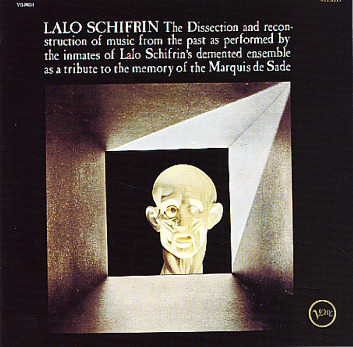
For short: Schifrin/Sade. I found it stuck under my rickety shopping-cart wheel, making the metal hinges swing the rolling basket in circles. This is sort of what the music did to my mind.
When I played this piece at parties, almost no one had a frame of reference for a rollicking mesh of blues, Bach, bebop, and “Bossa Antique” -- harpsichord scatting and chamber improv on cello and viola just didn’t seem to catch on.
But to me, it was perfect: An Argentine pianist/bandleader -- the guy who penned “Mission Impossible” and dozens more themes -- dredging classical baroque notions into a bluesy jazz idiom for a kind of soundtrack for my strolls, years later, into the hills of Salzburg.
Mozart would have sat in on that jam session.
You see, across nation and time and cultural context, jazz persists and continues to inform such experiences of world waltzing. As Salzburg historian Reinhold Wagnleitner puts it in his excellent collection Satchmo Meets Amadeus, jazz is “the classical music of globalization.”
I had the pleasure of meeting Reinhold at a recent Salzburg Global Seminar, and I wanted to share with him my stories of musical admixture, my own head medley produced by Bootsy and amplified by Wagner (maybe with a few beats by DJ Qbert).
The essence of his anthology, based in cross-disciplinary symposia from New Orleans to Salzburg: That Satchmo meets Amadeus every time we recognize the glorious, global connections between classical, pop, and our current mass culture. From the uneasy navigation of their hometown limitations, to the enshrining of each with an invisible TRADEMARK insignia, Pops and Moze created music that really moved, from Salzburg to Vienna, from New Orleans to Chicago to New York, and their tunes (properly received) turned the idea of classical versus pop, of high versus low culture, right on its powdered-wig head.
But more than that, Satchmo Meets Amadeus explodes the dichotomy between controlled, complex, classical execution versus naïve, “native” jazz genius. (In the shadows, observe the tired, hung-out-to-dry notion that jazz was purely African in provenance, later stolen by white people for someone else’s profit.)
Consider the Jews expelled from Europe, Austria included, who spread the tidings of classical music and helped build an industry of American production and distribution, recognizing genius where others saw only “race records.” Consider the Sicilians in New Orleans who taught voice, instrumentation, and arrangement to black people. Consider New Orleans as the biggest opera city in 19th century USA, mounting Mozart for Sidney Bechet, Buddy Bolden, and of course Satchel Mouth, among others.
Contrasting the catch-all put-down of “world music” as currently conceived, Satchmo Meets Amadeus gives true meaning to jazz as the first authentic world music, a sound forged in the uniquely spiced pot of New Orleans gumbo that included Creoles, Euros, Indios, and Africans of every diasporic shade and savor. From these origins, jazz went up the Mississippi to the Northern industrial corridor, on to New York, and out to the rest of the world, recognized finally and especially through the traumas of World War as the true sound of liberation.
The operative metaphor, here, is apt and American: The shot-gun wedding. Satchmo Meets Amadeus is a sort of nuptial presided over with a rifle. Like the deep Southern, Scots-Irish/Appalachian blood-feud brought to a boil by a bastard child and a marriage pressed at the end of a gun barrel, this book brings together global players divided only by historical amnesia but now thrown into conversation by the cataclysms of the 20th century, immanently unpacked in the idiom of globalization.
Highlights include Penny von Eschen’s re-hash of Satchmo Blows up the World (Harvard UP 2004), here sliced down to a meditation on “The Real Ambassadors” during the Cold War, touching on Louis Armstrong’s partly-Pepsi-sponsored tour of Africa in 1960-61, capturing the glaring contradiction of Jim Crow America touting black musicians to fight Cold War race perceptions. This piece carries over into essays about both Nazi contradictions with respect to jazz and the contradictory uses of Satchmo/Amadeus in pop/tourism.
Deeper still, historic pieces dig into the related histories of the Habsburg Monarchy, Salzburg, and New Orleans, within the context of colonial bartering and power-positioning. While recognizing the place of jazz as “the American high modernist contribution to world culture,” other pieces -- such as “New Orleans: An American Pompeii?,” by Lawrence N. Powell -- struggle to place Satchmo/Amadeus at the center of our current concepts of globalization. Given the rate of global change, will New Orleans merely be the first of various cities leveled and lost to climate shifts? And what will we have learned, really, from Satchmo/Amadeus, beyond tourism soundtracks, if their global import becomes sunken lost treasure?
In addition to the big questions, I take away from Satchmo Meets Amadeus a personal connection with Reinhold Wagnleitner at the Salzburg Global Seminar this July 2007. I enjoyed his personal narratives of trying to open up the Salzburg scene, to get past classical stagnation with the energy of jazz. His stories about musicians, tunes, and concerts remind me of my own love for such cities as San Antonio, for its unique contributions to American and global cultures.
(See, also, period pictures of Reinhold in his ’70s jazz/rock combo Pentameter, for which he played bass and injected new music into the Salzburg youth scene, documented in Satchmo....)
Behind today's trademarks and copyrights, you can still find the spark of musical revolution and a true global avant-garde, now on MP3 blogs and electronic platforms of digital convergence. What’s the next variation, Mozart? What’s the time signature and key, Satch?
Perhaps a sequel? A reprise, titled FLACO MEETS FALCO, A "Texe-Mexe" Odyssey featuring Mozart-as-Mestizo on the Frontiers of New Sanzburgtonio? Or Wolfie's Beautiful Big Enchilada, maybe Sir Douglas Sahm as Hill-Country Jedermann, or From Yodel to Grito: Alps Meet Hicks in the Trans-Atlantic Tradition of Country Yelping...etc., etc., etc., usw, &c.
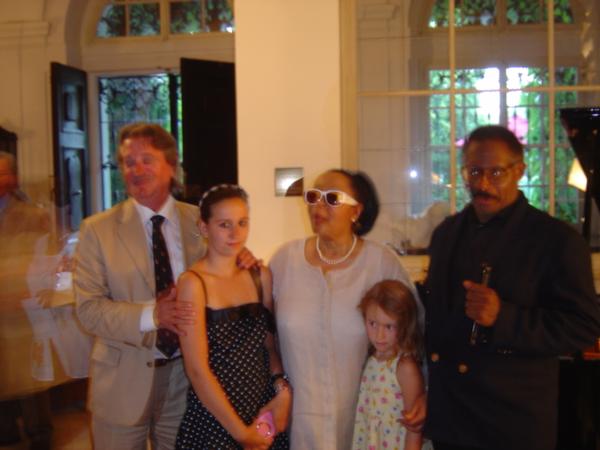
[Reinhold Wagnleitner, with musicians Valerie Capers and John Robinson, plus daughters Anna and Ella, after the Salzburg Seminar International Studies Program 20 Jazz Concert and Banquet...]
Checking Out
Review of Hotel America: Scenes in the Lobby of the Fin-de-Siecle, by Lewis Lapham (Verso, 1996)
The United States at the end of the century is like a top-flight hotel from the Gilded Age turned transient flop-house. The service is slipping, the management ignores the repair calls and the menial help doesn't even speak English. Enter the lobby, though, and a picture of embalmed opulence presents itself, as if to make up for all the problems with nice floral arrangements and classical Muzak.
In a recent interview, Harper's editor Lewis H. Lapham explained his vision of a country slouching toward the millennium: "Americans want to identify with somebody in the elevator of the Four Seasons, not people cleaning up garbage in the alley." According to Lapham's new collection of editorial "Notebooks," most Americans remain lost in the lobby despite dreams of elevation, wandering a post-Cold War terrain of confusion and diminished opportunity.
Lapham threads the theme of confusion through essays touching on issues and events from 1989 to the present, pinpointing how the promises of democracy run thin on the reality of oligarchy: "The United States by 1989 had so arranged its financial affairs that 10 percent of the population held at least 70 percent of the nation's wealth, and 5 percent...owned all the nations capital assets." Expanding on this fact, Lapham shreds conventional political wisdom with acerbic and incisively crafted prose, exploding the official fictions of foreign policy ("What Washington has always wanted in Panama is not a democratic government but a gamekeeper who could be trusted to manage the rabbits") and domestic intrigue ("What is wanted in Washington is the illusion of reform, not the thing itself").
But while Lapham succesfully picks apart the official story like a scab on the country's underbelly, he fails to deliver sustained proposals for reform. A recurring disclaimer: "I've never been very adept in the arts of practical advice."
—by Benjamin Ortiz
NewCity 25 January 1996
Low Riders on the Storm
Review of Roll Down Your Window: Stories From a Forgotten America, by Juan Gonzalez (Verso, 1996)
DESTINATION: "Forgotten America." The barrios, disempowerment zones, projects and factory floors where real people work, sweat and try to make better lives. Brought to you by free raid agreements, disinvestment and U.S. capital flight toward Latin American maquiladoras, where labor and environmental standards are weak and average pay is eighty-eight cents an hour.
LOCAL COLOR: The borderless lives of the impoverished, targeted by ruthless corporate mugging and then ignored by the business-as-usual pages of daily papers. "The real heroes of our time," not the welfare cheats and pathological felons reported at every turn.
YOUR GUIDE: Juan Gonzalez. Raised in El Barrio; educated with brick in hand in the riots and protests of the sixties and seventies; mobilized as a founding member of the Puerto Rican Young Lords Party; and led by the needs of the powerless. A unique voice in the New York Daily News -- Latino, pro-labor, bilingual and not affaid to break it down: "Government refuses basic maintenance precisely because the cities are now so black and brown that the wealthy downtown enclaves and well-to-do suburban areas simply will not allow it."
SIGHTS/SOUNDS: Muzak salsa flavors visions of rent strikes; union busting; multi-racial riots in L.A.; systematic racist police brutality; financial scams bred by a legal system biased against the poor; toxic working conditions created by executive greed and indifference; layoffs coupled with executive pay raises; anti-immigrant hysteria; dictator states funded with U.S. dollars; indigenous revolution in Chiapas; the anti-Castro embargo; crumbling urban infrastructure; and gated suburban communities.
CRUISE CONTROL: Drive past police checkpoints, mega-prisons under construction, high-tech surveilance facilities and cities on fire, roll up your window and turn on the-air conditioning. "Rage gathers in the shadows ... Quadruple the jail cells and you will not lock it up. Break all the unions and you will not chase it away."
—by Benjamin Ortiz
NewCity 15 February 1996
Americanizing in Tongues
“I think that Christ was a heavy radical.” As a statement of politicized spirituality by a religious Latino, this comment suggests progressive associations with Catholic liberation theology, especially for those familiar with ’80s Latin American solidarity movements.
But Arlene M. Sánchez Walsh—a DePaul University professor of religious studies—records these thoughts from John Luna, a 50-something Southern California Chicano and member of the Vineyard ministry, a post-denominational strand of evangelical Christianity labeled charismatic. Where Luna challenges his church to “walk a picket line or be willing to do a sit-down,” another Latino evangelical—Cruz “Sonny” Arguinzoni, a founder of Victory Outreach Pentecostal ministries—clarifies his political outlook for Sánchez Walsh: “The Kingdom of God is not a democracy.”
In these instances of fieldwork from Latino Pentecostal Identity: Evangelical Faith, Self, and Society, Sánchez Walsh captures a sense of diversity among Latinos and within burgeoning Pentecostal and charismatic ministries which claim 5 million of the 37 million U.S. Latinos.
Spanning more than a century, the history of Latino participation in American Pentecostalism runs from retrogressive to radical chic, as the Christian evangelical movement has come to recognize pop culture, consumer merchandising and immigrant ministry as growth areas to seize on a growing sense of disappointment with Catholicism and alienation from mainstream Protestantism.
With imminent changeover of the papacy, priestly scandals and crises in Catholic dogma, it is significant that in Latin America (home to almost a third of the world’s Catholics), a quarter of the population is now Protestant. And evangelical Christians are making the greatest inroads by seeking converts among marginal populations in such places as jails, halfway houses and migrant-worker fields and among gangs and drug addicts.
“The idea of a monolithic progressive Latino political consciousness, free of spiritual impulses, has never existed,” she writes. “Indeed, for nearly a century, classical Pentecostals (Assemblies of God), Pentecostal social missions (Victory Outreach), and, more recently, charismatics (the Vineyard) have served as alternative vehicles for spiritual attainment and social service.”
Sánchez Walsh constructs a trenchant history while maintaining rigorous analysis. Separating the rhetoric of easy accommodation from the history of Latino subordination and gender inequity within these churches, she challenges readers to understand Pentecostalism as one route to empowerment and social engagement that U.S. Latinos have made their own while preserving a sense of ethnic difference.
Yet the story of Pentecostal and Latino assimilation into evangelical Christianity is not one of a simple conversion narrative. Sánchez Walsh disputes media coverage, scholarship and conventional wisdom that Latinos share a Catholic ethos, especially given generations of Latinos who have been neither Catholic nor mainstream Protestant. At the same time, Sánchez Walsh points out, “Latino churches tend not to incorporate themselves into the larger political right culture of conservative evangelicals. Latino evangelicals tend to be much more mainstream and less conservative on social issues. For example, they would want public education, amnesty for immigrants, more resources for education in urban areas, gang prevention, a whole host of issues that keep them from the Christian right.”
Central to Latinos in Pentecostalism is the ideology of the Holy Spirit—with its subordination of racial and social differences to spiritual insight—and the transcendence of language barriers through speaking in tongues.
Moreover, Pentecostalism has provided opportunities for higher education through Bible colleges, leadership and employment, and a cultural bridge for immigrants, sometimes through cooptation of folk and pop culture into a Christian mold. Still, Sánchez Walsh criticizes the anti-intellectualism, legalism and insularity of Pentecostalism. And her work is meant to counter similar protective shields in academic, cultural and political contexts that dismiss religious ideology and the position of experience one might have from within a community of faith. “To view evangelicals as a monolith is wrong,” she says. “And it is another kind of orthodoxy to draw the line of authenticity at religion as somehow having a simple ulterior, right-wing motive.”
As published in In These Times as Americanizing in Tongues