On Global English and the American Language

This handout is a collection of quotes, notes, and observations relevant to our readings on language.
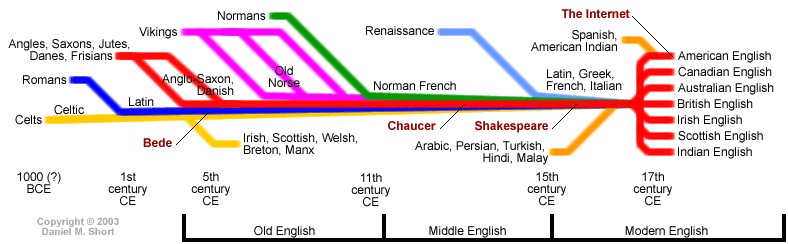
Encapsulated development of English (just the broad strokes):
Old English (Germanic) --> Latin incorp. from Roman missionaries --> Norman Invasion (1066)/English Frenchified --> Middle English (5 major dialects)/Chaucer --> Early Modern English (Shakespeare) --> Conquest of the New World, incorporation of indigenous languages and Spanish (e.g. vaquero becomes buckaroo, barbacoa becomes barbecue) --> Continuing immigration & diaspora make for MexiStani, Frángles, Blaxicans, Cubonics, the Blackcent, etc.
ANECDOTES: bulshitería (Guatemalan friends), fahita (Alma Pita restaurant), puro party (Texas)
“The first American colonists had perforce to invent Americanisms if only to describe the unfamiliar landscape and weather, flora and fauna confronting them. … But this occasional tolerance for things American was never extended to the American language. Most of the English books of travel mentioned Americanisms only to revile them … The climax came in 1863, when the Very Rev. Henry Alford, D.D. dean of Canterbury, printed his ‘Plea for the Queen’s English.’ He said: ‘Look at the process of deterioration which our Queen’s English has undergone at the hands of the Americans.’” (Mencken 3 and 27)
antibaby: “birth control pill” (Stavans 69)
bananaspli: “banana split” (Stavans 74)
cat: “Dude, hipster, a righteous groover” (Décharné 26)
el cheapo: “…cheap”
hip-hop: “…a subculture esp. of inner-city youths whose amusements include rap music, graffiti, and break dancing…”
hipiteca: “Aztec hippy” (Stavans 143)
loco: “mentally disordered: CRAZY, FRENZIED”
“On and on, Latinos’ marketing popularity is uncritically treated as a sign of their ‘coming of age’ in U.S. society or else, equally uncritically, condemned as a sign of their commodification; but seldom have studies looked at marketing as constitutive of U.S. Latinidad. … In these constructions the Spanish language is built as the paramount basis of U.S. Latinidad.” (Dávila 3-4)
“There is no Americano dream. There is only the American dream created by an Anglo-Protestant society. Mexican Americans will share in that dream and in that society if they dream in English.” (Huntington 45)
Works Cited
Dávila, Arlene. Latinos Inc.: The Marketing and Making of a People. Berkeley: UC Press, 2001.
Décharné, Max. Straight From the Fridge, Dad: A Dictionary of Hipster Slang. NY: Broadway Books, 2000.
“El cheapo.” Merriam-Webster’s Collegiate Dictionary. 10th ed. 1999.
“Hip-hop.” Merriam-Webster’s Collegiate Dictionary. 10th ed. 1999.
Huntington, Samuel. “The Hispanic Challenge.” Foreign Policy March/April 2004: 30-45.
“Loco.” Merriam-Webster’s Collegiate Dictionary. 10th ed. 1999.
Mencken, H.L. The American Language: An Inquiry Into the Development of English in the United States. 4th ed. NY: Alfred A. Knopf, 1938.
Stavans, Ilan. Spanglish: The Making of a New American Language. NY: HarperCollins, 2003.
Paper #3 Sample Works Cited Page
This sample Works Cited page for Paper #3 provides a good example of the kinds of sources and style of citation you'll need for this assignment.
Paper #3 Criteria
Grading Criteria
Each section below is worth two (2) points. Unacceptable work earns 0, and exceptional work earns 2. The assignment counts for a total of ten (10) points toward the final grade.
SOURCE USE
Does the writer correctly cite five appropriate sources in the essay and on the Works Cited page?
ESSAY STRUCTURE
Does the writer establish and effectively develop a thesis throughout the paper?
SENTENCE & PARAGRAPH STRUCTURE
Does the writer communicate ideas in well-structured sentences? … paragraphs?
GRAMMAR
Is the English correct?
OVERALL QUALITY OF ASSIGNMENT
Has the writer turned in a clean, solid essay with full and convincing development? Is the argument based in effective source use and strong critical thinking about those sources?
Paper #3 Instructions
For Paper #3, pick one of the textbook articles we’ve read thus far — review the “Course Calendar” on your syllabus (from pages 5 through 8, Weeks One through Seven) to see all of the textbook readings that have been assigned.
Pick one piece, and start researching in the Truman library databases to find relevant sources and ideas. Given our discussion of the reading in class, can you find articles that connect to the topic or topics covered in the textbook essay? Can you find sources that explain and expand upon the assigned reading?
Pursue research in the following areas, and make sure you look for sources from within the past ten years: 1. a database reference source (preferably the Encyclopedia Britannica), 2. a database journalism (news) article, 3. a database scholarly-journal article, and 4. any relevant web site outside of Truman’s databases (remember that the databases also provide outside web-site references for more info, for example Opposing Viewpoints).
Once you have completed your research, start drafting an argumentative research paper that responds to and expands on the textbook essay while developing your own argument.
DRAFT MAP
• INTRO: Start by identifying the textbook essay that prompted your research and that essay’s main argument or claim. Briefly discuss the topic or topics at the heart of the piece, and move toward your own thesis statement that clearly establishes your position. With respect to the textbook essay, you may agree or disagree with the author, agree with one aspect of the essay while disagreeing with another, or develop your own original position on one of the main ideas or topics discussed by the textbook author. This paper will prove your thesis through current database research. (For the intro, develop 1 to 2 paragraphs that lead toward a clearly established thesis.)
• BODY:
A. Reference Source – one to two paragraphs of sum and analysis, to establish some facts about the topic. Focus your analysis specifically on how the source contributes to or helps prove your thesis.
B. News Article – one paragraph of brief sum followed by one paragraph of analysis and interpretation focused on how the source helps prove your thesis
C. Journal Article – same as “B” above.
D. Web Site – same as “B” above.
E. Identify and respond to counter-arguments regarding your position —you may also refer to parts of your research that bring up counter-arguments or refutation of your ideas and parts of your research that help you respond to those counter-arguments. (2 to 3 ¶s)
• CONCLUSION: End with one to two paragraphs that conclude your case, and finalize the argument with a thesis re-statement.
COMP Paper #2 (Media Journal)
GRADING CRITERIA
Each section below is worth two (2) points — unacceptable work earns 0, and exceptional work earns 2. The assignment counts for ten (10) points of the final grade.
Source Use
Does the writer cite all source-references correctly in the essay and on a Works Cited page?
Summaries
Does the writer summarize effectively?
Responses
Does the writer critically analyze the media in effective responses?
Conclusion
Does the writer conclude with a few paragraphs of critical insight about the entire assignment?
Grammar
Is the English correct?
Citing Sources
PLAGIARISM & MLA FORMAT
Avoiding Plagiarism
In the Western tradition of scholarship, writers clearly acknowledge the use of sources as a way to bring integrity, authority, and proof to bear on academic work. As students and scholars, we consider intentional plagiarism to be outright theft, an act that destroys integrity and yields at least a failure for the course (if not expulsion from the learning community). Unintentional plagiarism – using someone else’s words/work without clear acknowledgment – consists essentially of uninformed, sloppy, and/or lazy scholarship. But careful use of sources can avoid plagiarism.
First, always take careful notes and keep complete details on any piece of research. Second, use word-for-word quotes sparingly, only when the wording is especially strong, memorable, or crucial to your argument. Paraphrase pieces from a source when the wording is not particularly strong but details are relevant. And summarize lengthy passages (or an entire work) to get at a main idea you’d like to include in your paper.
MLA In-Text Citation
Whether quoting, paraphrasing, or summarizing, you are using someone else’s work, and so it is always necessary to cite the source. Depending on what kind of source you have and what you’re doing with it, the key is to make the source clear to the reader, so that they will know you are referring to another’s work and so they can find it on your Works Cited Page.
When quoting an author, be sure to use punctuation marks. To direct the reader to the author, you can either name the author within your prose or put the name in a parenthetical cite. Either way, be sure to put the page number in parentheses, like this:
● George Orwell describes his neighborhood “to convey something of the spirit of the Rue du Coq d’Or” (5).
● Some critics have referred to terrorists as “super-empowered angry men” (Friedman 167).
Follow these same guidelines when you summarize, paraphrase, or even just refer to someone else’s ideas, words, research, work, etc. NOTE: If you quote a section that takes up longer than four lines of typewritten text, be sure to use a block quote, e.g.:
In Orwell’s universe, poverty seems to affect the poor in the same way that wealth affects the rich:
The Paris slums are a gathering-place for eccentric people – people who have fallen into solitary, half-mad grooves of life and given up trying to be normal or decent. Poverty frees them from ordinary standards of behavior, just as money frees people from work. (7)
See your textbooks for exceptions (author/page unknown, etc.).
The Works Cited Page
Since the Works Cited page is organized per alpha order, with the author’s last name first, you see how crucial it is to make clear in-text citations for your reader to find a source on the WC page.
To build a WC page, first consult an MLA guide to find out how to format any given piece of research. You can then put these cites in alpha-order per the first significant term of the cite – sometimes there will not be an author, and so the first term of a cite might not be a last name but a corporate author or even the title of the work. See the New World Reader for lists of citation formats.
On Wikipedia
Here are just a few more reasons to go beyond the popular reference site and instead do some Truman library database research...
...from beloved "fake" TV pundit Stephen Colbert and The Colbert Report via YouTube...
Media Concepts & Questions
Consider the following Media Concepts and Questions handout while reviewing the news for upcoming class discussions and writing.
The New Yorker on Illegal Immigration
Here's a link to The New Yorker magazine web site and an article arguing about "the real numbers on illegal immigration."
Tips for Final Drafting of Paper #1
Now that you have received feedback on your rough draft, consider these Tips for Final Drafting of Paper #1.
COMP Paper #1 – Criteria
GRADING CRITERIA
Each section below is worth two (2) points; unacceptable work earns 0, and exceptional work earns 2. The assignment counts for ten (10) points of the final grade.
Summary
Is it coherent and complete?
Essay Structure
Does the writer establish a thesis? Does the paper develop this thesis with clear organization?
Sentence & Paragraph Structure
Does the writer communicate ideas in well structured, strong sentences?...paragraphs?
Grammar
Is the English correct?
Overall Quality of Assignment
Has the writer turned in a good essay?
COMP: Thesis Statements
Constructing a Thesis Statement
For extra practice, review the following examples and formulas for constructing a sound thesis statement.
Lite/Simple:
The moral of George Orwell’s story is that even a slum can have valuable life lessons and experiences, just as I had when I first moved to this country and started working.
Though Orwell says his job was acceptable and his neighborhood colorful, I see only misery in his situation and personally will never live in a slum again.
The main idea in Down and Out is that poverty makes for unusual social situations, and I can agree given my own experience living in an SRO.
Heavy/Advanced:
Though globalization brings a better standard of living to developing countries, international organizations should monitor and foster fair working conditions so that sweatshops can be eliminated.
Hip-hop has spread around the world to become a global phenomenon, but fans should remember its roots as an American art-form that once advocated community instead of materialism.
Although Nike is environmentally sound and provides a useful product, it is not a socially responsible company because it treats workers unjustly.
Types of Assertion:
Opinion, Policy, Evaluation, Cause, Interpretation
Tests:
1. Is the statement too vague?
2. Is the statement too explicit (e.g. “In this research project, I plan to argue _________.”)
3. Is it too subjective?
4. Is it too objective?
5. Is the statement appropriate to the assignment?
Process:
1. Start with a working thesis: “I believe X because Y.”
2. Refine your thesis through research, reading, and note-taking.
3. Refine your thesis through drafting, and then revise it as you go along.
4. Use qualifying terms to focus, narrow, and strengthen your thesis.
A Few Sample Paragraphs
Note the three-sentence structure in the following paragraphs, demonstrating how a paragraph mirrors the structure of an essay: introduction, body, and conclusion. This basic structure is more important to conveying your ideas than any random formula for how many sentences you should have in a paragraph.
Smoking is for lowlifes, at least on film. A survey of 1990s blockbuster movies found that on-screen smokers tended to be poor and villainous. But while the habit may have lost its previous glamour, it retains a “cool” factor that is likely to seduce impressionable adolescents. (“Cigs” 15)
The trouble with human space flight is that perception is everything. Nations that undertake the challenge of sending their citizens into space are engaged in a calculated display of technical prowess. Taxpayers and politicians have been willing to go along with the attendant cost and risk to human life so long as the goal seems worthwhile. (“Editorial” 3)
As he has in the past, Mr. Calderón called on the United States Congress to pass changes to immigration law that would grant legal status to about 12 million Mexicans living and working illegally in the United States. He also reiterated his strong opposition to plans to build more fences and other barriers along much of the southern border. The assembled business executives and dignitaries gave him a standing ovation. (McKinley)
WORKS CITED
“Cigs for villains.” NewScientist 13 Aug. 2005: 15.
“Editorial: Keep on flying.” NewScientist 13 Aug. 2005: 3.
McKinley, Jr., James C. “Mexican President Assails U.S. Measures on Migrants.” The New York Times 3 Sept. 2007. 3 Sept. 2007 http://www.nytimes.com/2007/09/03/world/americas/03mexico.html.
International News Sites
Feel free to post your favorite links to international English-language news sites, in addition to those listed here.
Al-Ahram Weekly
Al-Jazeera
All Africa
Asia Times
The Associated Press
British Broadcasting Service
Canadian Broadcasting Corporation
China Daily
Gulf Daily News
Iran Focus News
The Jerusalem Post
The Jordan Times
Kyodo News Service, Japan
Nigerian News
Globalized Slums
Our first 102 reading assignment, Down and Out in Paris and London by George Orwell, dates back to 1933, but a Harper's article by Mike Davis connects the rise of mega-cities, slums, and global urban poverty directly to the current policies and forces of globalization.
Download the slums handout (Word doc) with brief quotes from this article. Also, you can read the entire text of Down and Out in Paris and London on-line.
Paper #1 Lab-Drafting Instructions
Paper #1 began with in-class rough-drafting during Week One, and here are the instructions for getting started on Paper #1. If you missed the drafting session, get in touch with Professor Ortiz to schedule a make-up session during office hours. If you completed the rough draft in class, then wait for comments on your draft, to be returned during class in Week Two.
What is plagiarism?
This brief article from The Chronicle of Higher Education reviews the basics of recognizing and avoiding plagiarism.
SYLLABUS: COMP 102-B
Welcome to English 102-B, FALL 2010!
REQUIRED TEXT:
Click on the picture above to see on-line purchasing options...
Download the syllabus for English 102 Section B in PDF format.